
Are your current door specifications actually hitting the 1.4 W/m²K thermal efficiency threshold required by Part L, or is a vague technical datasheet risking your site progress? With the UK construction industry expected to grow by 2.2% in 2026, the pressure to secure high-performance uPVC doors for trade Kent has never been higher. You’ve likely felt the frustration of supply chain delays stalling a residential project or inconsistent product quality forcing a second visit. It’s a common industry challenge that drains your margins and damages your professional reputation.
We understand that a reliable Kent-based trade partner is the foundation of a successful build. This technical case study shows you how to optimise project efficiency and compliance using trade-grade uPVC door systems. We’ll provide clear technical specs for energy and security, alongside strategies for securing faster lead times. You’ll gain a methodical overview of how modern glazing technology bridges the performance gap, ensuring every installation meets the latest FENSA and Part L standards with total precision.
Key Takeaways
- Learn how to navigate Part L Building Regulations by selecting uPVC systems that exceed thermal performance requirements for Kent residential projects.
- Discover how to source high-performance uPVC doors for trade Kent to achieve faster lead times and maintain consistent quality across multi-unit developments.
- Understand the critical role of wall thickness and internal reinforcement in differentiating trade-grade systems from standard retail alternatives.
- Master accurate surveying techniques and structural opening management to eliminate site delays and ensure a “measure twice, order once” workflow.
- Explore a real-world case study from Maidstone that demonstrates how to balance strict project budgets with high-end architectural aesthetics.
The Evolution of uPVC Doors for Trade in Kent Projects
Trade-grade uPVC has undergone a technical revolution. It’s no longer just the budget choice for Kent developments. Modern contractors now prioritise structural integrity and long-term performance over the cheapest possible frame. The material science behind Polyvinyl chloride (uPVC) properties provides the foundation for this shift. High-performance profiles feature increased wall thickness and internal galvanised steel reinforcement. These elements are vital for preventing frame deflection in high-traffic residential blocks. When you source uPVC doors for trade Kent, you aren’t just buying a frame; you’re investing in a system designed to withstand the coastal winds and temperature fluctuations of the Southeast.
Logistics play a critical role in project profitability. Sourcing locally reduces the risk of site breakage. Long-haul transport often leads to hairline cracks or damaged gaskets that aren’t visible until installation. A local Kent supply chain ensures that your uPVC doors arrive in peak condition. This proximity allows for rapid site turnaround, helping you hit tight completion deadlines without the stress of distant shipping delays. It keeps your site moving and your margins protected.
Trade Supply vs Retail Standards
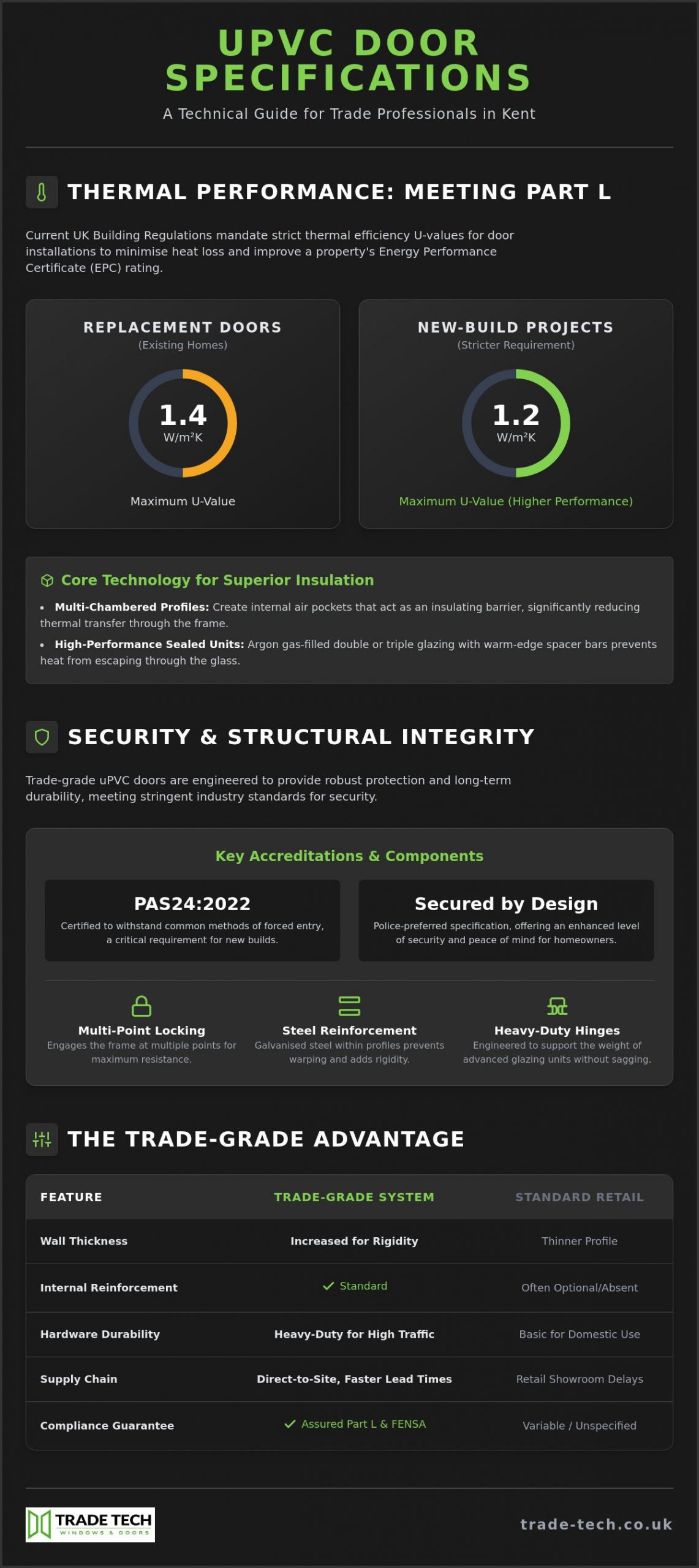
Hardware durability is the primary differentiator between trade and retail products. Trade-grade installations require heavy-duty hinges and multi-point locking systems that can handle thousands of cycles. We also focus on the integration of precision-engineered sealed units. These units are essential for meeting the 1.4 W/m²K U-value required by Part L regulations. Our direct-to-site delivery model is built for the trade. It bypasses the delays of retail showrooms, placing the product exactly where your fitters need it.
Meeting Local Architectural Demands
Kent’s architectural heritage requires a nuanced approach to glazing. You need to match traditional weatherboarding in rural villages while catering to modern urban developments. The shift from basic white frames to foiled finishes has been rapid. Anthracite Grey and black foils are now the dominant choice for modern renovations. For heritage conversions, customisation is essential. Whether your project requires high-performance uPVC or complementary composite doors and aluminium windows, the goal is a cohesive finish that satisfies both building regs and client expectations. Heritage projects with conservation requirements may also benefit from our guide to trade uPVC sliding sash windows, which covers how to achieve authentic timber-effect aesthetics whilst meeting the latest thermal and security standards.
Technical Specifications: Energy, Security, and Compliance
Compliance isn’t optional for your site progress. Current standards in Approved Document L dictate strict thermal limits. For existing homes, replacement units must hit 1.4 W/m²K. New-build projects require a tighter 1.2 W/m²K. Meeting these targets with uPVC doors for trade Kent ensures your project passes building control without delay. You should consult the official UK Building Regulations for doors and windows to confirm specific ventilation requirements under Part F. This often necessitates the inclusion of trickle vents to maintain air quality in increasingly airtight properties.
Reliability comes from hardware longevity. Don’t settle for standard retail hinges that sag under the weight of high-performance glazing. High-performance trade systems utilise multi-point locking mechanisms and reinforced galvanised steel within the profiles. These components are tested to PAS24:2022 standards. They provide the security and structural stability your clients demand. Specifying Secured by Design (SBD) accredited systems offers an additional layer of police-preferred security. It’s a significant selling point for residential developers looking to add value to their builds.
Thermal Efficiency and U-Values
Multi-chambered profiles are the core of modern thermal performance. They create stagnant air pockets that trap heat within the frame. This design directly reduces energy bills for the end-user whilst improving the property’s EPC rating. For projects in exposed coastal areas of Kent, triple glazing offers superior acoustic and thermal insulation compared to standard double units. Whilst the current requirement is 1.2 W/m²K for new builds, the industry is already preparing for the 2027 Future Homes Standard. This update will likely lower requirements further to 0.8 W/m²K. You can find more detail in our resource on Energy Efficiency in uPVC Window Frames. For contractors working on period properties where window specification is equally critical, our professional guide to trade uPVC sliding sash windows for 2026 compliance provides detailed U-value and PAS 24 guidance relevant to conservation-area developments.
Security and Weather Performance
Kent’s weather can be unpredictable. High-performance EPDM gaskets and weather-tight seals are non-negotiable for exposed East Sussex or Kentish coastal sites. PAS24:2022 certification is the mandatory benchmark for new-build residential entrance doors. It ensures the entire door set, including the frame and hardware, can resist professional forced entry attempts. If you’re working on high-traffic areas or commercial conversions, specify heavy-duty low-aluminium thresholds. These provide long-term durability and Part M compliance for easy access. Review our current trade pricing to see how these high-performance specifications align with your next project budget.
Case Study: Optimising a Kent Development with uPVC Systems
In a recent multi-unit development in Maidstone, a lead contractor faced the common industry dilemma of delivering high-end aesthetics on a mid-range budget. Sourcing uPVC doors for trade Kent became the pivotal decision for this 10-unit residential scheme. The developer needed to move away from standard white frames to something that felt premium yet remained cost-effective. By selecting foiled Anthracite Grey profiles, the project achieved a contemporary architectural look that mimicked more expensive materials while maintaining the thermal benefits of uPVC. This choice allowed the developer to reallocate funds to internal finishes without compromising the external kerb appeal. For a broader understanding of high-performance glazing specification in this area, our guide to double glazing Maidstone provides a comprehensive trade resource covering compliance and procurement strategies.
Ensuring every entrance met Approved Document Q security requirements was a non-negotiable part of the specification. Each unit required PAS24 certification to satisfy building control and provide peace of mind for future residents. By integrating high-security multi-point locks as standard, the contractor avoided the need for expensive third-party retrofitting. It’s this level of technical foresight that separates successful trade projects from those plagued by compliance failures and last-minute site adjustments.
Product Comparison: French vs Patio Doors
The Maidstone project utilised a mix of opening mechanisms to suit different floor plans. We analysed the site requirements and specified uPVC French doors for the ground-floor units with smaller garden apertures. These provided a classic aesthetic that appealed to traditional buyers. For the upper-floor balconies and larger living spaces, uPVC sliding patio doors were the superior choice. They maximise natural light and offer a space-saving solution where an outward-swinging door would be impractical. This strategic mix ensured the developer didn’t overspend on complex bi-folds while still delivering the “wow factor” through expansive glazing.
Logistical Success Factors
Success on a multi-unit site often hinges on the delivery programme. For this development, coordinated delivery schedules ensured that uPVC doors arrived exactly when the apertures were ready, preventing on-site storage damage. We supplied pre-glazed units, which significantly reduced the installation time per unit. This approach allowed the fitting teams to secure the building envelope faster, enabling internal trades to start their work ahead of schedule. Technical support during the early specification stage meant that structural openings were correctly sized from day one. Choosing a reliable partner for uPVC doors for trade Kent ultimately led to a seamless installation phase across all 10 units, proving that logistics are just as important as the product itself.
Best Practices for Trade uPVC Door Installations
Precision on site is the final hurdle in maintaining project profitability. When installing uPVC doors for trade Kent, your margin depends on a first-time fix. This process begins long before the delivery vehicle arrives. In Kent renovations, particularly with older Victorian or Edwardian brickwork, structural openings are rarely perfectly square. You must verify the lintel’s structural integrity and the aperture’s dimensions at multiple points. A 5mm discrepancy might seem minor during the survey, but it leads to significant frame distortion if the unit is forced into place. Measure twice. Order once. Install once.
Effective sealing is about more than just aesthetics. It’s about long-term weather-tightness in exposed locations. Use high-modulus acetoxy-free silicone to avoid discolouration on foiled frames. Ensure the perimeter seal is consistent and deep enough to handle thermal expansion. For high-performance uPVC doors for trade Kent, the final handover is your chance to demonstrate quality. Check the multi-point locking engagement and ensure the threshold is perfectly level. This ensures compliance with Part M for easy access and prevents future call-backs for alignment issues.
Pre-Installation Checklist
Don’t wait until the old door is out to check your new supply. Site progress stalls when a unit arrives with the wrong specification. Follow these steps before starting work:
- Verify aperture squareness and floor levels across the entire width.
- Confirm hardware and handle finishes match the project’s architectural specification.
- Inspect all sealed units for transport damage or scratches immediately upon delivery.
- Check that the frame colour and foil texture are consistent with the rest of the site’s glazing.
Common Pitfalls to Avoid
Avoid over-tightening frame fixings. This common mistake bows the jambs and prevents the locks from engaging smoothly. In patio systems, never block the drainage paths in the bottom track. If water can’t escape through the designated channels, it will eventually track back into the property. Finally, avoid cheap, acidic sealants. These react with the uPVC and cause permanent yellowing or peeling over time. Using the right materials ensures the installation looks as good in five years as it does on handover day. Secure your project’s success by reviewing our trade pricing and technical support options.
Why Trade Tech Windows & Doors is the Preferred Partner for Kent Trade Glazing
Your reputation as a contractor relies on the precision of your suppliers. Trade Tech Windows & Doors provides a dedicated partnership that extends beyond simple product delivery. We offer comprehensive technical support from the initial specification through to the final on-site handover. By choosing us for uPVC doors for trade Kent, you gain access to a local team that understands the specific challenges of the Southeast construction market. We focus on stability, speed, and technical excellence to ensure your projects remain profitable and compliant.
A fragmented supply chain is a risk to your margins. Trade Tech Windows & Doors acts as a single-source provider, offering an extensive range that includes high-performance composite doors and precision-engineered aluminium windows. This consolidated approach simplifies your site logistics and ensures a consistent aesthetic across all glazing elements. Our trade pricing is transparent and competitive, designed specifically to support the commercial goals of Kent-based developers and installers.
Streamlined Supply Chain Management
Site delays are costly. We’ve optimised our operations to reduce lead times for contractors across Kent and East Sussex. Whether you need standard frames or bespoke architectural solutions like roof lanterns, our logistics team ensures your order arrives in sequence with your build schedule. Trade Tech Windows & Doors has deep expertise in the specific requirements of new build contractors and developers, providing the technical data and compliance certification necessary for rapid building control sign-off.
Start Your Next Project with Trade Tech Windows & Doors
Reliability is the foundation of professional success. Don’t let inconsistent quality or vague technical data stall your next development. By partnering with Trade Tech Windows & Doors, you benefit from a streamlined procurement process and direct access to industry experts who speak your language. We invite you to request a trade quote for your next project and experience the difference of a dedicated trade partner. Visit our contact page today for technical enquiries or to discuss your specific uPVC doors for trade Kent requirements.
Secure Your Next Development with Technical Precision
Specifying glazing for modern residential projects requires more than just a budget-focused mindset. High-performance systems are now a regulatory necessity. Success relies on balancing high-end architectural aesthetics with the strict thermal and security benchmarks demanded by Part L and PAS24. By prioritising technical accuracy during the survey and installation phases, you protect your margins and ensure every project moves seamlessly toward building control sign-off.
TradeTech serves as a dedicated partner for contractors and developers across the Southeast. We are a specialist supplier for Kent and East Sussex, offering expert technical support to navigate complex compliance requirements. Our competitive trade pricing is designed to support your profitability whilst ensuring you receive the highest standard of uPVC doors for trade Kent. We provide the stability and speed you need to maintain momentum on site, regardless of the project’s scale.
Request a Trade Quote for Your Kent Project Today
We look forward to helping you deliver excellence on your next development with reliable, trade-grade glazing solutions.
Frequently Asked Questions
How long is the typical lead time for trade uPVC doors in Kent?
Lead times depend on the specific profile and finish chosen for your project. Standard white frames typically have a faster turnaround, whilst bespoke foiled options require additional time for precision manufacturing. We focus on providing realistic dates to help you manage site progress effectively and avoid costly delays.
Do your uPVC doors meet the latest Part L Building Regulations?
Our uPVC door systems are fully compliant with the 2023 amendments to Part L Building Regulations. We supply units that achieve U-values of 1.4 W/m²K for replacements and 1.2 W/m²K for new-build projects. This ensures your installation meets current energy efficiency standards without the risk of building control rejection.
Can I order bespoke uPVC door colours for a trade project?
You can specify a wide range of foiled finishes to meet specific architectural requirements. Whilst Anthracite Grey and Black are the most frequent choices for modern Kent developments, other woodgrain and flat colour foils are available. These finishes provide a durable, high-end look that mimics more expensive materials at a trade-friendly price point.
What security certifications do your trade uPVC doors carry?
Every trade unit we supply is tested to PAS24:2022 standards as a minimum requirement. We also offer Secured by Design (SBD) specifications for projects requiring police-preferred security levels. These certifications cover the entire door set, including the multi-point locking systems, security hinges, and reinforced frames.
Do you provide direct site delivery across East Sussex and Kent?
We provide direct-to-site delivery across all of Kent and East Sussex to support your project timelines. This service is designed to reduce the risk of transport damage and save your team valuable time on site. Our logistics team coordinates with your project manager to ensure the uPVC doors for trade Kent arrive exactly when needed.
Are your uPVC doors suitable for high-traffic commercial applications?
Trade-grade uPVC is suitable for many high-traffic environments when specified with the correct hardware. We recommend utilising heavy-duty hinges and low-aluminium thresholds to ensure long-term durability in commercial or communal residential areas. These components are designed to withstand frequent use whilst maintaining Part M compliance for easy access.
How do uPVC doors compare to aluminium for coastal Kent developments?
uPVC is an excellent choice for coastal developments because it is naturally resistant to salt-air corrosion. Aluminium offers slimmer sightlines but requires a specific marine-grade finish in these exposed environments to prevent pitting. Our uPVC doors for trade Kent provide a cost-effective, low-maintenance alternative that delivers exceptional thermal performance in harsh weather conditions.
What support do you offer for large-scale residential developments?
We provide dedicated technical support for large-scale residential developments from the initial tender stage. This includes assistance with technical specifications to ensure compliance with Approved Documents L, F, and Q. Our team also manages coordinated delivery schedules to keep multi-unit sites moving without the bottleneck of supply chain delays.