
Specifying uPVC for large-scale glazing might save on the initial invoice, but it often costs your reputation when the material fails to meet the structural demands of modern architecture. You know that site delays caused by erratic lead times are the fastest way to erode project margins and client trust. Finding a trade partner who delivers technically superior aluminium sliding doors kent professionals can rely on is critical for maintaining your construction schedule.
This guide provides the technical clarity you need to specify the ideal system for any South East development. You’ll discover how to balance aesthetics with the 1.4 W/m²K thermal targets required for 2026 extensions, ensuring every installation meets PAS 24:2022 security standards. We compare aluminium and uPVC on durability and lead times to help you secure a reliable supply chain that avoids common Part L compliance pitfalls and prepares your projects for the March 2027 Future Homes Standard.
Key Takeaways
- Understand the structural advantages that allow aluminium to support expansive glass walls with significantly slimmer sightlines than uPVC.
- Compare the long-term performance and colour-fastness of powder-coated aluminium against the budget-friendly benefits of uPVC foil finishes.
- Learn how to specify thermal breaks and glazing units that achieve U-values of 1.2 W/m²K to future-proof your projects against 2026 regulations.
- Discover how to source aluminium sliding doors kent developers trust to ensure fast turnarounds and avoid costly site delays.
- Identify the ideal hardware configurations for specific site conditions, from ultra-slim coastal profiles to heavy-duty rural lift-and-slide systems.
Why Aluminium Sliding Doors are the Standard for Kent Developments
Kent’s architectural landscape is undergoing a significant transformation. From high-end coastal developments in Thanet to sensitive Victorian renovations in Tunbridge Wells, the demand for expansive, high-performance glazing has never been higher. Developers are increasingly moving away from traditional materials. They need solutions that offer both structural integrity and aesthetic appeal. The local market now expects a level of finish that only precision-engineered systems can provide.
Aluminium has emerged as the industry standard for these projects. It provides the strength required for a large sliding glass door without the bulky profiles associated with uPVC. Specifying aluminium sliding doors kent wide allows you to create the seamless “inside-outside” transition that modern homeowners demand. It’s a choice that reflects a commitment to quality and architectural precision.
To better understand the precision required during the installation of these systems, watch this helpful video:
For developers, the choice of material directly impacts property value and buyer interest. Aluminium’s ability to support larger glass panes with fewer vertical mullions creates the unobstructed views that define premium real estate. This structural advantage is particularly relevant in Kent’s rural areas and coastal properties, where the surrounding landscape is the primary asset. By choosing high-quality patio sliders, you ensure the building envelope remains secure and weather-tight. This reliability is vital for maintaining margins and avoiding post-completion snagging issues.
The Shift Towards Slimline Architectural Glazing
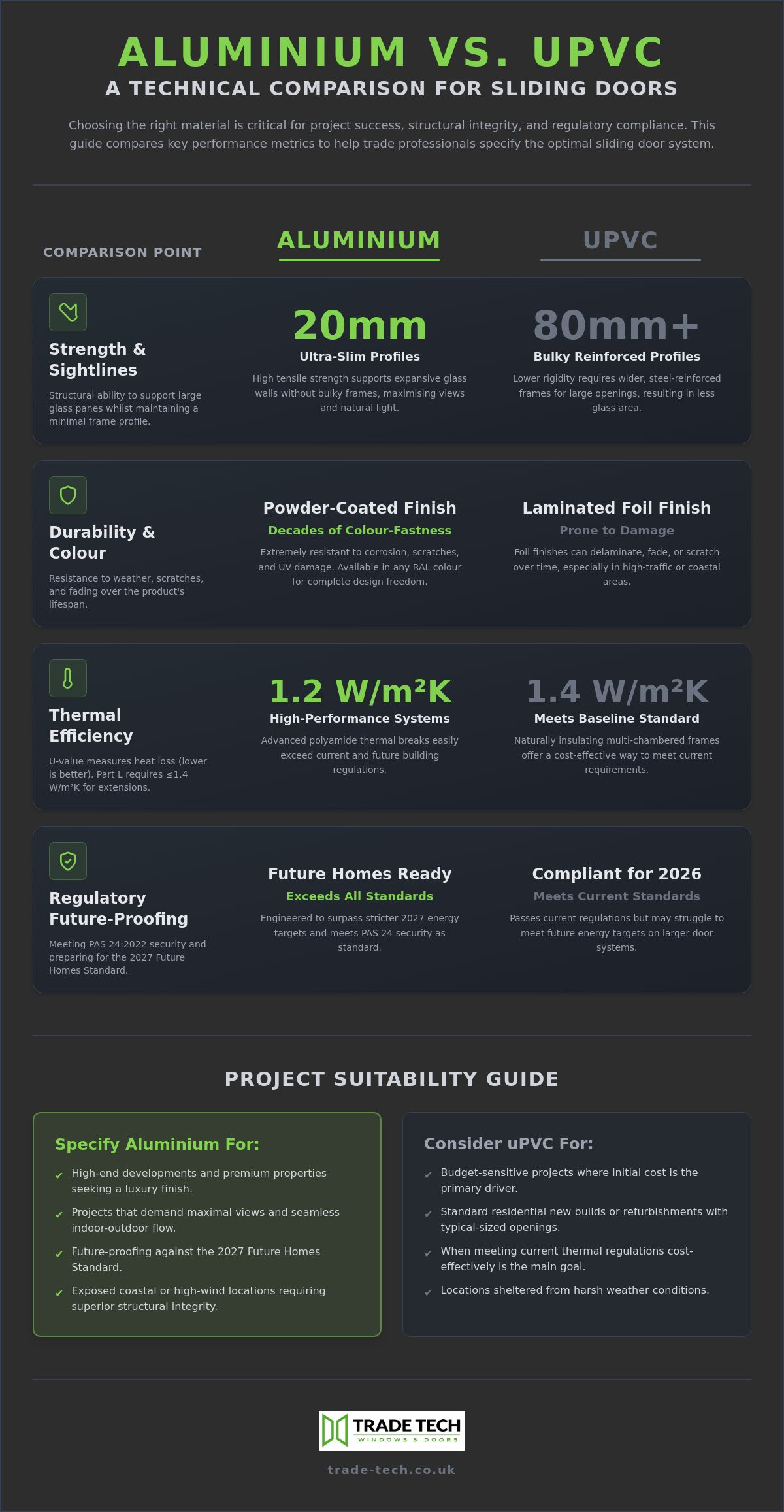
Ultra-slim sightlines, often as narrow as 20mm, have become the benchmark for luxury Kent projects. Achieving this minimalist look requires a material with high tensile strength. Aluminium handles the wind-load requirements of exposed coastal sites whilst maintaining its slim profile. It is the only viable option for creating expansive glass walls that don’t compromise on safety or performance. This balance of aesthetic minimalism and structural resilience is what sets aluminium apart in the current market.
Meeting 2026 Building Regulations in the South East
Regulatory compliance is a major pain point for South East contractors. Under current Part L regulations, replacement doors and extensions must achieve a maximum U-value of 1.4 W/m²K. Modern aluminium systems utilise advanced thermal breaks to meet these 2026 standards easily. With the Future Homes Standard arriving in March 2027, specifying high-performance aluminium now future-proofs your new build contractors and developers projects against even stricter energy requirements. Documented performance is now essential for a smooth building control sign-off.
Aluminium vs uPVC Sliding Doors: A Trade Comparison
Choosing between aluminium and uPVC is rarely a case of one being objectively better than the other. It’s about matching the material to the project’s specific constraints and the client’s expectations. For high-end aluminium sliding doors kent projects, the structural rigidity and longevity of metal are usually non-negotiable. Conversely, uPVC remains the workhorse of the residential sector, offering a cost-effective solution for developments where thermal performance must be balanced against a strict budget.
Aesthetic differences are immediately apparent on site. When installing aluminium sliding doors kent installers benefit from a product that doesn’t just look better, but handles the rigours of a busy site with greater resilience. Aluminium profiles are powder-coated, offering a durable finish in any RAL colour. This process ensures a consistent, high-quality appearance that lasts for decades. uPVC relies on foil finishes to achieve different colours. Whilst foils have improved significantly, they cannot replicate the crisp, slim sightlines that define a modern architectural aesthetic. In high-traffic areas or exposed coastal sites, the scratch-resistance of powder-coated aluminium offers a clear advantage over plastic alternatives.
Performance and Durability Comparison
Temperature fluctuations in the South East can be significant. Aluminium is a highly stable material that resists the expansion and contraction that often plagues uPVC frames. This stability prevents the doors from sticking or dropping, reducing the need for costly return visits to site. You can expect a service life of 45 years or more from a quality aluminium system. In contrast, uPVC typically has a lifespan of around 20 years before the hardware or the profile itself begins to degrade. Both materials must comply with Approved Document L, ensuring the building envelope meets modern energy standards.
When to Specify a uPVC Sliding Door
There are specific scenarios where a uPVC sliding patio door is the logical choice. For social housing contracts or budget-conscious home renovations, the lower initial cost is a major benefit. Modern uPVC is not the “cheap” option it once was. Multi-chambered profiles are excellent at trapping heat, often achieving superior thermal insulation without the need for the complex thermal breaks found in aluminium. They are a practical, low-maintenance choice for standard residential applications where the ultra-slim look of aluminium isn’t a priority. To see how these options fit your next project, you can view our trade pricing for a direct comparison.
Architectural Examples: Maximising Kent Views with Slim Sightlines
Kent’s diverse topography, from the exposed cliffs of Thanet to the sheltered valleys of the Weald, dictates specific glazing requirements for every project. When specifying aluminium sliding doors kent developments often require a balance between massive glass spans and structural resilience. Modern systems allow for panels that reach heights of three metres, providing the “glass wall” aesthetic that defines premium residential architecture. Your choice of configuration directly impacts how the end-user interacts with the space.
In coastal areas like Margate or Broadstairs, ultra-slim 20mm profiles are the primary choice for unobstructed sea views. These systems minimise visual interruptions whilst maintaining the strength needed to withstand high wind loads. For more exposed rural locations, heavy-duty lift-and-slide systems offer a more robust solution. These units utilise a mechanism that lifts the door onto rollers for effortless movement but drops it onto a compressed seal when closed. This creates an airtight barrier against driving rain and coastal gales.
Configuration also dictates floor space efficiency. A 3-track system allows three panels to stack behind each other, opening up two-thirds of the total aperture. This is often a superior choice for wide extensions compared to a 2-track system, which only allows for a 50% opening. For projects requiring massive spans, multi-panel configurations of up to six panels can create an expansive transition between the home and garden.
To achieve a truly seamless flow in these luxury developments, developers often coordinate with specialist contractors like Kroll Interiors to ensure the internal floor tiling perfectly aligns with the flush thresholds of the sliding systems.
Configuring Doors for Large Openings
Moving panels that weigh up to 400kg requires precision engineering. Inline sliders are suitable for standard sizes, but lift-and-slide mechanics are essential for oversized glass. These systems ensure the door remains easy to operate for the homeowner over its 45-year lifespan. It’s critical to ensure structural lintels are calculated to prevent deflection, as even a few millimetres of movement can affect the sliding mechanism. Whilst bi-folding-doors offer a full clear opening, sliding doors provide larger glass areas and superior thermal performance. If you are also specifying folding glazing systems for Kent developments, our professional trade guide on bi fold doors kent contractors rely on covers the full installation process and Part L compliance requirements. All specifications must adhere to the UK Building Regulations for thermal efficiency to ensure a smooth building control sign-off.
Colour and Finish Trends in Kent
Anthracite Grey (RAL 7016) continues to dominate the Kent market, providing a sharp, modern contrast to traditional red-brick properties. However, location-specific finishes are vital. Properties in Dover, Folkestone, or Whitstable require marine-grade powder coating. This specialised finish protects the aluminium from salt-spray corrosion, which can otherwise degrade standard coatings within years. Dual-colour options are increasingly popular, allowing developers to maintain a uniform external appearance whilst using white or lighter tones internally to match the interior design scheme; read more about bespoke interiors that complement these architectural choices.
Technical Performance: Thermal Efficiency and Weather Rating
Engineering high-performance aluminium sliding doors kent contractors can install with confidence requires a deep understanding of thermal dynamics. The core of any modern aluminium frame is the thermal break. This polyamide strip separates the internal and external profiles, effectively halting the transfer of heat across the metal. It’s the primary reason why aluminium now competes with, and often exceeds, the thermal efficiency of traditional uPVC systems.
Whilst current building regulations require a maximum U-value of 1.4 W/m²K for extensions, specifying systems that achieve 1.2 W/m²K ensures your projects remain compliant well into the future. This superior performance relies heavily on the quality of the sealed-units used within the frame. Beyond heat retention, weather tightness is verified through BS 6375-1 testing. This standard measures air permeability, water tightness, and wind resistance. For exposed Kent sites, these ratings are non-negotiable to prevent internal damp and draughts in high-wind conditions.
Glazing Options for Enhanced Comfort
Glazing isn’t a one-size-fits-all component. For south-facing Kent extensions, solar control glass is essential to prevent the “greenhouse effect” during summer months. Acoustic glazing is another frequent requirement for developments near the M20 or high-traffic rail corridors, significantly reducing decibel transfer for the homeowner. For a truly high-end finish, consider integral-blinds. These are housed between the glass panes, offering maintenance-free privacy that won’t interfere with the sliding mechanism or the slim architectural sightlines.
Security Standards for Trade Compliance
Security is a primary concern for homeowners and a legal requirement for developers. All systems must meet PAS 24:2022 standards to ensure resistance against forced entry. For new build residential projects, Document Q compliance is mandatory. This involves specifying toughened or laminated safety glass alongside multi-point locking systems that secure the door at several intervals along the track. These features provide the peace of mind your clients expect from a premium installation. Request a technical quote for your next project by talking to our trade specialists today.
Streamlining Your Supply: Why Kent Contractors Choose Trade Tech Windows & Doors
Site delays are the primary threat to project profitability. When you’re managing a complex development, you don’t have time to chase missing components or navigate vague delivery windows. Sourcing aluminium sliding doors kent installers can rely on requires a supplier that understands the pace of the South East construction industry. Trade Tech Windows & Doors has built an operation around the needs of the trade, prioritising logistical precision alongside product excellence. It’s about providing a stable foundation for your project’s success.
Our local presence in Kent allows us to offer a level of responsiveness that national suppliers simply can’t match. We provide direct trade pricing and transparent, detailed quotes that help you manage your project budgeting with total accuracy. There are no hidden costs or unexpected surcharges. You get technical support from the initial specification stage through to on-site installation advice. This proactive approach ensures that the systems you order are the systems that fit, first time, every time.
Reducing Lead Times for Aluminium Systems
Common industry delays often stem from fragmented supply chains. We manage our inventory and logistics to keep your site moving. By sourcing from a local Kent specialist, you bypass the transit risks associated with long-distance haulage. Our dedicated fleet provides reliable delivery across Kent and East Sussex, ensuring your aluminium sliding doors kent arrive in pristine condition and exactly when scheduled. For regular contractors looking to maintain a competitive edge, you can access our trade pricing to see how we help protect your margins. If you want to further optimise your glazing procurement strategy, our guide on direct trade windows sourcing for Kent and Sussex contractors provides a comprehensive logistical framework for managing lead times and Part L compliance.
Comprehensive Support for New Builds
Large-scale residential developments and bespoke architectural new builds require more than just a product drop. Trade Tech Windows & Doors offers dedicated account management for developers and architects, providing the technical documentation required for building control and Part L compliance. Whether you’re specifying high-performance aluminium windows or expansive sliding systems, our team ensures every unit meets the required thermal and security benchmarks. We act as a partner in your success, not just a line item in your procurement list.
Ready to secure a reliable supply chain for your next project? Contact Trade Tech Windows & Doors today for a competitive trade quote and experience a service designed specifically for the Kent construction trade.
Secure Your Next Specification with Precision-Engineered Glazing
Specifying the right system is about balancing architectural ambition with rigorous technical standards. You’ve seen how aluminium sliding doors kent developments require robust thermal breaks and PAS 24:2022 security certification to meet modern building control requirements. Choosing aluminium over uPVC ensures your projects benefit from 45-year lifespans and the slim 20mm sightlines that today’s market demands.
Success on site depends on more than just the product. It requires a specialist trade supplier for Kent and Sussex who understands the pressure of construction schedules. Trade Tech Windows & Doors provides fast turnarounds on all aluminium and uPVC quotes to keep your project moving without delay. Our team is ready to provide the technical data and logistical support necessary to future-proof your builds against the March 2027 standards.
Request a Trade Quote for Aluminium Sliding Doors from Trade Tech Windows & Doors
We look forward to supporting your next build with technically superior products and reliable local delivery across the South East.
Frequently Asked Questions
What is the maximum size for an aluminium sliding door panel?
Modern aluminium systems support individual panels up to 3 metres in height and 3 metres in width. These dimensions allow you to create expansive glass walls with minimal vertical interruptions. High-performance rollers are essential for these weights, ensuring the panels remain easy for the homeowner to operate over a 45-year lifespan.
How do aluminium sliding doors compare to bi-fold doors for Kent projects?
Sliding doors offer significantly larger glass areas and slimmer sightlines than bi-folds, making them the preferred choice for aluminium sliding doors kent developments focused on views. Whilst bi-folds provide a 100% clear opening, sliding systems provide a more consistent “glass wall” aesthetic. They also typically offer superior thermal performance due to fewer frame intersections. For a detailed technical breakdown of how to specify and install bi fold doors kent projects demand, our professional trade guide covers every stage from structural opening preparation to PAS 24:2022 security checks.
Are aluminium sliding doors thermally efficient enough for 2026 building regs?
Yes, our high-specification systems achieve U-values as low as 1.2 W/m²K, which comfortably exceeds the 1.4 W/m²K requirement for 2026 extensions. These ratings are achieved through advanced polyamide thermal breaks and high-performance sealed units. Specifying these systems now future-proofs your projects against the stricter March 2027 Future Homes Standard.
Can I get marine-grade finishes for aluminium doors near the Kent coast?
We provide marine-grade powder coating as a standard specification for any coastal development. This specialised finish is essential for properties in locations like Whitstable, Dover, or Folkestone. It protects the aluminium from the corrosive effects of salt spray, ensuring the finish remains pristine and doesn’t blister or peel over time.
What are the typical lead times for trade aluminium sliding doors in Kent?
Typical lead times for trade aluminium sliding doors kent range from three to six weeks depending on the specific colour and configuration. Sourcing from a local specialist helps you avoid the logistical delays associated with national distributors. We prioritise fast turnarounds on quotes and deliveries to help you keep your site moving and maintain your project margins.
Is a pvc sliding door more secure than an aluminium one?
Neither material is inherently more secure, as both must meet PAS 24:2022 standards for trade compliance. A pvc sliding door relies on internal steel reinforcements, whilst aluminium offers natural structural rigidity. Security is ultimately determined by the quality of the multi-point locking system and the inclusion of toughened or laminated safety glass.
What sightlines are available for slimline aluminium sliding doors?
Interlocking sightlines are available as narrow as 20mm for ultra-slim architectural systems. These minimalist profiles are ideal for luxury developments where unobstructed views are the primary requirement. For standard trade applications, sightlines typically range from 44mm to 77mm, providing a balance between aesthetic appeal and the structural strength required for high wind-load areas.
Do you provide technical drawings for architectural specification?
We provide comprehensive technical drawings and CAD files to assist with the specification process. These documents are vital for ensuring accurate structural calculations and lintel sizing, especially for oversized panels. Having access to documented performance data also ensures a smoother sign-off process with building control and helps you avoid common compliance pitfalls on site.