
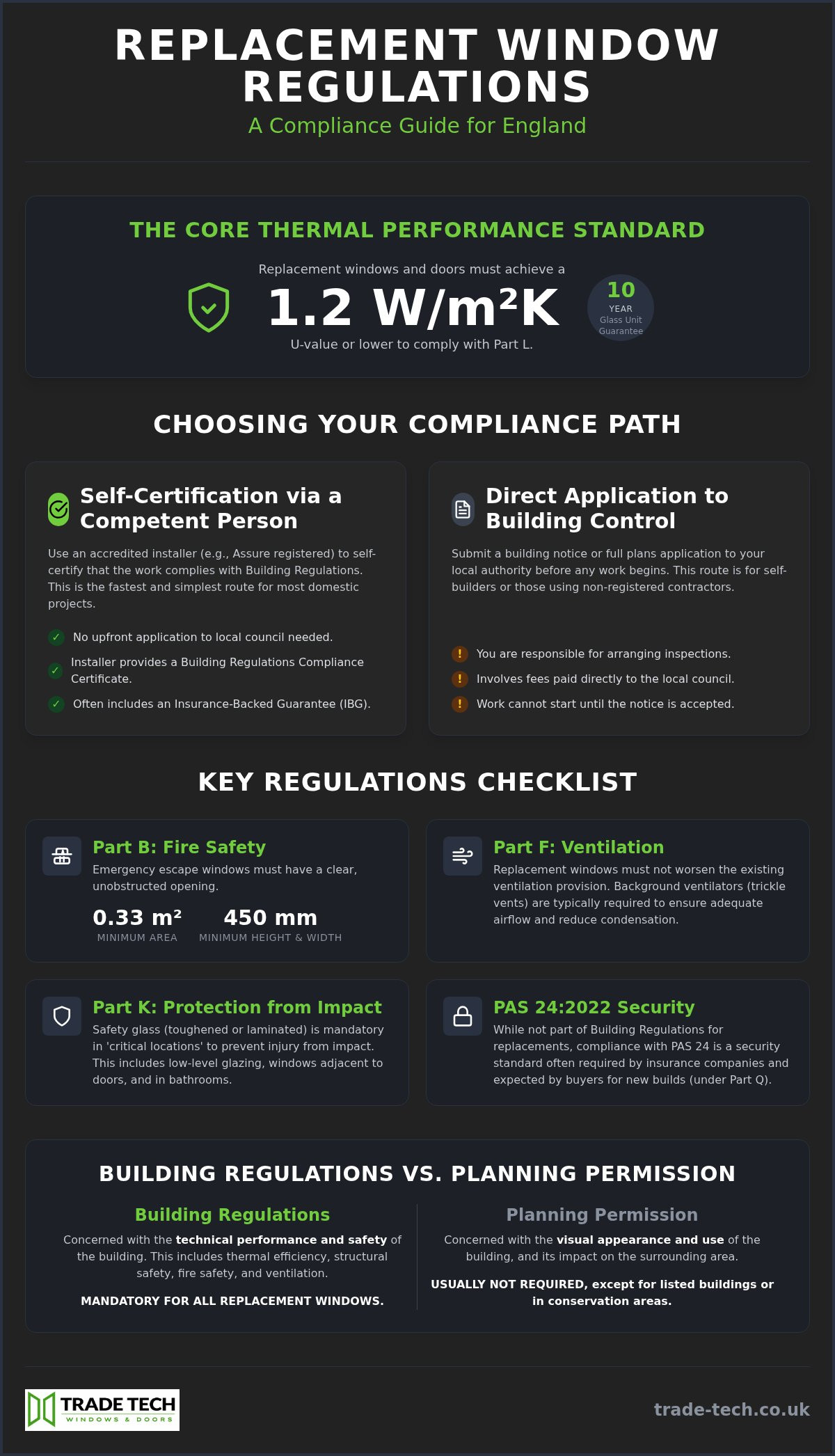
Replacing domestic windows in England requires proof of compliance with Building Control Requirements for Replacement Windows, specifically achieving a maximum target U-value of 1.2 W/m²K under Part You can satisfy these legal standards either by hiring a registered competent person installer or by submitting a building notice directly to local building control before work starts.
Key Takeaways: You must ensure replacement windows meet a 1.2 W/m²K U-value target and obtain certification via an Assure-registered installer or a local authority building notice.
- Replacement units must achieve a thermal insulation target of 1.2 W/m²K or lower.
- Except when living in listed buildings or conservation areas, planning permission is usually unnecessary.
- Hire an Assure-registered installer to self-certify work and avoid manual building control applications.
- Emergency escape windows require a clear opening of 0.33 square metres and 450mm dimensions.
In brief: You either use a competent-person installer who self-certifies, or you file a building notice yourself before work begins. Either route still has to hit the 1.2 W/m²K Part L target, Part K safety glass rules, Part F ventilation levels and Part B escape sizes.
Building Control Requirements for Replacement Windows: 3 Compliance Paths
You select your compliance route based on whether a certified fitter (competent installer) handles the installation or you submit plans directly. Three situations come up again and again on Kent and East Sussex jobs:
- You want speed on a like-for-like domestic swap: use an Assure-registered competent installer so the work is self-certified and you skip upfront council inspections.
- You are a self-builder or you are using a non-registered contractor: submit a building notice to local authority building control before work begins.
- You are altering structure or building a new extension: detailed plans must be approved before fabrication starts.
With clients we see that choosing self-certification saves time on site. Trade Tech Windows & Doors is an Assure Certified Installer, which simplifies local authority sign-offs. Where applicable and subject to the eligibility requirements, terms, conditions and exclusions of the relevant scheme, qualifying installations will also be provided with an Assure 6-Year Insurance-Backed Guarantee (IBG).
The first path relies on an accredited trade professional to self-certify the installation and avoids upfront council inspections entirely. The second path fits property owners managing their own projects. The third path covers major structural alterations. To verify specific site requirements, review our building control checklist for step-by-step regulatory guidance. Meeting energy saving rules (Part L) keeps your building sign-off on schedule.
Building Regulations vs Planning Permission: What You Decide First
Planning permission governs a building’s appearance, whereas energy saving rules mandate technical standards for structural safety and thermal efficiency.
Most domestic window replacements do not require formal planning permission unless you live in a listed property or designated conservation area. All new glazing must still satisfy legal building control requirements. You can self-certify compliance through an Assure certified installer or apply directly to your local council.
Overlooking structural openings or ventilation leads to costly compliance issues. Review common regulation failures so you can plan around them before fabrication.
Picture the rear elevation of a semi in Kent or East Sussex the week a buyer’s solicitor raises enquiries: the front looks fine, yet the uncertified rear frames stall the sale. Upgrading rear fenestration boosts energy efficiency while securing proper certification for a smooth house sale.
A commenter in the forums.moneysavingexpert.com thread "To replace windows or not, MoneySavingExpert Forum":
"Usually, you’d not make your money back on new windows but would make the property easier to sell." (source)
Property owners frequently prioritise front elevation aesthetics over rear window standards, but uncertified works can halt a sale during legal enquiries. Official building control sign-off reassures future buyers regardless of window placement.
Part L Performance: Hit the 1.2 U-Value Target
Replacement windows must achieve a U-value of 1.2 W/m²K or lower to comply with energy saving rules.
When older windows have dropped, developed gaps, and provide poor insulation, upgrading your glazing stops draughts and retains internal heat. Double-glazed units supplied by Trade Tech Windows & Doors are guaranteed for 10 years against premature seal failure. That cut in building heat loss shows up on both comfort and running costs.
Swapping compromised frames for properly rated profiles removes the structural cold spots that drive condensation. High-performance double glazing gives a clear efficiency boost over legacy installations.
| Window Feature | Standard Requirement |
|---|---|
| Thermal Insulation Target | 1.2 W/m²K U-Value or lower |
| Sealed Glass Guarantee | 10-year manufacturing warranty |
To keep safety alongside energy efficiency, read our guide to Part Q security rules for windows and doors. Certified profiles protect the thermal envelope you have just paid to improve.
Tip: Always request individual thermal calculations for your exact unit sizes to confirm they meet the standard 1.2 W/m²K limit required for replacement projects.
Part K Safety Glazing and Part F Ventilation: What Your Survey Checks
Your replacement windows must incorporate safety glass in critical locations and maintain adequate background ventilation.
During site surveys, installers check low-level glass areas to protect occupants from impact injuries. Glazing positioned within 800mm of the floor level requires toughened or laminated safety glass under Part K. Impact-resistant glass is also required for doors and neighbouring side panels within 300mm of the doorway edge up to a 1500mm height.
Ventilation needs equal attention during window upgrades. You must ensure replacement frames do not reduce existing air supply levels. Fitting trickle vents provides controlled, continuous background airflow to limit condensation inside modern, highly sealed homes. Learn more about Part F ventilation rules for modern properties. Trade Tech supplies compliant frame configurations across Kent and East Sussex. Fabricated PVC-U and aluminium window frames are guaranteed against manufacturing defects for 10 years. Correct ventilation protects indoor air quality while safety glass protects the people using the rooms.
Part B Fire Safety: Size Escape Openings Correctly
Clear opening calculations are required under Approved Document B fire safety regulations so residents can escape during emergencies.
Selecting French casements removes the flying mullion (meeting stile), providing an unobstructed clear opening that helps you meet emergency egress criteria. In a recent multi-unit development in Maidstone, a lead contractor faced the familiar dilemma of balancing high-end aesthetics with mid-range budgets. Sourcing uPVC doors for trade Kent resolved the issue: foiled Anthracite Grey uPVC profiles with multi-point locks met security and thermal standards while freeing funds for internal finishes. Profile choice protected the project margin without sacrificing compliance.
Measure brick to brick to confirm the structural aperture yields an openable area of at least 0.33 square metres. Width and height dimensions must also measure at least 450 mm each. Low-threshold profiles help maintain these clearances on tight outer frame dimensions.
Ensure all hinges allow the window to remain open without assistance during an emergency. Trade Tech Windows & Doors supplies compliant systems designed for rapid trade installation.
PAS 24:2022 Security Standards Buyers and Insurers Expect
Approved Document Q sets physical resistance standards for new dwellings; it does not legally apply to replacement windows in existing homes. Buyers, lenders and insurers still routinely ask for the same performance on replacement stock, so specifying to PAS 24:2022 keeps your paperwork clean at sale or remortgage.
High-security multi-point locking systems come as standard on Trade Tech trade units and are engineered to meet the PAS 24:2022 security benchmark. For added protection, hardware fitted to products supplied by Trade Tech is guaranteed against manufacturing or operational failure for 1 year.
Internal glazing beads secure the pane from inside the room, which makes exterior removal of the sealed unit harder on accessible elevations of your Kent or East Sussex home. Modern externally beaded systems can also be designed for security when the locking and fixing specification is correct, so judge the full hardware package rather than bead position alone. Factory-assembled sashes with PAS 24:2016 certification arrive ready for site compliance checks.
Self-Certification vs Direct Application: Which Route Fits Your Project
Hiring a certified fitter is the efficient choice when you are replacing windows solely to achieve a uniform appearance across your home. Managing building control applications yourself takes extra time and fees for functional units.
According to the GOV.UK Competent Person Schemes guidelines (2024), self-certification removes the need to submit a building notice directly to local authorities, so you avoid unnecessary paperwork.
Assure certification status keeps energy saving rules compliance documented while saving you administrative hassle. Direct applications suit self-builders; self-certification suits busy homeowners who want the certificate without chasing the council. Standard uPVC windows feature lead times of 4-6 weeks as of June 15, 2026. Professional installation keeps the compliance trail intact from survey to sign-off.
4 Steps to Direct Building Control Approval
Submit a building notice to your local council before starting replacement window installations. From site visits across Kent and East Sussex, proper oversight prevents costly tear-outs later. Independent applications incur administration fees and require scheduled site visits from local surveyors.
- Submit the notice: File your paperwork with the local authority at least two days before fitting starts.
- Order compliant units: Source frames that achieve energy saving rules standards with a U-value of 1.2 W/m²K or lower.
- Notify for inspection: Request a surveyor visit while the opening remains exposed to check structural support and insulation.
- Receive your certificate: Obtain final sign-off documentation once the inspector verifies full regulatory alignment.
Proper sealing stops perimeter draught leaks. Professional installers apply expanding foam continuously around every frame. Poorly fitted units leave irregular gaps and drive thermal losses at the wall junction.
A commenter in the replacement-windows.com thread "After Install Questions, Replacement Windows Discussion Board …":
"To fit the new windows with thicker vinyl frames, the installers cut the drywall casing and result was not always sharp, straight and clean ending up with some irregular 1/4-3/8in gaps." (source)
That outcome shows how sloppy installation techniques compromise the wall junction and why physical inspections matter for tight frame integration. If you are running the direct route, build inspection dates into the programme before the old frames come out.
When Unregistered Replacement Window Installs Fail at Sale
Skipping certified fitter registration creates expensive legal hurdles when you sell. Solicitations during conveyancing often demand an indemnity policy or retrofitted building control approval for uncertified glazing.
Local authority enforcement actions can force you to replace non-compliant units entirely. From installer field reports, buyers frequently demand price reductions when energy saving rules documentation is missing.
Situation: you reach exchange and the buyer’s solicitor flags missing Part L evidence on the rear frames. Solution path: either chase retrospective building control approval or buy an indemnity policy. Numeric reality: the indemnity covers legal fees but leaves the thermal inefficiencies untouched, so proper compliance at install remains the cheaper route over the life of the property.
If you already face this issue, secure retrospective approval before the next set of enquiries lands.
Frequently asked questions
Do you need permission?
You usually do not need planning permission for replacement windows unless your property is listed or located within a designated conservation area. Local council rules apply if you alter the overall size or appearance of the original openings. In standard homes, replacing existing frames is permitted development. You must still comply with relevant building control requirements for replacement windows.
What building regulations apply to replacement windows and doors?
Energy saving rules mandate that replacement units meet strict thermal standards, such as achieving a U-value of 1.2 W/m²K or lower. Fire safety rules (Approved Document B) dictate emergency exit dimensions, where French casements often help satisfy escape criteria. Specifying units to PAS 24:2022 gives you the security performance many buyers and insurers expect, even though Approved Document Q itself applies to new dwellings rather than replacements. Fabricated PVC-U and aluminium window and door products from Trade Tech carry a 10-year guarantee against manufacturing defects.
When is safety glazing required?
Safety glass is mandatory in critical location areas where accidental impact is likely. This includes any window glazing situated within 800mm of the finished floor level. Doors and adjacent side panels up to 300mm from the door edge require toughened glass up to 1500mm from floor height. Compliance reduces injury risk and satisfies national structural safety standards.
What ventilation rules apply to different rooms?
Replacement windows must provide background ventilation that meets or exceeds the capacity of the original frames. You must retain trickle ventilators or add equivalent acoustic insulation and background air vents to maintain indoor air quality. Habitable rooms require rapid purge ventilation through opening sashes to limit moisture build-up. Bathrooms and kitchens require specific extraction capabilities to control humidity.
Who can install windows and doors?
You can hire a certified fitter registered with an approved scheme like Assure to self-certify the work. Alternatively, you can submit a building control application directly to your local authority before starting the installation. Trade Tech Windows & Doors operates as an Assure Certified Installer in Kent and East Sussex. Qualifying installations receive an Assure 6-Year Insurance-Backed Guarantee (IBG) subject to scheme terms.
Building Control Compliance Support for Your Next Project
Meeting Building Control Requirements for Replacement Windows keeps your installation aligned with current UK regulations in 2026: Part L thermal targets, Part K glazing, Part F ventilation, Part B escape sizes, and PAS 24:2022-level security where your buyer or insurer expects it.
The specialist team applies over 50 years of industry knowledge to support trade projects across Kent and East Sussex. Trade Tech supplies high-performance uPVC and commercial aluminium products engineered to meet energy saving rules and fire safety rules, with PAS 24:2022 security compliance available for peace of mind at handover. The business was recognised as Rooflight Supplier of the Year, Homebuilding and Renovating Awards 2021. Qualifying work is protected through an Assure 6-Year Insurance-Backed Guarantee (IBG).
Submit your project specifications via Trade Tech Contact Us to request a detailed quote.