
Why are your project timelines still at the mercy of national suppliers who treat your site like a mere order number? In a high-stakes construction environment, a three-week delay on a glazing delivery doesn’t just stall the build; it erodes your profit margins and damages professional reputations. You already know that meeting the 2026 Part L thermal requirements is no longer optional. It’s a technical necessity that demands absolute precision. Sourcing high-performance uPVC Casement Windows requires a balance of rigorous energy standards and dependable local logistics.
This professional guide ensures you master the technical specifications and logistical requirements for your next development. We’ll show you how to secure a reliable supply chain that delivers durable, A+ rated units without the communication breakdowns common with national firms. You’ll gain a clear roadmap for achieving FENSA-compliant installations whilst navigating the complexities of modern thermal regulations. From specific U-value targets to site-specific delivery strategies in Kent and East Sussex, this is your definitive specification framework for the year ahead.
Key Takeaways
- Understand the multi-chambered frame technology and sealed units required to exceed 2026 thermal standards and achieve A+ energy ratings.
- Identify the ideal structural configurations for your site, comparing the performance benefits of side-hung and top-hung window designs.
- Navigate mandatory UK building regulations for uPVC Casement Windows, focusing on trickle vent compliance and safety glass placement.
- Discover how architectural colour palettes and woodgrain foils can elevate new build aesthetics whilst maintaining long-term material stability.
- Learn how to leverage trade-only supply chains in Kent and East Sussex to eliminate site delays and secure competitive project pricing.
The Versatility of uPVC Casement Windows for Professional Projects
uPVC Casement Windows remain the UK’s most specified glazing style for a reason. They offer a level of functional versatility that other systems struggle to match. For developers and contractors, the primary appeal lies in the structural flexibility of the hardware. Side-hung configurations provide expansive ventilation and easy-access cleaning, whilst top-hung units allow for consistent airflow even during light rainfall. This adaptability makes them the default choice for diverse residential portfolios across the South East.
From a commercial perspective, uPVC delivers an unrivalled cost-to-performance ratio. Modern polymers provide the structural integrity needed for large apertures without the premium price tag often associated with architectural aluminium. They are equally suited to high-volume new developments where budget precision is critical, and to sensitive retrofit projects where improving the thermal envelope is the priority. The material’s inherent durability ensures that once installed, these units require minimal maintenance, reducing long-term snagging issues for the developer.
Standard vs. Flush Sash Casements
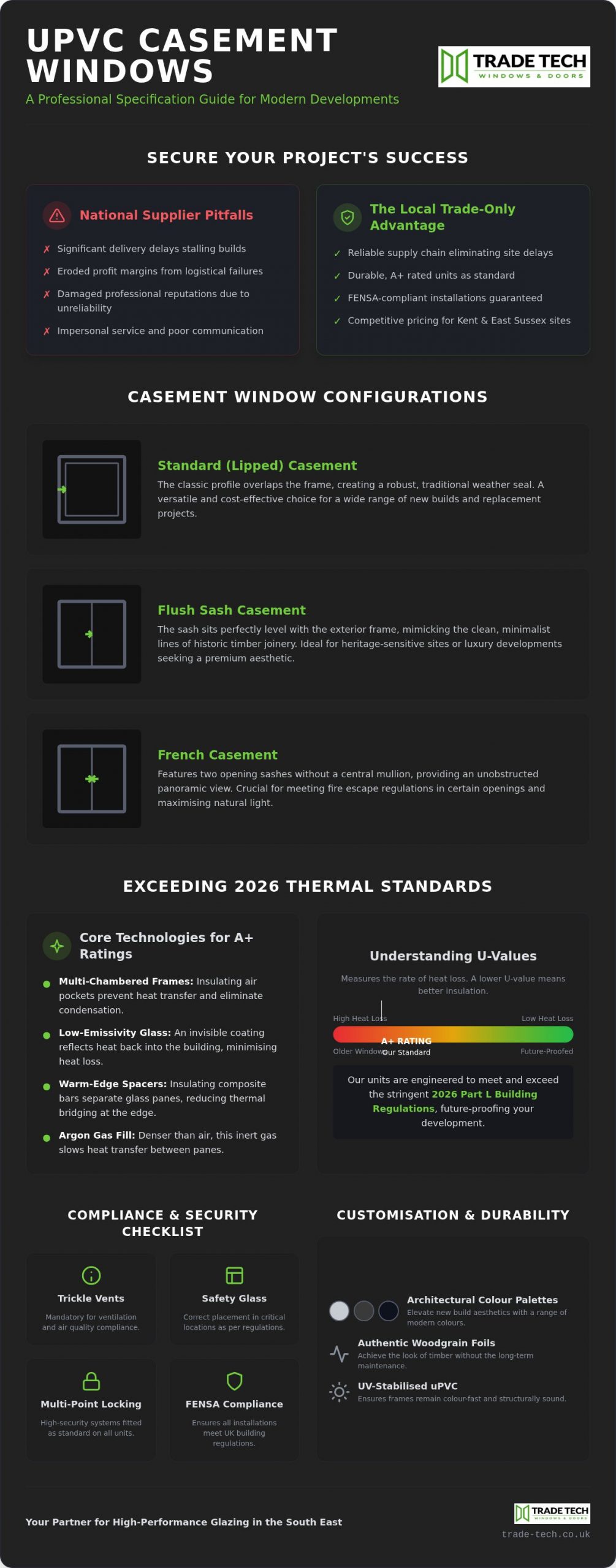
Traditional lipped casements feature a profile that overlaps the frame, providing a robust weather seal and a classic tiered appearance. In contrast, flush sash windows sit level with the exterior frame, mimicking the clean lines of historic timber joinery. Whilst flush sashes are often specified for heritage-sensitive sites or luxury builds to achieve a premium aesthetic, both styles now offer identical thermal and security performance. Modern manufacturing ensures that the choice between lipped and flush profiles is purely architectural, with no compromise on A+ energy ratings.
French Casement Variations
When a project demands an unobstructed view or requires a specific emergency egress solution, French casements are the professional’s choice. These units feature two opening sashes without a central vertical mullion. This double-opening mechanism is particularly valuable for meeting fire escape regulations in narrow openings where a standard casement would fail. They are a staple in rural Sussex and Kentish cottage renovations, where preserving a traditional aesthetic is as important as meeting modern safety standards. The lack of a central bar allows for maximum light ingress, making them an excellent specification for smaller rooms or properties with panoramic views.
Technical Specifications and Thermal Performance Standards
Precision engineering defines modern uPVC Casement Windows. It’s not just about the aesthetic; it’s about the internal geometry. Multi-chambered frame designs create insulating pockets of air. These chambers break the bridge between cold exterior surfaces and warm interior spaces. This technology prevents heat loss and eliminates the internal condensation common in older, single-chamber profiles. The result is a thermally-efficient, rigid, and stable frame that meets the demands of high-density housing.
High-performance sealed units are the core of any A+ rated specification. By combining low-emissivity glass with warm-edge spacer bars, these units reflect heat back into the building. For projects in exposed coastal regions like Folkestone, Hastings, or Eastbourne, we specify heavy-duty weather seals. These dual-compression gaskets ensure airtightness even under high wind pressure and driving rain. Security is equally rigorous. Every unit features multi-point locking systems as standard, providing the robust, dependable, and high-security protection demanded by modern developers.
Understanding U-Values and Energy Ratings
The 2026 Part L Building Regulations mandate stricter thermal thresholds for all new installations. U-values measure the rate of heat transfer through the window; the lower the number, the better the insulation. Whilst double glazing remains the trade standard for most retrofits, specify triple glazing for premium developments to future-proof against rising energy costs. Argon gas fill reduces thermal transmittance by providing a denser, less conductive medium than air between the glass panes. This ensures your project complies with the latest SAP calculations and environmental standards.
Durability and Material Integrity
Material failure is a significant risk for site profitability and long-term snagging lists. We use UV-stabilised uPVC compounds to ensure frames remain colour-fast, even in direct sunlight. Larger spans require internal galvanised steel reinforcement to maintain structural integrity under heavy wind loads. Unlike timber, these uPVC Casement Windows won’t rot, warp, or require repainting, making them the most efficient long-term choice for residential developers. If you need specific data for a tender or project planning, you can access our trade pricing and technical documents online.
Design Options: Customising for Regional Architecture
Standard white frames no longer dominate the professional landscape. Architectural demand has shifted towards sophisticated palettes that define a property’s character. Anthracite Grey remains the industry benchmark for contemporary aesthetics. It’s sharp. It’s modern. It works. For projects requiring a softer, more muted tone, Agate Grey provides a versatile alternative that sits comfortably in both urban and rural environments. These uPVC Casement Windows allow developers to achieve a high-end architectural look without the lead times or costs associated with bespoke metal systems.
Woodgrain foils offer a pragmatic solution for projects where timber aesthetics are required but maintenance budgets are restricted. These foils mimic the authentic texture and grain of natural oak or rosewood. They provide the visual warmth of wood with the structural stability of high-grade polymer. When combined with bespoke sizing for non-standard openings, these design options ensure that modern glazing can be tailored to any structural requirement. Precision manufacturing allows for exact millimetre accuracy, ensuring a perfect fit for unique architectural apertures.
Colour Trends in Kent and Sussex
Regional preferences significantly influence specification choices across the South East. Sussex developers frequently lean towards heritage shades like Sage Green or Cream to complement traditional flint and brickwork. In contrast, black or dark grey frames are the preferred choice for modern Kentish barn conversions, where they mimic the industrial feel of traditional steel windows. Dual-colour foiling is a critical trade requirement here. It allows for a bold, dark exterior statement whilst maintaining a neutral white interior to suit diverse tenant or homeowner decorating styles.
Hardware and Glazing Enhancements
Hardware selection serves as the final touch in property customisation. Traditional projects often benefit from monkey-tail or teardrop handles in antique black or brushed steel finishes. These small details reinforce the heritage feel of the build. For modern privacy and light control, integral blinds are an increasingly popular specification. These units are permanently sealed within the glazing, eliminating the need for external window dressings and reducing dust accumulation. Decorative glazing patterns also play a functional role, providing necessary privacy for bathrooms or street-facing windows without sacrificing natural light ingress.
Navigating Building Regulations and Installation Requirements
Compliance isn’t just a box-ticking exercise; it’s a legal safeguard for your business. For any installation of uPVC Casement Windows, background ventilation is now a non-negotiable requirement. Trickle vents must be specified to meet Part F of the Building Regulations, ensuring adequate airflow whilst maintaining the property’s security. Safety is equally paramount. Toughened glass is mandatory in all “critical locations,” which include any glazing within 800mm of the floor level or windows positioned within 300mm of a door.
Site preparation prevents costly delays. Before the glazing units arrive, verify that all apertures are cleared of debris, structurally sound, and checked for squareness. Check your lintels for level and ensure there is clear, safe access for the delivery vehicle and fitters. Relying on FENSA-registered installers for residential work streamlines the certification process. It provides homeowners with the necessary compliance documents without the need for separate local authority inspections. This level of professional oversight protects your reputation and ensures the installation of uPVC Casement Windows meets the highest industry standards.
Part L Compliance for 2026
The 2026 thermal efficiency targets demand significantly lower U-values to reduce the UK’s housing carbon footprint. Building Control now requires granular documentation for new developments, including detailed thermal calculations and glass specifications. You must ensure your trade windows are manufactured to meet these specific, more rigorous thresholds. We provide the full suite of technical data sheets required to satisfy inspectors and ensure your project passes the final SAP assessment first time.
Professional Installation vs. Supply Only
The choice between supply-only and a full installation service often dictates the project’s final quality. A dedicated installation team brings logistical precision to the site. They handle the offloading, positioning, and mechanical fixing of units, which drastically reduces the risk of transit damage or onsite accidents. Improper fitting of uPVC frames can lead to thermal bridging, draughts, or water ingress, negating the benefits of high-performance glazing. A single-point-of-contact for both supply and fit ensures total accountability. It eliminates the “blame game” between manufacturer and installer, providing a seamless transition from factory floor to finished aperture.
Consult our specialists for new build glazing requirements
Trade Tech Windows & Doors: Your Partner for Glazing Supply in the South East
Trade Tech Windows & Doors serves as a dedicated trade partner for contractors, developers, and professional installers across Kent and East Sussex. We recognise that site delays directly impact your project’s bottom line. Our operational model prioritises technical accuracy and rapid fulfilment. We supply high-performance uPVC Casement Windows with a level of reliability that national manufacturers often fail to provide. By selecting a local specialist, you gain a responsive service that understands the specific pressures and logistical requirements of the South East construction market.
Accessing competitive trade pricing allows your projects to remain profitable whilst meeting the 2026 energy standards discussed earlier. Our comprehensive inventory extends beyond standard glazing to include high-security composite doors and architectural aluminium windows. Consolidating your procurement with Trade Tech Windows & Doors simplifies onsite management. It ensures that every component, from the main frames to the bespoke sealed units, meets a consistent performance benchmark and aesthetic finish.
Expertise Across Residential and Commercial Sectors
We manage a diverse range of project requirements, from bespoke residential renovations to large-scale glazing installations for new developments. Our team provides the technical oversight necessary for complex architectural specifications, ensuring every unit is manufactured to precise millimetre tolerances. We supply all required data sheets and certifications to satisfy Building Control and project stakeholders. If you’re planning a complex build or a multi-unit development, contact us for a project-specific quote and professional consultation.
A Streamlined Supply Chain for the South East
Local sourcing is a strategic choice for the modern developer. It reduces the carbon footprint of your build by minimising transit distances from the factory to the site. We maintain a dependable delivery network across Maidstone, Ashford, and Brighton. We don’t just drop off units; we coordinate with your site managers to ensure deliveries align with your specific installation phases. This collaborative mindset removes the common logistical bottlenecks associated with national haulage. Trade Tech Windows & Doors operates as an extension of your team, keeping your project moving with the efficiency your clients demand.
Securing Project Success with High-Performance Glazing
Meeting the 2026 Part L requirements demands absolute technical precision. Multi-chambered frames and A+ rated sealed units are now the baseline for professional specifications. By prioritising regional design trends and strict building regulation compliance, you ensure your developments excel whilst meeting every mandatory thermal threshold. Sourcing high-quality uPVC Casement Windows from a specialist local supplier eliminates the logistical friction that often stalls site progress. It protects your profit margins. It secures your professional reputation.
Trade Tech Windows & Doors remains the dependable partner for Kent and Sussex developers. We offer the technical support, A+ rated glazing, and reliable turnaround times essential for project profitability. We provide the expert installation services required to keep your site moving at pace. Our focus on local logistics ensures that your unique specifications are met with total accuracy. We are committed to supporting the continued growth and excellence of the South East construction industry.
Request a Trade Quote for Your Next Project
Let’s build a more efficient future together.
Frequently Asked Questions
What are the current U-value requirements for uPVC casement windows in 2026?
The 2026 thermal standards require uPVC Casement Windows to achieve a U-value of 1.2 W/m²K or lower for replacement projects. New build developments often demand even more rigorous specifications to meet overall SAP targets. We provide full technical documentation to ensure your project complies with the latest Part L regulations. Using triple glazing can further reduce these values for high-performance architectural requirements.
Can uPVC casement windows be used in conservation areas in Kent?
Many local authorities in Kent allow high-quality uPVC in conservation areas if the design mimics original timber. Specify flush sash profiles with woodgrain foils and mechanical joints to satisfy planning officers. These units provide the traditional aesthetic required whilst offering modern thermal performance. Always verify specific Article 4 directions with the relevant district council before finalising your project specification for these sensitive locations.
How do flush sash windows differ from standard uPVC casements?
Flush sash windows sit level with the exterior frame, creating a smooth, flat surface that replicates historic joinery. Standard uPVC Casement Windows feature a lipped profile where the sash overlaps the frame. Whilst the aesthetic differs significantly, both systems offer identical multi-chambered frame technology and A+ rated energy performance. The choice depends entirely on whether the project requires a contemporary or heritage finish.
What is the typical lead time for trade uPVC window orders in the South East?
Our standard lead times for white trade units typically range from two to three weeks. Bespoke architectural colours like Anthracite Grey or heritage woodgrain foils may require additional production time. We prioritise logistical efficiency across Kent and East Sussex to prevent site delays. Contact our team with your specific schedule to receive a precise delivery window that aligns with your project’s construction phases.
Are trickle vents mandatory for all replacement windows?
Trickle vents are mandatory for the majority of replacement windows and all new build installations under Part F of the Building Regulations. They provide essential background ventilation without compromising the security of the property. Failing to include these can lead to compliance issues during Building Control inspections. We specify high-capacity vents that meet these legal requirements whilst maintaining a discreet external profile for the property.
Do you provide FENSA certification for your installations?
We provide full FENSA certification for every residential installation our dedicated team completes across the South East. This certificate confirms the work complies with all relevant Building Regulations and is essential for future property sales. If you choose a supply-only service, the responsibility for registration lies with the installing contractor. Our technical support team can provide the necessary product data to assist with your independent registration.
Can I order uPVC casement windows with integral blinds?
You can specify integral blinds for any of our casement units. These blinds are permanently sealed between the glass panes, protecting them from dust and physical damage. They are an excellent solution for bathrooms, street-facing windows, or modern office spaces where privacy is a priority. This option eliminates the need for external dressings and reduces long-term maintenance requirements for the property owner or developer.
What security ratings do your uPVC window frames achieve?
Our window frames achieve high-security ratings, including PAS 24 compliance as standard. Every unit features multi-point locking mechanisms and internal glazing beads to prevent glass removal from the exterior. These robust security features meet the “Secured by Design” requirements often demanded by developers and local authorities. This ensures your project provides a safe and dependable environment for the end-user throughout the property’s lifespan.