
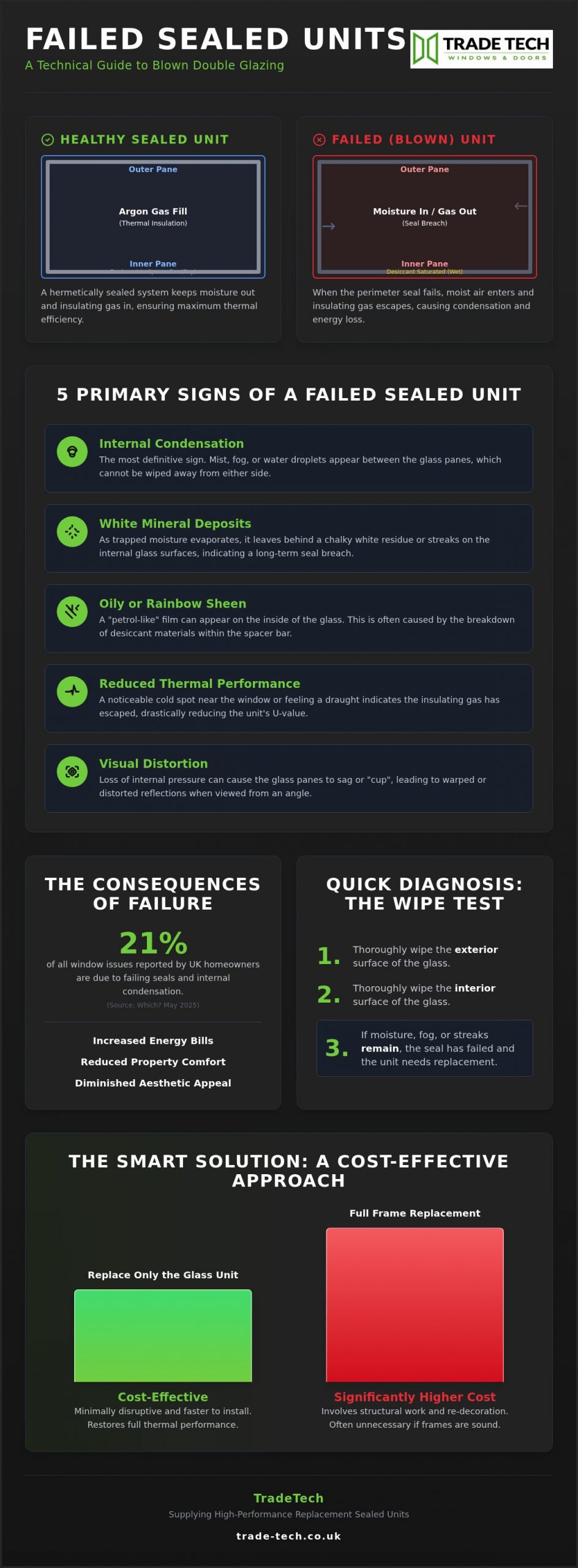
A failed sealed unit is a thermal liability. It compromises property integrity and turns high-performance glazing into a source of constant energy loss. Identify the definitive signs of a failed sealed unit early to maintain building efficiency and aesthetic appeal. You’ve likely noticed the fogging between the panes or felt a persistent draught despite the window being locked tight. It’s frustrating to guess whether you’re seeing normal surface condensation or a terminal seal failure that’s inflating your heating bills. According to Which? data from May 2025, failing seals and internal condensation account for 21% of all window issues reported by UK homeowners.
This guide provides a professional diagnosis for your next residential or trade project. You’ll learn the technical causes behind “blown” glazing and how to specify high-performance replacement units that meet current Part L requirements. We’ll examine the solar pumping cycle, the impact of gas depletion, and the most efficient way to restore thermal performance without the expense of full frame replacement. Whether you’re a homeowner or a contractor, this technical overview ensures you make the right call on replacement glass.
Key Takeaways
- Understand the mechanical failure of the Insulated Glass Unit (IGU), focusing on how spacer bar degradation and desiccant saturation lead to permanent damage.
- Identify the definitive signs of a failed sealed unit, from internal fogging to the presence of white mineral deposits that signal a terminal seal breach.
- Learn the professional “wipe test” method to accurately differentiate between temporary surface condensation and permanent blown double glazing issues.
- Evaluate the impact of argon gas depletion on U-values and why replacing the glass unit alone is a cost-effective alternative to full frame replacement.
- Discover the essential technical steps for measuring replacement units in uPVC or aluminium systems to ensure a high-performance fit for your next project.
What is a Failed Sealed Unit and Why Does it Happen?
An Insulated Glass Unit (IGU) is a high-performance, hermetically sealed component. It consists of two or more panes of glass separated by a spacer bar. This spacer bar contains desiccant beads. These beads absorb any residual moisture within the cavity to prevent internal fogging. To maintain this dry environment, manufacturers apply a dual-seal system. The primary seal, usually polyisobutylene, acts as a moisture barrier. The secondary seal, often polysulphide or silicone, provides the necessary structural integrity. When these seals breach, the unit is “blown”. Understanding the signs of a failed sealed unit starts with recognising this structural breakdown. At Trade Tech Windows & Doors, we supply units designed to withstand these environmental pressures. What is a sealed unit exactly? It is a precision-engineered barrier against the elements.
Modern units often feature Argon or Krypton gas fills to enhance thermal performance. A failed seal doesn’t just let moisture in; it lets these heavy gases out. This gas depletion often occurs long before visible condensation appears. It significantly reduces the unit’s U-value, making the property harder to heat. This invisible failure is just as critical as a fogged window. It turns a high-specification glazing system into a simple, inefficient sheet of glass.
The Mechanics of Solar Pumping
Daily temperature fluctuations create a physical cycle known as solar pumping. As the sun hits the glass, the air or gas inside the cavity expands. This forces the glass panes to bow outwards. At night, the gas cools and the panes contract. This constant movement exerts relentless pressure on the perimeter seals. Over time, the seal loses its elasticity and eventually develops microscopic fractures. South-facing windows in Kent and East Sussex are particularly vulnerable. They endure higher levels of solar gain and more extreme expansion cycles. This often leads to premature failure compared to shaded elevations. It’s a mechanical reality of glazing in exposed locations.
Manufacturing and Installation Factors
Failure isn’t always down to age. Poor installation often accelerates the process. If a window frame lacks adequate drainage, water pools in the glazing rebate. This standing water eventually breaks down the secondary seal through constant immersion. Chemical compatibility is another critical factor. Using the wrong glazing silicones can cause a chemical reaction that softens the seal. Correct placement of glazing bridges and packers is essential. These components ensure the unit remains elevated and allows water to reach the drainage holes. Precise, professional, and accurate installation prevents these avoidable failures. High-quality components deserve high-quality fitting to ensure longevity.
5 Primary Signs of a Failed Sealed Unit
Recognising the signs of a failed sealed unit early prevents escalating energy costs and protects the structural integrity of the window frame. While some indicators are obvious, others require a technical eye to detect before the glass becomes completely obscured. Identifying these faults allows for a targeted replacement of the glass unit rather than a more costly full-frame installation.
- Internal condensation: The presence of mist, fog, or water droplets between the two panes of glass.
- White mineral residue: Chalky streaks or spots left behind when internal moisture evaporates.
- Oily appearance: A “petrol-like” rainbow sheen on the internal glass surface caused by desiccant breakdown.
- Cold spots and draughts: A noticeable drop in thermal performance near the glass, indicating gas depletion.
- Visual distortion: Reflections that appear warped or “cupped” due to a loss of internal pressure.
Identifying Internal Condensation
Moisture between the panes is the most frequent indicator that a seal has breached. This usually starts as a light “fogging” during cold snaps when the temperature of the glass drops below the dew point of the air trapped inside. In the early stages, this mist might disappear as the sun warms the unit. However, once the desiccant beads inside the spacer bar reach their saturation point, they can no longer absorb ingress. This leads to heavy water droplets and permanent vertical streaks. Because this moisture is trapped inside the hermetically sealed cavity, it’s impossible to wipe away. If you can’t clear the mist from either the internal or external face, the unit has reached terminal failure.
Optical Distortions and Oily Films
High-quality units often exhibit more subtle technical signs before total failure. If a unit was originally Argon-filled, the slow leak of this heavy gas creates a vacuum effect. This causes the glass panes to bow inwards, a phenomenon known as “cupping”. You can spot this by looking at the reflection of a straight line, such as a brick course or a neighbouring roofline, in the window. If the line appears curved or distorted, the internal pressure has failed.
Another specific sign is an oily rainbow sheen on the glass. This occurs when the desiccant beads break down chemically. The oils used in their manufacture leach out and coat the internal glass faces. If you notice these optical shifts, it’s time to source high-performance replacement sealed units to restore the thermal envelope. These subtle shifts often precede visible misting but indicate that the unit’s U-value has already been compromised.
Diagnosis: Condensation vs Blown Double Glazing
Distinguishing between environmental factors and structural failure is critical for any maintenance schedule. Misidentifying environmental moisture as one of the signs of a failed sealed unit can lead to wasted budget and unnecessary material disposal. Use a clear diagnostic hierarchy to determine the source of the moisture before ordering a replacement. Not all misted glass requires a new unit.
- External surface moisture: Usually a sign of high-performance thermal glass working correctly.
- Internal (room-side) moisture: Typically indicates a ventilation issue or high humidity within the property.
- Moisture between panes: Definitive proof of a terminal seal breach.
External condensation occurs when the outer pane of glass is significantly colder than the dew point of the outside air. This happens because the internal heat is being successfully reflected back into the room, leaving the outer pane cold. If you see dew on the outside of your aluminium windows on a cold morning, your glazing is performing efficiently. Conversely, room-side condensation suggests that moist air is hitting a cold surface. Under Building Regulations Part F, replacement windows must include trickle vents to mitigate this. If moisture is on the room-side surface, check that vents are open and air circulation is unobstructed.
The “Wipe Test” and Surface Analysis
The “wipe test” is the fastest way to verify a unit’s integrity. Follow these steps to confirm the location of the moisture:
- Clean the external face of the glass with a dry cloth.
- Clean the internal (room-side) face of the glass.
- If the mist persists, the moisture is trapped within the hermetically sealed cavity.
Use a high-intensity torch to inspect the unit further. Shine the light at an angle to reveal “scudding” or white mineral deposits. These are dried residues left behind when moisture enters and evaporates repeatedly. They are permanent and cannot be cleaned. Finally, inspect the perimeter gasket and glazing bead. Look for physical gaps or perished rubber that might be allowing water to pool against the primary seal.
Thermal Performance Testing
For a more technical assessment, use an infrared thermometer to measure surface temperatures. Compare a suspect unit against a known healthy unit on the same elevation. A failed unit will often show a significantly higher internal surface temperature in winter because the insulating gas has escaped. A thermal bridge caused by seal failure is a localised area of high heat transfer where the insulating gas has been replaced by conductive moist air. Identifying these temperature drops allows you to justify the replacement of sealed units based on energy efficiency rather than just aesthetics.
The Impact of Failed Glazing on Building Integrity
Ignoring the signs of a failed sealed unit leads to more than just a poor view. It triggers a cascade of structural and financial consequences that compromise the entire building envelope. When a seal breaches, the unit’s ability to regulate temperature vanishes. This failure turns a precision-engineered thermal barrier into a conductor. For commercial East Sussex projects, this creates a significant, uncalculated load on HVAC systems. These systems must work harder to compensate for the heat gain in summer and loss in winter, leading to accelerated equipment wear and spiked operational costs.
Structural degradation is a slower but more damaging result of seal failure. Moisture ingress doesn’t stay confined to the glass. It often migrates into the glazing rebate, where standing water can perish gaskets and corrode aluminium or rot timber. This eventually hits the property’s resale value. To mitigate the risk of broader moisture damage, you can visit Wallguard London for expert damp proofing and mould removal services. A building with visible “blown” glazing suggests a lack of maintenance, which can be a major red flag for surveyors and potential buyers during the valuation process.
A failed unit is a major energy drain. Once the insulating argon gas escapes, the thermal performance of the glass drops sharply. Research from the Glass and Glazing Federation (October 2023) highlights that older, inefficient glazing can be 50% less effective than modern units meeting current standards. This makes it impossible to maintain the 1.4 W/m²K U-value required by Part L Building Regulations. This failure doesn’t just increase energy bills; it significantly expands the property’s carbon footprint. Maintaining thermal integrity with sealed units is the only way to ensure a building remains compliant and cost-effective to run.
Mould, Damp, and Health Risks
Failed glazing creates persistent cold spots on the internal glass face. These surfaces become primary sites for condensation, which facilitates localised mould growth. This isn’t merely a cleaning chore; it compromises indoor air quality (IAQ) and can trigger respiratory issues for occupants. In heritage Kent properties, the risk is even higher. Many of these buildings feature traditional timber frames that are highly susceptible to rot when exposed to constant moisture from a failed unit. Protecting these structural assets requires identifying the signs of a failed sealed unit early and replacing the glass before the damp spreads to the surrounding fabric.
Order high-performance replacement sealed units today
Sourcing Professional Replacement Sealed Units
Once you have identified the signs of a failed sealed unit, the priority shifts to efficient remediation. If the existing frames remain structurally sound, replacing only the glass unit is the most logical and cost-effective solution. This approach preserves the integrity of the property while significantly reducing material waste and onsite disruption. For trade professionals and developers, it allows for a rapid turnaround that restores the building’s thermal performance without the logistical complexity of a full-frame installation.
Technical precision is mandatory during the measuring phase. You must record the exact width, height, and overall thickness of the unit. Standard thicknesses such as 24mm or 28mm are common, but variations exist across different profile systems. To ensure an accurate fit, always measure the unit after removing the glazing beads. This prevents errors caused by measuring only the visible glass area. Specifying modern Low-E (low-emissivity) coatings and Argon gas fills is essential to meet the 1.4 W/m²K U-value required by current Building Regulations, transforming a failed window into a high-performance asset.
Specifying the Right Replacement
Consistency across the property is vital for both aesthetics and safety. You must match the existing glass type, specifying toughened safety glass for doors and low-level glazing or laminated glass where enhanced security is required. For privacy, ensure any obscure or patterned glass matches the original specification exactly. We recommend upgrading to warm-edge spacer bars for all new units. These bars, made from insulating plastic composites rather than conductive aluminium, significantly reduce the risk of thermal bridging at the glass edge. This specification ensures the new glass performs perfectly within the uPVC casement windows already on-site, preventing the signs of a failed sealed unit from reappearing prematurely.
The Trade Tech Windows & Doors Advantage for Local Projects
Trade Tech Windows & Doors operates as a specialist partner for the construction and installation industry across Kent and East Sussex. We understand the fast-paced nature of the trade and the requirement for absolute technical precision. Our facility manufactures high-performance sealed units to professional standards, ensuring every component meets rigorous quality benchmarks. We provide a dependable supply chain for new build contractors and developers who require accurate lead times and reliable support. For technical specifications or to access our competitive trade pricing, contact our expert team today. We provide the high-quality components necessary for professional success.
Restore Thermal Performance with Precision Glazing
Efficiently managing the building envelope requires a proactive approach to maintenance. Identifying the signs of a failed sealed unit early prevents the compounding costs associated with structural damp and excessive energy consumption. By distinguishing between environmental condensation and terminal seal failure, you ensure that every replacement is a targeted, value-driven investment in the property’s longevity.
Selecting high-performance glass ensures your windows meet modern thermal standards without the need for comprehensive frame replacement. Trade Tech Windows & Doors provides the technical expertise and precision-manufactured components required for residential and commercial projects across Kent and East Sussex. Our commitment to accuracy and efficiency makes us the dependable partner for the local trade industry.
Get a professional quote for replacement sealed units from Trade Tech Windows & Doors
Take the final step toward optimising your property’s thermal efficiency and ensure your next project is built on a foundation of quality and reliability.
Frequently Asked Questions
Can a failed sealed unit be repaired without replacing the glass?
No, a terminal seal breach requires a full replacement of the glass unit to restore its function. While some services offer to drill holes to dry out the cavity, these are temporary cosmetic fixes. They don’t restore the hermetic seal or the insulating gas. Replacing the Insulated Glass Unit (IGU) is the only professional way to ensure the window meets current Part L thermal performance standards.
How long should a double glazed sealed unit typically last?
A standard sealed unit has an average lifespan of 10 to 25 years. This duration depends heavily on the quality of the primary and secondary seals used during manufacturing. Environmental factors like high solar gain on south-facing elevations or poor frame drainage in older systems can accelerate failure. Correct installation with appropriate glazing packers is essential for reaching the upper end of this lifespan.
Will a failed window seal cause my energy bills to increase significantly?
Yes, failed seals allow insulating gases like Argon to escape, turning your window into a thermal conductor. Research shows that older, inefficient glazing can be 50% less effective than modern units. This heat loss forces your heating system to work harder to maintain room temperature. Identifying the signs of a failed sealed unit early allows you to restore the building’s thermal envelope and reduce wasted energy costs.
Is it possible to replace just the glass in a uPVC window frame?
Replacing only the glass unit is a standard and highly efficient procedure. If the uPVC or aluminium frames are in good condition, there’s no technical requirement to replace the entire window. This targeted approach is significantly more cost-effective and reduces material waste. It involves removing the internal glazing beads, swapping the old IGU for a new high-performance unit, and refitting the beads securely for a tight seal.
Why is there condensation on the outside of my new windows?
External condensation is actually a sign that your high-performance glazing is working correctly. It occurs when the outer pane is so well-insulated from the internal heat that its temperature drops below the dew point of the outside air. This usually happens on cold, clear mornings. It confirms that heat is being reflected back into your property rather than escaping through the glass, proving the unit is intact.
What is the most common cause of double glazing seal failure in the UK?
Solar pumping is the leading cause of seal failure. Daily temperature fluctuations cause the glass to expand and contract, putting constant pressure on the perimeter seals. Over time, this mechanical stress creates microscopic breaches. Poor frame drainage also plays a major role; if the unit sits in standing water, the secondary seal will eventually perish, leading to the common signs of a failed sealed unit like internal misting.
Does a misty window always mean the seal has blown?
A misty window only indicates a blown seal if the moisture is trapped between the two panes. If you can wipe the condensation away from the room-side or the outside, the unit’s seal is likely still functional. Room-side condensation typically points to high humidity and poor ventilation. You should check that trickle vents are open as required by Part F Building Regulations before concluding that the unit has failed.
How do I measure a sealed unit for replacement?
You must measure the width, height, and overall thickness of the glass unit. To get an accurate reading, remove the glazing beads and measure the unit from edge to edge. Don’t just measure the visible glass area. Thickness is critical; standard units are often 24mm or 28mm, but you must verify this to ensure a secure fit. Always specify safety glass where required by Part K Building Regulations. If your project involves other glass elements like furniture or table protectors, Glass Mirror House provides premium toughened safety glass cut to size.