
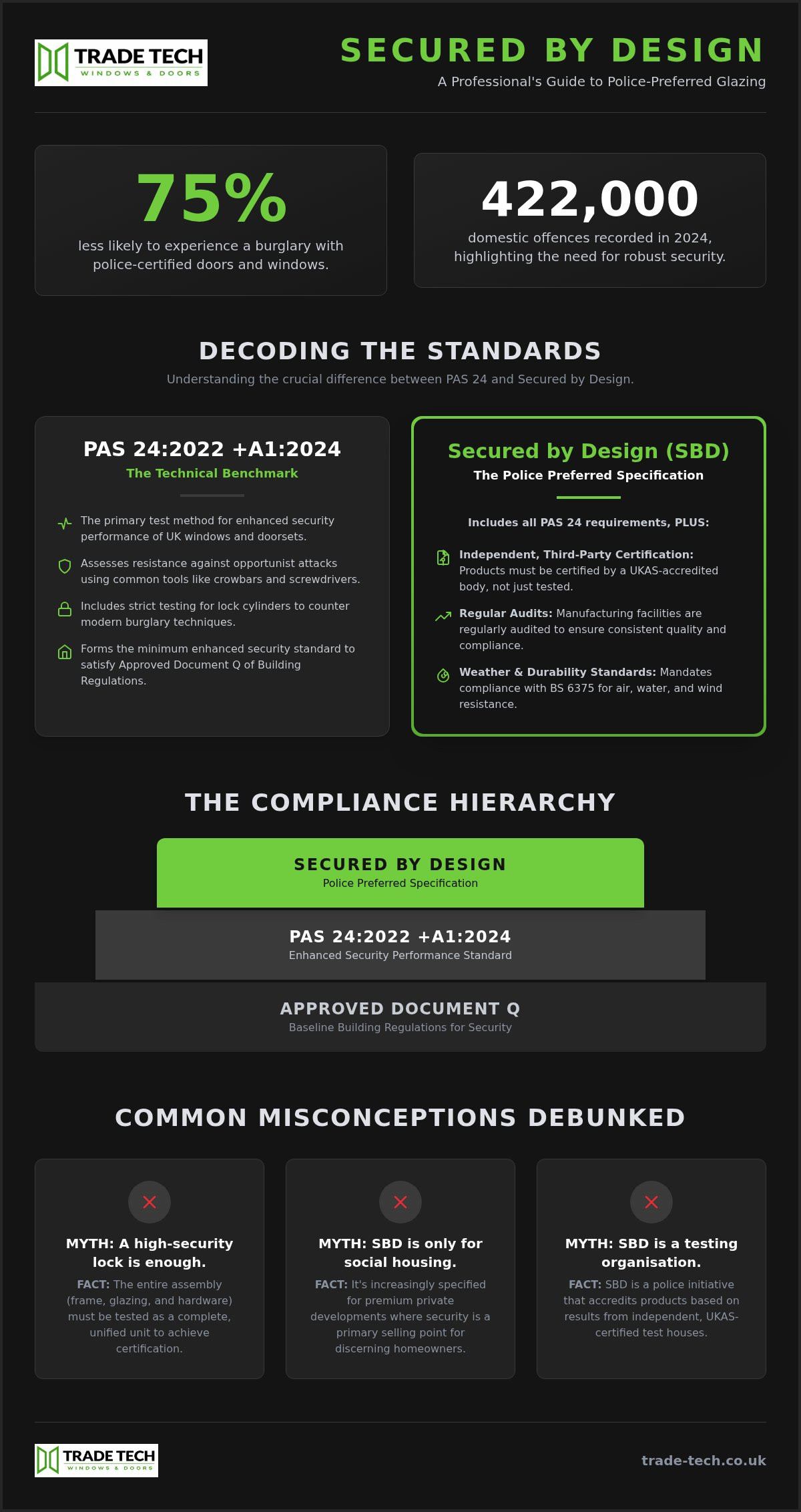
Properties fitted with doors certified to police standards are 75% less likely to experience a burglary. In a landscape where domestic offences reached 422,000 in 2024, the security of your glazing isn’t just a tick-box exercise for Building Control; it’s a critical project safeguard. You already know that navigating the transition to the new PAS 24:2022 +A1:2024 standard is a logistical headache. Distinguishing between basic Part Q compliance and full Secured by Design windows and doors accreditation shouldn’t be a guessing game for busy developers in Kent and East Sussex.
We understand that your reputation relies on the stability and security of the products you install. This guide provides the technical clarity you need to master SBD requirements and secure your projects against modern burglary tactics, specifically addressing the recent focus on cylinder lock vulnerabilities. You’ll gain a clear roadmap for compliance that satisfies both inspectors and homeowners.
We will break down the latest certification deadlines, the specific commercial benefits of SBD-accredited glazing, and how to source reliable trade supply for your next residential build. This is your professional framework for delivering excellence in every opening.
Key Takeaways
- Distinguish between PAS 24:2022 +A1:2024 and SBD to ensure your project specifications meet the latest 2026 security benchmarks.
- Learn how to specify Secured by Design windows and doors across uPVC and aluminium systems to balance architectural style with police-preferred security.
- Understand how SBD-accredited glazing simplifies Approved Document Q compliance and accelerates the building control approval process.
- Evaluate the performance of SBD-specified uPVC casements and aluminium systems for both residential and commercial developments.
- Optimise your procurement strategy by sourcing certified products from a specialist trade partner in Kent and East Sussex.
Understanding Secured by Design (SBD) for Trade Projects
Established in 1989, the initiative was created to integrate security into the very fabric of the built environment. It operates as a police-led scheme focusing on crime prevention through environmental design. Specifying Secured by Design (SBD) accredited systems is now a standard requirement for new-build contractors and developers working on local authority or housing association tenders. These organisations prioritise SBD because it offers a proven framework for reducing burglary rates across the UK.
Local authorities mandate these standards to protect long-term asset value and tenant safety. For the trade, this means SBD is often a non-negotiable prerequisite for winning large-scale contracts. Trade Tech Windows & Doors provides the technical expertise to ensure your glazing meets these benchmarks. It is vital to distinguish between the organisation itself and the products it accredits. SBD doesn’t manufacture glazing; it sets the rigorous ‘Police Preferred Specification’ that manufacturers must meet to earn the right to use the logo.
The Police Preferred Specification Explained
The Police Preferred Specification is the benchmark for Secured by Design windows and doors. It ensures that a product has been tested to withstand common methods of forced entry. This isn’t a self-certified claim. Every product must undergo independent third-party certification by a UKAS-accredited body. This process involves regular audits of the manufacturing facility to ensure consistent quality. Trade Tech Windows & Doors works with certified systems to ensure the units delivered to your site match the high-performance prototype tested in the lab. This level of oversight builds trust with building control officers and insurers.
Misconceptions: What SBD is Not
Confusion often arises regarding what SBD actually does. It is a membership organisation, not a laboratory or a test house. It relies on results from external facilities to grant accreditation. Another common myth is that a high-security cylinder lock automatically grants SBD status. It doesn’t. The entire assembly, including the frame and hardware, must be tested as a complete unit. Don’t assume SBD is only for social housing projects. Trade Tech Windows & Doors supplies these systems for premium private developments where security is a primary selling point for homeowners. If you are looking to explore New Builds from Willmac Group, you can see how high-quality construction and security are seamlessly integrated. It is a proactive investment in peace of mind.
Decoding the Standards: PAS 24 vs. Secured by Design
PAS 24:2022 serves as the core technical benchmark for security in the UK glazing industry. It’s the primary test method used to assess the resistance of doorsets and windows against unauthorised entry. While many professionals assume PAS 24 compliance is synonymous with SBD, the two are distinct. SBD is a police security initiative that uses PAS 24 as a baseline but demands higher levels of third-party oversight. The latest iteration, PAS 24:2022 +A1:2024, has introduced even stricter testing for lock cylinders to counter modern burglary techniques. Specifying PAS 24 alone might satisfy basic insurance requirements, but it doesn’t always provide the comprehensive quality assurance that local authority tenders demand.
What Happens During a PAS 24 Security Test?
Testing is rigorous and physical. It simulates an ‘opportunist attack’ using tools like screwdrivers, crowbars, and bolt cutters. Technicians attempt to create an entry point within a specified time limit, focusing on known weak spots like hinges and locking points. Mechanical loading tests then apply significant pressure to the frame and hardware. This ensures the system doesn’t buckle or detach under sustained force. PAS 24 is the minimum enhanced security standard for UK dwellings. Without this certification, a product cannot be considered for SBD status. Every component, from the glass to the gasket, must work as a unified, resilient system to pass.
Weather Performance and Durability Standards
Security shouldn’t come at the expense of longevity. SBD requirements extend beyond forced entry to include BS 6375 Parts 1, 2, and 3. These standards cover air permeability, water tightness, and wind resistance. For projects in Kent and East Sussex, where coastal exposure is a constant factor, these ratings are vital. They ensure that Secured by Design windows and doors remain ‘fit for purpose’ throughout their service life, resisting salt spray and high winds. A product that is secure but fails to keep out the rain is a liability for any developer. By adhering to BS 6375, SBD-certified products guarantee durability and functional excellence. This holistic approach ensures the glazing performs as well in a winter storm as it does during a security breach. If you’re managing a development that requires specific performance data, you can request technical specifications and trade pricing for our SBD-certified ranges. High performance. Total security. Long-term reliability.
SBD Specification Across Window and Door Materials
Choosing the right substrate is a balance of aesthetics, budget, and performance. While uPVC remains the volume leader for residential developments, aluminium has seen a surge in specification for modern commercial glazing and high-end residential projects. Both materials can achieve SBD status, but the technical path to compliance differs. Understanding these nuances ensures you specify the right Secured by Design windows and doors for your Kent or Sussex site without compromising on the architectural vision. Material choice is often dictated by the specific security risks identified in Building Regulations, which highlight the need for robust physical barriers in new dwellings.
Securing uPVC and Aluminium Systems
For residential projects, uPVC casement windows are the standard choice for efficiency and cost-effectiveness. To meet SBD criteria, these units must feature internal glazing beads. This design prevents intruders from simply removing the glass from the outside to gain entry. Multi-point locking mechanisms are essential, providing multiple engagement points along the frame to resist jemmying. In contrast, aluminium windows offer inherent structural strength. This makes them ideal for high-traffic commercial environments where durability is as important as security. The slim profiles of aluminium don’t sacrifice strength; they rely on the material’s rigidity to pass mechanical loading tests. When specifying aluminium bi-folding doors, SBD accreditation is particularly important due to the large glass areas and multiple moving panels. These systems utilise heavy-duty shoot-bolts and anti-lift tracks to resist targeted attacks on the folding mechanism.
SBD Requirements for Composite Doors
Hardware choice is the deciding factor in composite door compliance. You cannot simply fit a secure lock to a standard slab and call it SBD-ready. Leading composite door suppliers provide fully certified doorsets tested to PAS 24:2022 standards. This certification covers the entire assembly: the slab, the reinforced frame, the hinges, and the threshold. Laminated glass is a mandatory requirement for SBD-compliant door units with glazing. This ensures that even if the outer pane is shattered, the interlayer maintains a physical barrier. This level of detail is why SBD is cited as a primary route to achieving mandatory security levels. It’s a comprehensive approach that leaves no weak points for an opportunist burglar to exploit.
Aesthetic flexibility has improved significantly across all SBD-certified materials. You no longer have to choose between a ‘prison-style’ look and high security. Modern uPVC and aluminium systems offer a wide range of RAL colours and woodgrain finishes. This allows developers to maintain a consistent design language across a project whilst ensuring every opening meets the highest security benchmarks. Whether you are working on a traditional residential block or a contemporary commercial shopfront, the availability of certified products ensures that security is built-in, not bolted on.
Building Regulations and the Value of SBD Accreditation
Compliance with Approved Document Q is mandatory for all new-build dwellings in England. This regulation sets out the minimum standards for security to ensure a building can resist unauthorised access. Using Secured by Design windows and doors is amongst the most efficient ways to meet these criteria. It removes the ambiguity of testing individual components because the entire doorset or window assembly is already certified to the required standard. This provides a clear path for installers who don’t want to get bogged down in technical disputes with building control officers.
Meeting Approved Document Q Requirements
While Part Q primarily targets new dwellings, including those created through a change of use, its influence is spreading into the renovation sector as a benchmark for quality. Professional new build contractors and developers prioritise SBD because it eliminates the risk of an inspector rejecting a non-compliant installation. SBD accreditation provides ‘deemed to satisfy’ evidence for Part Q, meaning the certification is accepted as proof of compliance without further testing. This streamlined process saves time on-site and reduces the administrative burden of proving product performance during the final sign-off phase.
Beyond the legal requirements, SBD adds tangible value for the end client. Research indicates that properties with SBD-approved doors are 75% less likely to be burgled. There is also a 25% reduction in criminal damage to properties with these systems. Many insurance providers recognise these figures, which often leads to lower premiums for homeowners. For developers, this is a powerful Unique Selling Point (USP). Marketing a property as “Police Preferred” increases its marketability and provides buyers with peace of mind. It positions the development as a premium environment, which can support higher asking prices in competitive markets across Kent and East Sussex.
Future-Proofing Your Glazing Specification
Specifying to the highest current standard protects against future regulatory shifts. We expect security requirements to tighten as burglary tactics evolve. By investing in high-specification hardware and frames now, you avoid the need for costly retrofits later. There’s also a significant operational benefit for the trade. SBD-certified products undergo rigorous durability testing, which naturally leads to a reduction in remedial call-outs. Using tested, stable systems ensures that once a project is finished, it stays finished. It’s a proactive way to protect your margins and your reputation.
Consult our technical team for Part Q compliance support
Sourcing SBD-Certified Glazing in Kent and East Sussex
Reliability remains the primary currency in the construction sector. Specifying high-performance glazing is only the initial step; ensuring it arrives on-site on time and to the exact technical specification is where many projects encounter friction. Selecting a specialist trade supplier like Trade Tech Windows & Doors with deep local expertise is essential for maintaining project momentum. In the South East, logistical precision and technical knowledge are non-negotiable for contractors managing tight margins and strict handover dates. Your supply chain must be as robust as the hardware it delivers.
Trade Tech Windows & Doors understands the unique pressures of the Kent and Sussex development landscape. We provide a stable foundation for your projects by offering direct trade supply of Secured by Design windows and doors. Our focus remains on speed, accuracy, and comprehensive support. We eliminate the confusion often found with general merchants by speaking the language of the trade. This ensures that every unit delivered meets the rigorous standards discussed in earlier sections, from PAS 24:2022 compliance to weather tightness benchmarks.
Local Trade Supply for the South East
Sourcing SBD casement windows for Kent housing projects requires a partner who understands regional building control expectations. Large-scale developments in East Sussex demand consistent quality across hundreds of units. We maintain strict quality control to ensure every frame and doorset is identical in performance and finish. Trade professionals can access exclusive trade pricing for these high-specification units, allowing you to deliver police-preferred security without inflating your project costs. We manage the complex lead times associated with certified products, providing you with realistic delivery schedules that keep your site teams moving.
Partnering with Trade Tech Windows & Doors for Project Success
Technical support is a critical advantage when specifying complex SBD glazing units. Our team assists with detailed technical specifications to ensure your tender documents are watertight. We provide the ‘deemed to satisfy’ evidence required for Part Q compliance, saving you administrative headaches. This no-nonsense, professional approach to glazing supply is designed to protect your time and your reputation. We don’t just supply products; we provide the technical advice necessary for you to succeed in a competitive market. Our local presence in the South East means we are responsive to your needs, offering a level of service that faceless national suppliers cannot match. Contact the Trade Tech Windows & Doors team for your next SBD-specified tender to experience a more efficient way to source professional glazing.
Securing Your Next Development with Precision
Mastering the technical framework of Secured by Design windows and doors ensures your projects meet the rigorous demands of modern building standards without the risk of non-compliance. By prioritising independent third-party certification and the latest security benchmarks, you protect your professional reputation and deliver tangible peace of mind to homeowners. Trade Tech Windows & Doors stands as your specialist in Part Q compliant glazing, offering direct supply for developers and contractors who value efficiency and precision. Stable, secure, and resilient.
Partnering with an expert trade supplier ensures your specifications remain resilient against evolving burglary tactics. We provide the local expertise needed to manage the logistical challenges of sites across Kent and East Sussex. This professional approach guarantees that your glazing isn’t just a component; it’s a stable foundation for a safe and marketable property. We look forward to helping you deliver excellence on your next project.
Request a trade quote for SBD-accredited windows and doors
Frequently Asked Questions
Is Secured by Design a legal requirement for new builds?
Secured by Design is not a strictly mandatory legal requirement for all new builds, but compliance with Approved Document Q is. Most developers choose SBD because it serves as a “deemed to satisfy” route for Part Q, simplifying the building control sign-off process. For local authority or housing association tenders in Kent and East Sussex, SBD is often a non-negotiable contract requirement to ensure long-term site security and tenant safety.
What is the difference between PAS 24 and Secured by Design?
PAS 24 is the minimum security test standard required for windows and doors in the UK, focusing on physical resistance against opportunist attacks. Secured by Design is a police-led initiative that uses PAS 24 as its baseline but adds more stringent requirements. These include mandatory third-party certification and regular manufacturing audits. While PAS 24 proves a product can resist an attack, SBD ensures consistent quality through independent, ongoing oversight of the production line.
Do all new windows and doors have to be Secured by Design?
Not every window or door on a project requires this level of accreditation. Under Building Regulations, only “easily accessible” openings, such as ground floor windows or balcony doors, must meet the security standards outlined in Part Q. However, many contractors in the South East specify Secured by Design windows and doors throughout the entire development. This approach provides a consistent aesthetic and ensures that all units meet the same high benchmarks for weather performance.
How can I check if a product is actually SBD accredited?
You should never rely solely on a logo. The only definitive way to verify accreditation is by checking the official Secured by Design website member list. Search for the manufacturer or trade supplier to confirm their specific product lines are currently certified. At Trade Tech Windows & Doors, we provide full technical documentation and certification for our SBD-specified ranges, ensuring you have the evidence required for building control officers and insurance providers on your Kent or Sussex sites.
Does SBD accreditation affect the thermal efficiency of windows?
SBD accreditation focuses on security and physical strength, but it doesn’t negatively impact thermal performance. In fact, the high-specification hardware and reinforced frames required for security often contribute to a more robust, airtight unit. Our uPVC and aluminium systems are designed to meet both the security requirements of SBD and the thermal efficiency standards of Part L. This ensures your project remains energy efficient whilst providing the highest levels of police-preferred protection.
Can I get SBD-accredited aluminium bi-folding doors?
Yes, we supply SBD-accredited aluminium bi-folding doors specifically engineered for high-security applications. These units feature multi-point locking systems, anti-lift tracks, and high-security cylinders to resist targeted attacks on the folding mechanism. Specifying these for your developments in East Sussex ensures that large glazed areas don’t become a weak point in the building’s envelope. They provide the perfect balance of modern architectural style and the physical resilience required for Part Q compliance.
How much extra does it cost to specify Secured by Design?
Specifying SBD-certified products generally incurs a small premium compared to standard units. This covers the cost of higher-specification hardware, such as laminated glass and reinforced locking points, alongside the manufacturer’s third-party certification fees. However, these costs are often offset by the reduced risk of site delays and the avoidance of remedial call-outs. Developers frequently find that the increased marketability and potential for lower insurance premiums for homeowners provide a strong return on the initial investment.
What are the specific requirements for SBD roof lanterns?
SBD requirements for roof lanterns focus on preventing entry through the roof, especially on flat-roof extensions that might be accessible. The system must be tested to ensure the glazing cannot be easily removed from the outside. This often involves specific glass specifications and secure fixings for the lantern frame. We supply high-performance roof lanterns that meet these rigorous standards, providing a secure way to introduce natural light into residential or commercial projects across the South East.