
In the coastal corridor of East Sussex, the cheapest roof lantern quote often becomes the most expensive mistake a developer can make. You understand that balancing a project budget against the harsh reality of salt-heavy air and South East labour rates is a constant challenge. Uncertainty regarding structural reinforcement or the price leap from uPVC to aluminium can stall a project. This guide addresses the roof lantern installation cost East Sussex professionals must factor into their 2026 tenders.
We provide the transparency you need to secure accurate budgets. Avoid hidden expenses. Eliminate guesswork. You’ll gain a clear understanding of regional labour trends and material durability for exposed sites. We prioritise precision and reliability, ensuring your project remains profitable and compliant with the latest building regulations. It’s about delivering excellence without the logistical friction.
We’ll break down the primary cost drivers; compare technical specifications for coastal performance; and identify how sourcing directly from a trade specialist streamlines your lead times. From structural prep to final glazing, this is your roadmap for high-performance, durable, efficient installations.
Key Takeaways
- Understand how frame dimensions and material choices, such as uPVC or aluminium, dictate the core project budget.
- Accurately estimate the roof lantern installation cost East Sussex developers face by accounting for regional labour rates and complex scaffolding requirements.
- Specify salt-resistant finishes for coastal properties in Brighton and Hastings to prevent corrosion and maintain long-term structural integrity.
- Ensure full compliance with 2026 Building Regulations by selecting high-performance glazing that meets strict U-value thermal standards.
- Reduce project lead times and eliminate middleman markups by sourcing bespoke units directly from a specialist trade supplier.
Key Factors Influencing Roof Lantern Installation Cost in East Sussex
Accurate budgeting for glazing projects requires a granular look at site-specific variables. The roof lantern installation cost East Sussex contractors face depends heavily on the physical footprint and the structural integrity of the host building. It’s rarely just about the unit price. Every millimetre of span increases the load on the existing flat roof, requiring careful calculation before the first component arrives on site.
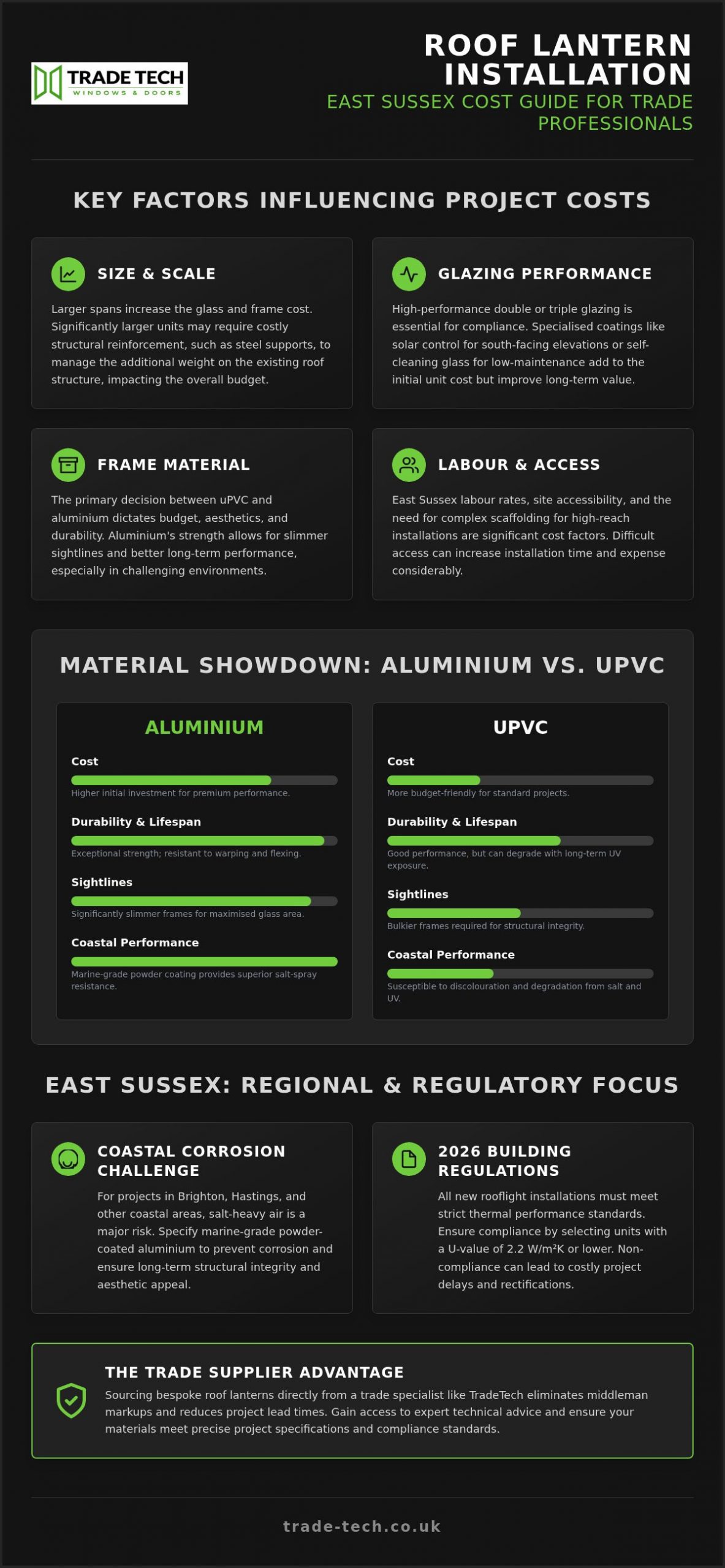
Frame material remains a decisive factor for both aesthetics and durability. While uPVC offers a budget-entry point for standard residential work, aluminium is the trade standard for modern East Sussex developments. Aluminium’s high strength-to-weight ratio allows for narrower sightlines and larger glass panes without bulky support bars. For a deeper architectural overview of a roof lantern, historical designs often used timber; however, 2026 standards favour thermally broken metal or high-grade polymers for longevity and weather resistance.
Size and Scale Considerations
Scaling a lantern isn’t a linear cost increase. Larger spans often cross a threshold where standard timber joists require steel reinforcement to manage the dead weight of the glass. This structural prep can significantly increase the effective roof lantern installation cost East Sussex installers must quote to remain compliant. Choosing bespoke roof lanterns allows for a precise fit to existing apertures, potentially avoiding expensive roof remodelling. Height and pitch also play roles. A steeper pitch increases the surface area of the glass, which raises material costs and affects the wind load calculations for coastal sites.
Glazing Performance and Thermal Efficiency
Thermal performance is no longer optional. Under 2026 Building Regulations, rooflights must achieve a maximum U-value of 2.2 W/m²K. Achieving this often requires high-performance double glazing or triple-glazed units. While triple glazing adds weight and upfront expense, it’s a vital consideration for projects prioritising long-term energy efficiency and occupant comfort.
Performance coatings add further layers to the budget. South-facing extensions in areas like Eastbourne require solar control glass to prevent the “greenhouse effect” during summer months. Similarly, self-cleaning glass is a practical investment for high-reach roofs where manual maintenance is difficult. These specifications ensure the installation remains functional and comfortable, protecting the long-term value of the development. Investing in the right glass spec now prevents costly retrofitting later.
Material Costs: Comparing Aluminium and uPVC Frameworks
For developers seeking additional ways to manage solar gain or enhance privacy on existing installations, professional window films can be a highly effective solution. To see how these treatments are applied to residential and commercial glazing, you can learn more about Mr Tint and their specialist film services.
For contractors and developers in the South East, the material choice is the most significant variable in the roof lantern installation cost East Sussex projects incur. It isn’t just about the initial invoice; it’s about risk management and long-term site performance. uPVC represents the budget-friendly entry point for standard residential work. It’s functional, efficient, and cost-effective. However, aluminium has become the dominant choice for modern architectural projects. While uPVC units are often cheaper to procure, aluminium provides the structural integrity required for expansive spans. Referencing the latest construction material prices confirms that while metal costs fluctuate, the performance gap justifies the investment for high-end builds.
The Benefits of Aluminium for South East Projects
In coastal towns like Brighton, Hastings, or Eastbourne, standard materials often fail prematurely. Aluminium lanterns feature high-grade powder-coated finishes. These resist salt-spray corrosion far better than polymer alternatives. The frames are significantly slimmer. This allows for more natural light and less visible bulk. It creates the high-end, minimalist aesthetic that premium buyers expect in 2026. For developers, this translates to better ROI. The unit won’t warp, flex, or discolour under intense coastal UV exposure. It’s a “fit and forget” solution that protects your professional reputation.
UPVC: Efficiency and Value
Don’t dismiss uPVC for mid-market developments. It remains an excellent choice for standard extensions where the budget is the primary driver. Modern uPVC lanterns utilise advanced multi-chambered thermal break technology. They’re designed to keep heat in and external noise out. They’re also virtually maintenance-free. This makes them ideal for high-volume rental developments or social housing projects. If your project already specifies uPVC casement windows, matching the lantern material ensures visual consistency across the property. It keeps the total roof lantern installation cost East Sussex installers quote within manageable limits for competitive tenders.
Colour customisation also influences the final trade price. Standard white or anthracite grey are the most economical options. Bespoke RAL colours add a premium and typically increase lead times. For a project to remain on schedule and within budget, choosing stock colours is often the smarter trade move. If you’re currently pricing a project, you can access our trade pricing to compare the current cost difference between these material tiers accurately.
Labour and Additional Installation Expenses
Calculating the roof lantern installation cost East Sussex developers encounter requires more than just a unit price. Professional labour and site preparation often represent a significant portion of the total tender. While some general builders offer glazing services, specialist installers bring the precision required for complex structural apertures and high-performance seals. This ensures the unit remains watertight and thermally efficient for decades. It’s about protecting your professional reputation and avoiding costly call-backs.
South East Labour Rate Benchmarks
Labour rates across the South East aren’t uniform. Projects in Brighton or Lewes often carry a regional premium compared to inland rural sites. This reflects the higher overheads and logistical challenges of urban coastal work. We recommend using FENSA-registered professionals. This certification guarantees that the installation meets current Building Regulations. A standard fit-out typically takes two to three days. This timeline assumes the aperture is already prepared and ready for the frame.
Structural alterations are a primary cost driver. If you’re creating a new opening or enlarging an existing one, the roof requires reinforcement. This often involves installing timber headers or steel beams to support the weight of the new lantern. These structural requirements can push the total roof lantern installation cost East Sussex contractors provide higher than a simple replacement project. Scaffolding is another essential factor. For multi-storey properties, safe access is a legal requirement. Don’t overlook site clearance. The disposal of old glazing units and structural debris adds a logistical layer that must be accounted for in your initial budget.
Ancillary Costs: Blinds and Automation
Modern specifications often include integrated technology to enhance occupant comfort. Integral blinds are a popular trade choice for south-facing extensions. They provide privacy and shade without the maintenance issues of traditional curtains. You should also consider the cost difference between manual and electric opening mechanisms. Automated systems allow for easy ventilation in high-reach areas. Finally, ensure your quote includes trickle vents. These are essential for meeting the ventilation requirements of Part F Building Regulations in 2026. These small details ensure the project remains compliant and functional.
East Sussex Regional Considerations and Regulations
East Sussex presents a unique set of geographical challenges that directly impact project specifications. You can’t apply a generic national cost average here. The roof lantern installation cost East Sussex projects require must account for salt-spray resistance and significant wind loads. In exposed South Downs locations, the pressure on glazing is intense. Standard units often fail if they aren’t engineered for these specific conditions. Proactive planning for these environmental factors prevents premature material degradation and ensures the longevity of the installation.
Compliance with 2026 Building Regulations is mandatory for every professional project. As of August 2026, rooflights must achieve a maximum U-value of 2.2 W/m²K to meet energy efficiency standards. This ensures thermal efficiency and prevents excessive heat loss in large open-plan extensions. In conservation hubs like Lewes and Rye, heritage constraints often dictate the frame profile and material choice. You must verify local Article 4 directions before commencing work. These directions can remove permitted development rights, requiring full planning applications for even minor external alterations.
Planning Permission and Permitted Development
Most roof lantern installations fall under Permitted Development, which helps keep the roof lantern installation cost East Sussex developers face more predictable. However, you must strictly follow the 150mm rule. The unit cannot project more than 150mm from the roof plane. It also cannot be higher than the highest part of the existing roof. If you’re working on a listed building, full planning approval and listed building consent are almost always required. Don’t risk starting without these approvals; enforcement action in East Sussex can be stringent and costly to rectify.
Coastal Durability and Maintenance
Seafront properties in Brighton and Hastings face constant salt-spray exposure. This makes aluminium the preferred trade choice over uPVC or timber. Its powder-coated finish provides a robust barrier against corrosion and pitting. Maintenance is critical for warranty compliance. Regular cleaning of the frames and glass prevents salt build-up. Specifying high-performance sealed units is essential for high-wind areas. These units are engineered to withstand the cyclic pressure of coastal storms without seal failure. They provide the structural stability required for the exposed South East coastline.
Request a technical specification for your East Sussex site
Sourcing from Trade Tech Windows & Doors: Competitive Pricing for Professional Projects
Sourcing directly from a specialist trade supplier is the most effective way to control the roof lantern installation cost East Sussex developers manage. Retail showrooms add significant markups to cover their extensive overheads. We eliminate those margins. Our direct-to-trade model prioritises speed, accuracy, and technical proficiency. You deal with specialists who understand the logistical pressures of the South East construction industry. This streamlined procurement ensures your project stays on schedule and within its allocated budget. We focus on delivering high-performance units that meet 2026 specifications without the typical retail friction.
The Trade Tech Windows & Doors Advantage for Developers
Efficiency drives profitability. Trade Tech Windows & Doors provides proactive support from the initial design phase through to final building control sign-off. By accessing trade pricing, you secure a competitive edge on tenders for bulk or repeat orders. We don’t just supply units; we provide technical solutions. This includes coordinating your lantern installs with aluminium bi-folding doors to ensure matching sightlines and uniform finishes. It’s a comprehensive approach that reduces on-site friction and ensures every glazing element arrives exactly when your installation team needs it.
Our team is intimately familiar with East Sussex geography. We understand the specific requirements for projects in the High Weald or along the exposed coastline. This local expertise allows us to provide bespoke specifications that match your exact project requirements. Trade Tech Windows & Doors prioritises fast turnaround times without compromising on high-performance standards. We understand that a delayed delivery can stall an entire build. It’s a partnership built on reliability, precision, and a deep understanding of the local trade environment.
Ready to Start Your Project?
Securing an accurate quote is the first step toward a successful installation. We offer a direct, no-nonsense path to procurement. You can view our full range of roof lights and roof lanterns online to identify the best fit for your development. This transparency allows you to calculate the total roof lantern installation cost East Sussex sites demand with absolute precision. Our expert team is available for technical consultations to discuss U-values, wind loads, and structural prep. We provide the detailed data you need to satisfy building inspectors and clients alike.
Don’t leave your project budget to chance. Contact us today to request a professional quote for your East Sussex site. We provide the tools and technical advice necessary for you to succeed in a competitive market. Our focus remains on delivering excellence, efficiency, and stable foundations for your professional projects. Trust the experts who speak your language and respect your deadlines.
Securing Excellence for Your East Sussex Development
Managing the roof lantern installation cost East Sussex projects incur requires a focus on material longevity and regulatory precision. You’ve seen how aluminium’s coastal resistance provides superior ROI compared to budget alternatives in high-exposure areas. Adhering to 2026 thermal standards ensures your build remains compliant, comfortable, and efficient. Every decision, from structural reinforcement to glazing specification, impacts the final project value and your professional reputation.
Partnering with a specialist South East trade supplier like Trade Tech Windows & Doors provides the technical support and FENSA-registered installation expertise necessary for high-stakes projects. We deliver high-performance aluminium and uPVC options tailored to specific site requirements. Our direct trade model removes middleman markups, streamlines your procurement process, and ensures your tenders remain competitive without sacrificing quality. We prioritise fast turnaround times to keep your development on schedule and within budget.
Request a professional trade quote for your East Sussex project
We’re ready to support your next project with precision and efficiency. Let’s build something exceptional together.
Frequently Asked Questions
Do I need planning permission for a roof lantern in East Sussex?
Most installations in East Sussex don’t require planning permission as they fall under permitted development. You must ensure the lantern doesn’t project more than 150mm from the roof plane or exceed the highest part of the existing roof. Properties in conservation areas like Lewes or Rye often have stricter Article 4 directions. Always verify with local building control before starting. This prevents legal issues and ensures the roof lantern installation cost East Sussex developers pay remains a sound investment.
Is aluminium better than uPVC for a roof lantern in a coastal town like Eastbourne?
Aluminium is the professional standard for coastal towns like Eastbourne. Its high-grade powder-coated finish provides essential protection against salt-spray corrosion and intense UV exposure. While uPVC is a budget-friendly option, it lacks the structural integrity and durability required for exposed seafront sites. Aluminium frames are slimmer, allowing for larger glass areas. It ensures your project withstands the harsh, salty, South East weather for decades without warping or pitting.
How much does it typically cost to install a roof lantern on a flat roof?
The total cost varies based on dimensions, frame material, and structural requirements. Factors like the need for steel reinforcement or specialist scaffolding for multi-storey properties will influence the final quote. Every site in the South East has unique logistical challenges. Sourcing directly from a trade supplier helps reduce middleman markups. We recommend requesting a site-specific technical consultation to get an accurate breakdown of the professional roof lantern installation cost East Sussex projects require.
Will a roof lantern make my room too hot in the summer?
Modern roof lanterns won’t cause overheating if you specify solar control glass. These high-performance coatings reflect a high percentage of solar heat while maintaining excellent light transmission. This is vital for south-facing rooms in the sunny South East. You can also integrate opening mechanisms for purge ventilation. These features ensure the space remains comfortable throughout the summer months, while personal cooling units from FrostWave can offer additional comfort during extreme heatwaves. Occupant comfort is a priority for any professional development or extension.
A standard installation typically takes between two and three days for a professional two-person team. This timescale assumes that the structural aperture in the flat roof is already prepared and reinforced. If the project requires creating a new opening or installing steel beams, the duration will increase. Efficient coordination between the supplier and the site team is essential. It ensures the building remains watertight and the project moves quickly to the internal finishing stage.
Can I install a roof lantern on an existing conservatory roof?
You can’t usually install a heavy roof lantern directly onto a standard polycarbonate or glass conservatory roof. These structures aren’t designed to support the concentrated dead weight of a lantern frame. Most successful projects involve a solid roof conversion or a “warm roof” upgrade. This provides the structural stability required for the glazing. It’s a complex, technical, specialist task that needs careful load-bearing calculations to ensure safety and long-term performance.
What is the most energy-efficient glass for a roof lantern?
Triple glazing with low-emissivity (low-E) coatings is the most energy-efficient choice for 2026. These units are designed to meet or exceed the mandatory 2.2 W/m²K U-value required by current Building Regulations. High-performance double glazing with argon gas filling also provides excellent thermal retention. Choosing the right glass specification reduces heat loss in winter and prevents solar gain in summer. It’s a critical component for creating sustainable, year-round living spaces in East Sussex.
How do I maintain my roof lantern to ensure it lasts for decades?
Maintaining your roof lantern is straightforward but essential for warranty compliance. Clean the frames and glass twice a year with warm, soapy water and a non-abrasive cloth. This is particularly important for coastal properties where salt build-up can occur. Check the perimeter seals and drainage channels annually for debris. If your project includes self-cleaning glass, the maintenance requirement is significantly reduced. Regular inspections ensure the unit remains watertight and functional for its entire service life.