
A door that warps under the pressure of the Kent coast is more than a snagging issue; it is a direct threat to your professional reputation and project margins. You understand that delivering long-lasting kerb appeal requires more than just a stylish finish. It demands a product that stands up to salt air, fluctuating temperatures, and the increasingly rigorous standards of UK building regulations. Finding the right balance between aesthetic choice and technical performance is a constant challenge for modern contractors.
We recognise the frustration of navigating conflicting advice on GRP versus solid core options, especially when faced with long trade lead times that stall your progress. This 2026 guide simplifies the process. You will discover how to specify, source, and install high-performance composite front doors Kent developments require to meet the latest thermal requirements and PAS 24:2022 security standards. We provide the technical insight needed to ensure every installation offers maximum durability and efficiency.
From analysing the latest hero shades like Transformative Teal to understanding the impact of the September 2026 fire safety amendments, this article covers the essentials. We move quickly from regulatory theory to practical sourcing. You will learn how to streamline your supply chain and secure reliable, local trade support that keeps your Kent residential projects moving at pace.
Key Takeaways
- Understand why GRP skins are essential for resisting coastal corrosion and rural weather exposure across the Southeast.
- Compare the long-term maintenance cycles of timber with the superior price-to-performance ratio of modern composite materials.
- Learn how to specify composite front doors Kent developers require by conducting accurate aperture measurements and selecting the correct core density.
- Ensure full compliance with PAS 24:2022 security standards and thermal regulations by sourcing through specialist trade partners.
- Discover the logistical benefits of sourcing entrance doors alongside uPVC casement windows to streamline your project timeline.
Why Composite Front Doors are the Preferred Choice for Kent Properties
A composite door is not a single-material product. It is a highly engineered, multi-material solution designed to overcome the inherent weaknesses of traditional singular materials. By combining a high-density core with a robust outer skin, these composite doors provide structural integrity that timber or standard uPVC cannot match. Specifying high-performance composite front doors kent wide ensures that your developments maintain their integrity from the moment the first plot is sold. For developers and contractors, this translates to fewer call-backs and a product that maintains its performance for decades. It’s about delivering a “fit and forget” solution that withstands the test of time.
Resisting the Elements: Kent’s Coastal and Rural Challenges
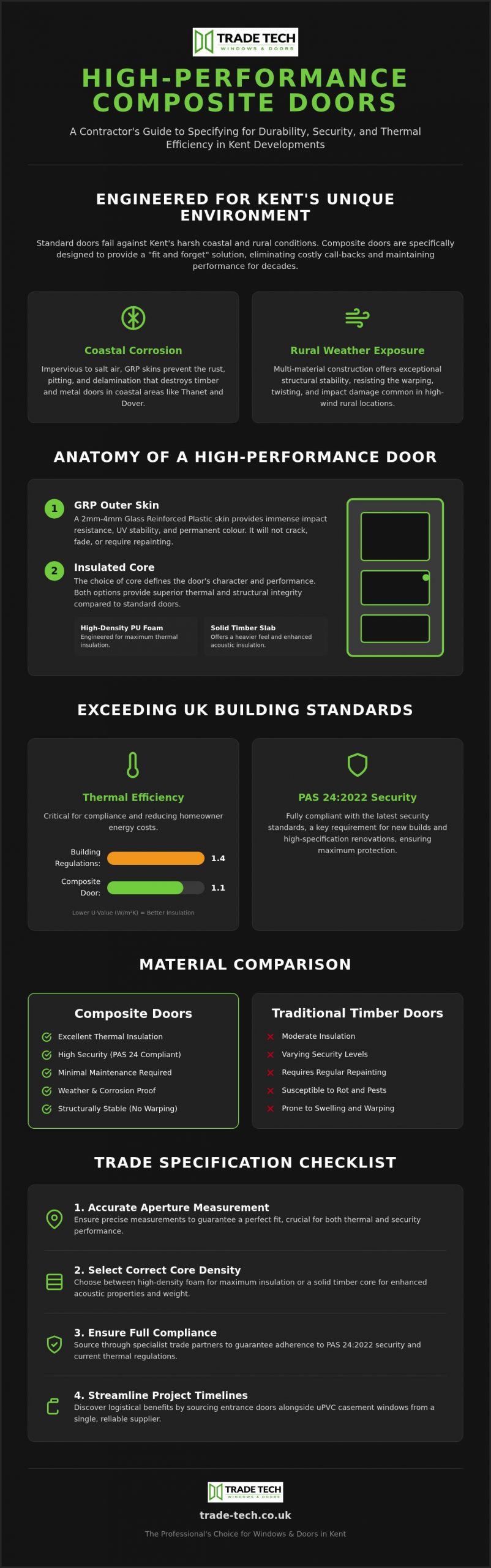
Kent’s geography presents unique challenges for external joinery. Coastal developments in areas like Thanet or Dover face constant salt-air corrosion. This environment quickly degrades traditional paint finishes and causes timber to swell or delaminate. Conversely, rural projects in the Weald must withstand high wind-loading and driving rain. The GRP (Glass Reinforced Plastic) skins used in professional composite front doors kent installations are impervious to these conditions. They don’t warp, rot, or twist. This “Kent-ready” durability ensures the door remains functional and weather-tight regardless of the exposure level.
Key performance benefits for Kent projects include:
- Corrosion Resistance: GRP skins won’t rust or pit in saline environments.
- Structural Stability: Multi-material construction prevents the seasonal movement common in solid wood.
- Impact Resistance: The outer skin protects against debris in high-wind rural areas.
Kerb Appeal and Property Value in the Kent Market
First impressions dictate property value. A high-quality entrance serves as a focal point for new-build developments, signalling quality throughout the entire build. Modern buyers in the Southeast are increasingly discerning. They look for specific aesthetic trends that blend with local architecture. Anthracite Grey remains a dominant choice for contemporary designs. Chartwell Green is frequently favoured for traditional or rural settings.
By selecting from a versatile Composite Doors range, you can match the architectural character of any project. This flexibility allows you to maintain a consistent design language across multiple plots. It ensures every unit benefits from professional-grade security and thermal performance. Investing in high-specification entrances isn’t just about aesthetics; it’s a strategic move to enhance the marketability of the development. Quality doors suggest a quality build.
Technical Specifications: What Defines a High-Quality Composite Door?
High-specification engineering distinguishes professional-grade units from standard retail alternatives. When specifying composite front doors kent developers must look beyond the surface. A high-quality door relies on a synergy between its core, its skin, and its structural frame. Most industry-leading options utilise either a high-density polyurethane (PU) foam core or a solid timber slab. GRP (Glass Reinforced Plastic) skins, typically 2mm to 4mm thick, encapsulate these cores to provide immense impact resistance and permanent colour longevity. This construction ensures the unit remains immune to the bleaching effects of UV rays and the mechanical stress of daily use.
Core Strength and Thermal Integrity
The choice of core significantly impacts the unit’s thermal performance and weight. High-density foam cores are engineered for maximum insulation, often achieving U-values as low as 1.1 W/m²K. This performance is critical for meeting the latest Building Regulations for doors, which currently require a maximum U-value of 1.4 W/m²K for replacements. Solid timber cores offer a heavier, more traditional feel and enhanced acoustic insulation; this is vital for developments near busy Kent transport links. Thermal breaks within the door frame further prevent cold bridging, ensuring the entrance remains a barrier against heat loss rather than a weak point in the building envelope.
Advanced Security and PAS 24 Standards
Security is the primary concern for modern homeowners and insurers. For new dwellings in Kent, all accessible doors must meet the PAS 24:2022 security standard. This involves rigorous testing against simulated forced entry. High-quality composite doors feature multi-point locking systems as standard, engaging hooks and deadbolts into a reinforced steel or aluminium frame. When sourcing composite front doors kent trade professionals should prioritise units that feature these integrated hardware solutions.
We recommend choosing units that include anti-pick, anti-drill, and anti-snap lock cylinders to mitigate the most common burglary methods. These technical refinements provide the quiet confidence that a development is secure from day one. If you are currently drafting a project specification, you can view our full technical range to see how these security features integrate with various door styles. By selecting a unit where the frame and door slab are designed to work together, you eliminate the alignment issues that often plague inferior products.
Comparing Composite Doors with Traditional Timber and uPVC Alternatives
Selecting the correct material for a development involves balancing initial capital expenditure against long-term performance. Whilst timber was once the standard for premium Kent properties, the professional consensus has shifted towards engineered solutions. Timber requires biennial repainting or restaining to prevent moisture ingress. Without this rigorous maintenance, natural grain is susceptible to twisting and swelling, leading to costly post-completion snagging issues. In contrast, the GRP skins found on composite front doors kent professionals specify are designed to remain maintenance-free for their entire 25 to 30 year lifespan.
Composite vs Timber: The Professional Verdict
The primary advantage of composite over timber is structural stability. Natural wood moves in response to Kent’s humidity levels. This creates alignment problems that compromise both security and weather-sealing. Engineered cores, whether solid timber or high-density foam, provide a stable foundation that does not react to environmental changes. This reliability is why many contractors now refer to The Professional Guide to Composite Door Suppliers when planning new-build specifications. You gain the aesthetic warmth of wood without the associated structural liabilities or the need for constant homeowner intervention.
Composite vs uPVC: Performance and Aesthetics
Developers frequently distinguish between different elevations by choosing composite for front entrances and uPVC Doors for rear exits. This strategy manages the budget whilst ensuring the primary kerb-side impression remains high-end. Standard uPVC is lightweight and cost-effective, but it lacks the “heft” and tactile quality buyers expect from a main entrance. A composite unit offers superior impact resistance due to its reinforced outer skin, making it far more difficult to breach than a standard uPVC panel.
Thermal efficiency also varies significantly across these materials. Whilst modern uPVC is a capable insulator, the multi-layered construction of a composite slab typically achieves better U-values, often exceeding the requirements set out in the UK Building Regulations for Doors. Aluminium is another contender, often used for commercial shopfronts or bi-folds. However, for a residential front entrance, composite often provides a better price-to-performance ratio. It delivers the thermal performance of high-end aluminium at a more accessible price point for large-scale Kent developments. You get a robust, secure, and thermally efficient entrance that matches the longevity of the building itself.
Sourcing and Specifying Composite Doors for Kent Trade Projects
Precision in procurement is the difference between a profitable project and a logistical nightmare. When specifying composite front doors Kent, trade professionals must follow a methodical approach to ensure the unit performs exactly as intended. Unlike timber, composite slabs are engineered to a finished size and cannot be planed or modified on-site. This makes the initial site survey and aperture measurement the most critical phase of the installation. A small error in measuring the structural opening can lead to alignment issues that compromise the unit’s thermal seal and security rating from day one.
Follow these four steps to ensure a seamless procurement process:
- Step 1: Professional Site Survey. Double-check the structural opening for squareness. Account for floor levels and threshold requirements to ensure a perfect fit without excessive packing.
- Step 2: Core and Glazing Specification. Select a high-density foam core for maximum thermal performance or solid timber for a heavier, traditional feel. Ensure all glass units are toughened for safety.
- Step 3: Hardware Selection. Choose handles, letterboxes, and knockers that meet high durability standards. For coastal Kent, specify hardware with advanced salt-spray resistance to prevent pitting.
- Step 4: Logistic Verification. Confirm current trade lead times with your supplier. Align delivery schedules with your installation team to avoid on-site storage risks and potential damage.
Technical Specification for Developers
Efficiency in design often involves coordinating multiple glazing elements simultaneously to maintain a consistent aesthetic. For a cohesive exterior, many developers match their door styles with uPVC Casement Windows to create a unified architectural language across the development. When specifying decorative glass, ensure you are ordering high-performance Sealed Units that don’t compromise the door’s overall U-value. Every specification must strictly comply with Part L of the Building Regulations. This ensures the property meets modern thermal efficiency targets and avoids regulatory delays during building control inspections.
Logistics and Trade Supply Efficiency
Time is your most valuable asset on a construction site. Sourcing from a local Kent Trade Window Supplier significantly reduces the risk of site delays caused by long-distance transport issues. Direct trade supply is a procurement method that removes retail mark-ups and middleman delays to streamline project procurement. Just-in-time delivery ensures that composite front doors Kent-based projects aren’t cluttered with fragile stock before the site is ready for installation. This proactive approach to logistics keeps your margins protected and your timelines intact across the Southeast.
Request a trade quote for your Kent development
Efficient Installation and Supply: The Trade Tech Windows & Doors Advantage in Kent
Trade Tech Windows & Doors serves as the specialist foundation for residential and trade projects across the Southeast. We understand that your professional reputation depends on the quality and durability of the units you install. By providing high-performance composite front doors kent developers can rely on, we eliminate the common friction points of supply and installation. Our expertise extends beyond residential entrances to include comprehensive Commercial Glazing and shopfronts. This dual capability makes us a versatile partner for mixed-use developments where consistency across different glazing types is mandatory. We focus on delivering stability and speed to ensure your project stays on track. We pride ourselves on our responsiveness. Your enquiries are handled with the urgency that the construction industry demands.
Comprehensive Glazing Solutions
Managing multiple suppliers leads to fragmented timelines and logistical errors. Sourcing Aluminium Windows and composite doors from Trade Tech Windows & Doors ensures technical compatibility and synchronised delivery. We offer specialised components like Integral Blinds for side panels, providing a maintenance-free finish for modern buyers. Our professional survey service uses technical assessments to verify aperture dimensions before production. This prevents on-site adjustments that stall progress. By centralising your glazing procurement, you reduce the administrative burden and ensure a unified aesthetic across all elevations.
Your Reliable Partner in Kent and East Sussex
We provide a no-nonsense, professional service tailored specifically for the technical demands of the trade. We are a supportive partner with deep local knowledge of Ashford, Maidstone, and the wider Kent region. This regional focus allows us to provide responsive support and logistical accuracy that national suppliers often fail to match. We prioritise the needs of New Build Contractors and Developers who require precision, speed, and technical proficiency. Our team understands the pressures of site deadlines and works proactively to protect your project timelines.
If you are currently planning a project and require a dependable supply of composite front doors kent wide, our technical team is ready to assist. We offer the stable foundation your project needs to succeed on time and within your set budget. You can Contact Us today for a detailed technical consultation or a competitive trade quote. We focus on delivering the tools and professional advice you need to maintain your excellence in the field. Our commitment to reliability ensures that your supply chain remains robust. This allows you to focus on the broader demands of your development.
Future-Proofing Your Kent Developments
As building regulations tighten and homeowner expectations rise, the choice of entrance door becomes a technical decision rather than a purely aesthetic one. You’ve explored how GRP skins and engineered cores mitigate the specific climatic pressures of the Southeast, from coastal salt air to rural wind-loading. By selecting high-performance units that meet PAS 24:2022 standards, you ensure every development is secure and thermally efficient from the first day of occupation. Sourcing the composite front doors kent projects require shouldn’t be a source of delay or technical confusion.
Trade Tech Windows & Doors provides the expert technical support and logistical precision required to navigate these complexities. We serve as a dedicated partner for contractors and developers, delivering professional-grade security and reliability across Kent and East Sussex. Our commitment to accuracy and speed ensures your builds move forward without the friction of supply chain failures.
Request a Professional Trade Quote for Composite Doors
Let’s build a more secure and durable residential landscape together. We’re ready to support your next development with glazing solutions that maintain their excellence for decades to come.
Frequently Asked Questions
What is the typical lifespan of a composite front door in Kent?
A high-quality composite door typically lasts for 30 years or more with minimal maintenance. This longevity outperforms traditional timber, which often requires repainting every few years to prevent rot. The GRP skin ensures the colour remains vibrant without fading. For composite front doors kent properties often require, this durability is essential to withstand coastal salt air and rural wind exposure. You only need to wipe the surface with warm soapy water occasionally.
Are composite doors more secure than uPVC or timber?
Composite doors offer superior security compared to standard uPVC or solid timber units. Their multi-layered construction makes them incredibly difficult to breach through brute force. Most units are tested to PAS 24:2022 standards and feature multi-point locking systems as standard. This provides developers with the quiet confidence that their properties are protected. The combination of a reinforced frame and a high-impact outer skin creates a formidable barrier against unauthorised entry.
Do composite doors require a specific type of frame for installation?
Yes, composite doors must be installed within a specifically engineered, reinforced outer frame to support the slab’s weight. These frames are typically constructed from heavy-duty uPVC with steel or aluminium reinforcements. Using a standard uPVC frame intended for a lighter panel will lead to sagging and alignment issues over time. Professional trade suppliers provide the door and frame as a matched, pre-hung unit to ensure the thermal seals and locking points align perfectly.
Can I customise the glazing and hardware for a trade project?
Trade projects allow for extensive customisation of both glazing and hardware to meet specific architectural requirements. You can choose from a variety of toughened glass patterns and high-performance sealed units. Hardware options include various finishes like polished chrome or brushed steel for handles, letterboxes, and knockers. This flexibility ensures that composite front doors kent contractors specify can match the unique character of any development, from contemporary apartments to traditional rural cottages.
What are the latest thermal efficiency requirements for front doors in 2026?
The current thermal efficiency requirement for replacement doors in existing homes is a maximum U-value of 1.4 W/m²K. For new-build properties, the Future Homes Standard targets a much lower U-value of 0.8 W/m²K. Most professional-grade composite doors easily achieve values between 1.1 and 1.4 W/m²K. Developers must verify that their chosen door specification meets these Part L regulations to avoid complications during building control inspections and ensure the property’s energy performance certificate is accurate.
How do composite doors perform in high-traffic commercial environments?
Composite doors are highly resilient in high-traffic residential environments like apartment block entrances. Their GRP skins resist scratches and impacts better than timber or uPVC. However, for extreme commercial traffic such as retail shopfronts, aluminium entrance doors are often more suitable due to their structural rigidity. For standard residential developments, the composite option provides the best balance of durability, aesthetics, and thermal insulation. It maintains its appearance even under constant daily use by multiple residents.
Is it possible to match the door colour with existing aluminium or uPVC windows?
You can achieve a perfect colour match between your composite door and existing window frames using RAL colour codes. Many manufacturers offer standard finishes like Anthracite Grey or Chartwell Green that align with common uPVC and aluminium profiles. For bespoke requirements, professional suppliers provide a spray-matching service. This ensures the entrance door integrates seamlessly with the overall glazing package of the property, maintaining a consistent design language across the entire building exterior.
What is the difference between a GRP skin and a solid core composite door?
A GRP skin is the protective outer layer made of glass-reinforced plastic, whilst the core refers to the internal insulating material. Most composite doors use either a high-density polyurethane foam core for maximum insulation or a solid timber core for added weight and acoustic performance. The GRP skin is bonded to this core to provide impact resistance and a weatherproof finish. Understanding this distinction helps developers choose the right specification for their specific project needs.