
Meeting the 1.4 W/m²K U-value limit for replacement glazing whilst maintaining a slim, 1930s-style profile is no longer just a design challenge; it’s a regulatory requirement that can halt site progress. You understand the pressure to deliver the iconic, industrial look your clients demand without sacrificing thermal efficiency or project timelines. Inconsistent quality and delayed deliveries from mass-market suppliers shouldn’t be the bottleneck in your high-end builds. Heritage aluminium windows offer the perfect bridge between historic aesthetics and modern performance, provided you have the right technical data and a reliable supply chain.
This article provides the essential specifications, aesthetic benefits, and procurement logistics needed to master heritage aluminium windows for trade projects across Kent and East Sussex. We will examine how to achieve those sought-after slim sightlines whilst meeting strict 2026 Building Regulations. You’ll also learn how to streamline your site delivery and partner with a supplier that respects your schedule. From navigating the Future Homes Standard to perfecting the “Crittall” look, this guide ensures your next installation is both compliant and visually stunning.
Key Takeaways
- Master the 2026 Part L technical requirements, ensuring your installations meet the mandatory 1.4 W/m²K U-value for replacement glazing.
- Achieve the iconic industrial look with heritage aluminium windows that combine ultra-slim sightlines with advanced polyamide thermal breaks for superior efficiency.
- Navigate the design nuances between Astragal and Georgian bars to deliver authentic multi-pane aesthetics for high-end heritage renovations.
- Optimise site logistics by understanding realistic procurement timelines and the critical role of precision surveying in avoiding installation delays.
- Streamline your supply chain by sourcing matching aluminium bi-folding doors and roof lanterns from a specialist trade partner in Kent and East Sussex.
What defines Heritage Aluminium Windows in 2026?
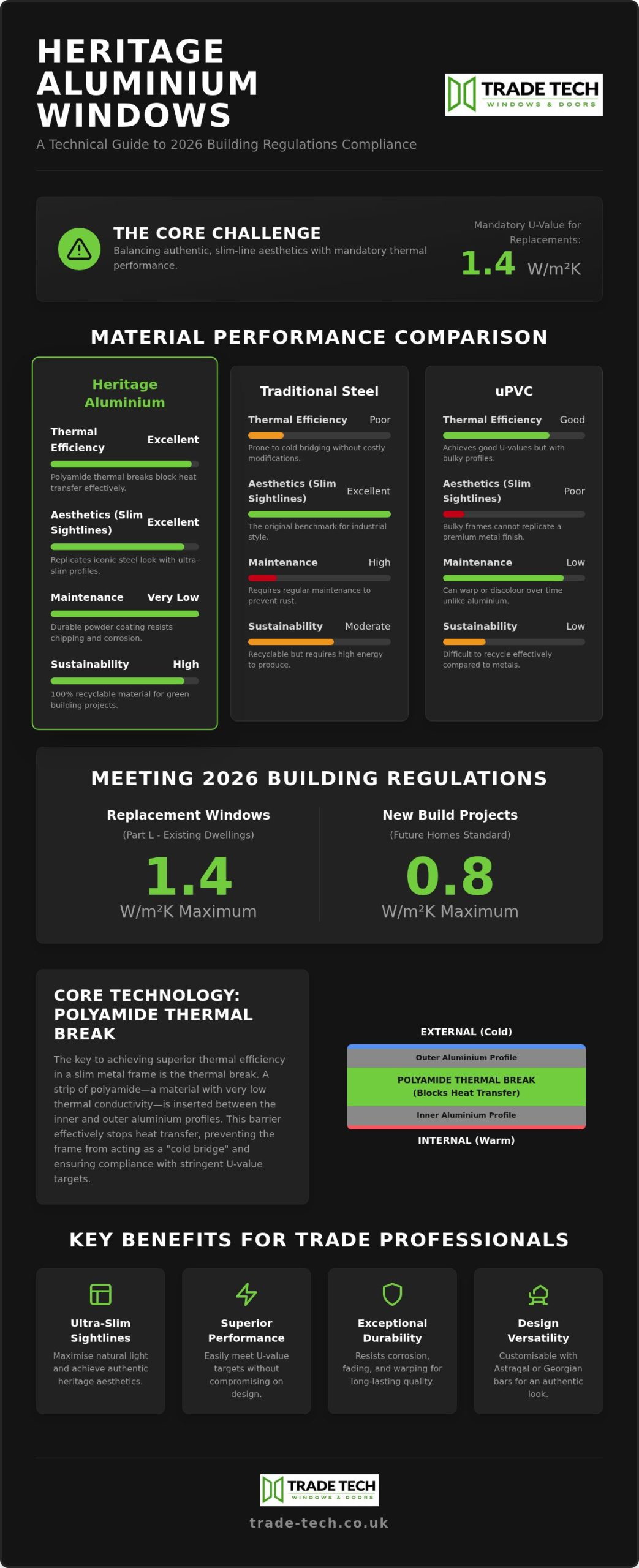
Developers across Kent and East Sussex are increasingly rejecting uPVC for high-end period renovations. The bulky profiles of plastic frames often fail to capture the delicate, industrial charm of original metal-framed buildings. While the History of metal windows is rooted in solid steel, modern Heritage aluminium windows provide a more versatile and thermally efficient alternative. These systems utilise advanced polyamide thermal breaks to separate the inner and outer window profiles. This technology effectively blocks heat transfer, allowing the frames to meet the 1.4 W/m²K requirements mandated in 2026 without the excessive depth required by uPVC.
Traditional steel windows, whilst beautiful, often struggle to meet the strict energy standards of the Future Homes Standard without becoming prohibitively expensive. Aluminium bridges this gap. It offers the same iconic slim sightlines and multi-pane aesthetic but adds the benefit of modern weather sealing and high-performance glazing. For a trade professional, this means you can offer a product that satisfies both the conservation officer’s eye and the building inspector’s report.
The Evolution of the Slim-Line Profile
Modern metallurgical engineering allows for incredibly slim frames that maintain high structural integrity. This is vital for developers working in conservation areas where planning officers scrutinise every millimetre of a window’s sightline. By reducing the frame width, you maximise the glazed area and natural light. Heritage aluminium is the intersection of 1930s design and 21st-century performance. These profiles are designed to replicate the “stepped” look of original steel windows, ensuring that new installations don’t look out of place in Victorian or Art Deco properties.
Material Benefits: Why Aluminium Over Steel or uPVC?
Durability remains the primary reason for choosing aluminium. High-quality powder coating provides a finish that resists chipping, fading, and corrosion, even in the salt-heavy coastal environments of the South East. Unlike steel, which requires regular maintenance to prevent rust, Aluminium Windows are virtually maintenance-free. They won’t warp or expand like uPVC, ensuring the hardware continues to operate smoothly for decades.
- Sustainability: Aluminium is 100% recyclable, which helps you meet the sustainability credentials required for modern green building projects.
- Precision: Extruded profiles offer tighter tolerances than timber or hand-welded steel, making site installation faster and more predictable.
- Aesthetics: Sharp, clean lines provide a premium finish that uPVC simply can’t replicate.
Specifying Heritage aluminium windows ensures your project maintains its architectural integrity whilst meeting the latest energy standards. It’s a high-performance solution that adds tangible value to any high-end renovation or new build.
Technical Specifications: Compliance and Building Regulations
Specifying Heritage aluminium windows requires more than an eye for design; it demands a rigorous approach to technical compliance. In a professional trade environment, you need products that don’t just look the part but also satisfy the increasingly strict demands of local building control. The 2026 update to Building Regulations, specifically Statutory Instrument 2026/335, has established clear benchmarks for thermal performance that every contractor in Kent and Sussex must meet.
For replacement windows in existing residential properties, the maximum allowable U-value is currently 1.4 W/m²K. New build projects face even tougher targets under the Future Homes Standard, which requires a maximum U-value of 0.8 W/m²K. These figures aren’t just suggestions; they are mandatory requirements that require a building regulations certificate for every installation. Failing to meet these targets can lead to significant site delays and costly remedial work.
Thermal Performance and U-Values
Achieving these targets relies on the quality of the thermal break. Polyamide strips are inserted between the internal and external aluminium profiles to prevent cold bridging, ensuring the metal frame doesn’t act as a conductor for heat loss. This engineering allows a slim-line frame to perform as effectively as a much deeper uPVC alternative. High-performance Sealed Units are the final piece of the puzzle, using low-emissivity glass and argon-filled cavities to trap heat inside the building.
Weather performance ratings are equally vital for projects in exposed coastal or rural areas. Heritage aluminium windows are tested to rigorous standards for air permeability, water tightness, and wind resistance. This ensures that even with ultra-slim sightlines, the installation remains draught-free and structurally sound during the unpredictable storms common in the South East.
Security and Hardware for Trade Projects
Security is a primary concern for developers and homeowners alike. We provide multi-point locking systems as standard across our range, ensuring the sash is secured at multiple points along the frame. These systems are designed to meet PAS 24 standards, providing peace of mind without compromising the aesthetic integrity of the window. Document Q compliance is non-negotiable for new-build developments.
Glazing choice is often dictated by the specific U-value target of your project. Triple glazing is becoming a standard expectation for new builds aiming for the 0.8 W/m²K limit, even though it can cost 15% to 20% more than double glazing. For the majority of replacement projects, our high-spec double glazing comfortably meets the 1.4 W/m²K requirement, offering a balance of performance and cost-efficiency. If you are planning a complex project, you can request a technical trade price list to review our full range of compliant options.
Design Versatility: Customising Heritage Windows for Kent Projects
Aesthetic precision is the hallmark of high-end trade projects. While standard aluminium frames provide a modern, minimalist look, Heritage aluminium windows are specifically engineered to replicate the architectural language of the early 20th century. This goes beyond mere slimness. It involves a specific “stepped” frame profile and the use of authentic bar configurations that mimic original steel putty lines. For developers in Kent and East Sussex, this versatility allows for the sympathetic restoration of industrial warehouses, Art Deco residences, and Victorian school conversions without the maintenance burden of timber or the thermal failings of old metal frames.
Customisation starts with the frame configuration. Depending on the ventilation and access requirements of your site, you can specify various opening styles. Fixed frames provide the slimmest possible profile for non-opening areas, whilst casement and tilt-and-turn options offer practical functionality without disrupting the visual rhythm of the facade. These systems integrate seamlessly with other architectural elements, such as roof lanterns, allowing you to maintain a consistent heritage theme across an entire property extension or new-build development.
Astragal Bars and Sightline Details
The multi-pane look is central to the heritage aesthetic. In modern glazing, this is achieved through Astragal bars. These are surface-mounted onto the glass on both the internal and external faces, with a dummy spacer bar located inside the sealed unit. This technique creates the convincing illusion of individual small panes of glass whilst allowing the window to benefit from the thermal performance of a single, large high-performance unit. Using these bars ensures you can specify Casement Windows that satisfy strict conservation requirements regarding sightline depth and shadow lines.
Colour and Finish: The Power of Powder Coating
While matt black (RAL 9005) and anthracite grey (7016) remain the most popular choices for an industrial look, the design potential of powder coating is much broader. High-end projects often require bespoke RAL colours, such as deep bronze, agate grey, or even heritage creams, to match existing masonry or historical palettes. For sites along the Sussex coastline, we recommend marine-grade finishes. These coatings are specifically tested to withstand salt-heavy environments, preventing the bubbling and corrosion that can plague inferior products.
Dual-colour options are another vital tool for the professional installer. You can specify a bold heritage colour for the exterior to satisfy planning officers, whilst choosing a neutral white or light grey for the interior to match the client’s internal decor. This flexibility is a key reason why specifiers prefer High-Performance Aluminium Windows for Kent & Sussex Developers over more restrictive materials. By matching the finish to the specific environmental and aesthetic needs of the project, you ensure a premium result that lasts for decades.
Professional Procurement: Lead Times and Site Logistics
Procuring Heritage aluminium windows requires a methodical approach to ensure site progress remains on track. Lead times for bespoke aluminium can fluctuate based on the complexity of the RAL finish and specific hardware requirements. For developers in Maidstone, Ashford, and Brighton, sourcing through a local specialist provides a significant logistical edge. It reduces the risk of long-distance transport damage and simplifies the coordination of site deliveries. With material costs having risen by over 18% since 2021, protecting your margins means avoiding the delays caused by unreliable supply chains.
Site logistics for high-value glazing require careful planning. Unlike bulkier uPVC frames, slim-line heritage profiles require specific handling to prevent racking or misalignment during storage. We recommend ensuring all units are kept on suitable glass stillages and protected from site debris until the moment of installation. This proactive approach prevents the need for costly remakes that could derail a tight construction schedule. Effective communication between the site manager and the supplier ensures that deliveries coincide with the arrival of the fitting team, minimising double-handling.
Streamlining the Supply Chain
Sourcing direct from a trade specialist eliminates the communication errors common with multi-tiered retail suppliers. You deal directly with technical experts who understand the nuances of the 2026 Building Regulations. This professional support is invaluable during the specification phase, helping you select the correct profiles and hardware for your project’s specific wind load and thermal requirements. Direct procurement also allows for more accurate forecasting of project timelines, which is essential for managing client expectations in high-end builds.
Access our latest trade price list
Installation Best Practices for Trade Professionals
Accurate surveying is the foundation of a zero-defect installation. Even a minor discrepancy in the aperture measurements can compromise the thermal integrity of the window or lead to issues with the multi-point locking system. During the fitting process, maintaining the thermal break’s integrity is vital. Use high-quality perimeter seals and insulated packers to prevent thermal bridging around the frame. This ensures that the high-performance window performs exactly as specified in the technical data sheets once installed.
Handling slim-line frames requires precision. Use appropriate suction lifters for larger units to prevent undue stress on the corner joints. Once the frame is plumb and level, ensure the sash is properly “toed and healed” to maintain long-term operational smoothless. This level of attention to detail ensures the installation meets the aesthetic and security standards expected by developers in the South East.
Request a technical consultation for your Kent or Sussex site
Why Specifiers Choose Trade Tech Windows & Doors for Heritage Aluminium
Trade Tech Windows & Doors operates as a dedicated trade partner for the Kent and Sussex construction sector. We understand that high-end projects require more than just a product; they require a reliable supply chain and technical precision. Specifying Heritage aluminium windows is a strategic choice for professionals who need to balance architectural heritage with 2026 energy performance. Our role is to facilitate your success by providing high-performance glazing that meets current U-value targets whilst respecting your project timelines. We focus on the technical details so you can focus on the build.
Our comprehensive range allows for a unified architectural approach across an entire site. We don’t just supply windows; we provide matching aluminium bi-folding doors, sliding doors, and roof lanterns. This ensures that every element of your project’s glazing follows the same slim-line, industrial aesthetic. Whether you are working on a multi-material development that requires both uPVC and aluminium or a focused heritage renovation, our expertise ensures you get the right specification for every aperture. We bridge the gap between complex technical requirements and practical site solutions.
A Partner for New Builds and Renovations
Developers tackling large-scale commercial or residential projects need a supplier that can handle volume without sacrificing quality. We provide comprehensive support for New Build Contractors and Developers, ensuring that every unit delivered to site is compliant and ready for immediate installation. For more detailed insights into large-scale procurement and technical standards, consult our Commercial Windows: The Professional Guide 2026. We focus on streamlining your workflow from the initial technical quote to the final site delivery in Maidstone, Ashford, or Brighton.
The Trade Tech Windows & Doors Advantage: Quality and Support
The primary advantage of partnering with Trade Tech Windows & Doors is direct access to specialist knowledge. You won’t deal with a generic sales desk. Instead, you’ll have a direct line to fenestration experts who understand the daily pressures of the construction industry. We prioritise fast turnarounds because we know that site delays are costly. Our products are engineered to meet the latest building regulations, providing you with a zero-defect solution that protects your professional reputation. We provide the tools and technical advice necessary for you to succeed in a competitive market.
We take pride in being more than a supplier; we are a stable foundation for your project’s success. Our commitment to reliability and technical excellence makes us the preferred choice for specifiers across the South East. We respect your time and value your precision.
Contact Trade Tech Windows & Doors for a competitive heritage window quote
Future-Proof Your Heritage Projects
Successfully delivering high-end renovations in Kent and East Sussex requires a product that satisfies both the architectural demands of the past and the regulatory standards of the future. By specifying Heritage aluminium windows, you ensure your project achieves iconic slim sightlines without compromising on thermal efficiency. Success in the trade relies on more than just materials; it’s dependent on precision surveying, PAS 24 security as standard, and a supply chain that respects your site schedule.
Trade Tech Windows & Doors acts as a specialist supplier for the Southeast, providing the expert technical support necessary for contractors to succeed. We focus on streamlining your procurement process to eliminate the delays common with mass-market suppliers. Our team understands the specific logistical challenges of local sites, and it’s our priority to facilitate your professional success.
Request a Trade Quote for Heritage Aluminium Windows
We look forward to supporting your next high-performance installation with the accuracy and speed your project deserves.
Frequently Asked Questions
Are heritage aluminium windows suitable for conservation areas?
Heritage aluminium windows are frequently approved for use in conservation areas across Kent and East Sussex due to their ultra-slim sightlines. These profiles replicate the aesthetic of original steel windows while providing modern thermal performance. We recommend contractors consult with local planning officers early in the design phase to ensure the specific stepped profile meets local requirements. Their ability to mimic 1930s industrial designs makes them a preferred choice for sensitive period renovations.
How do heritage aluminium windows compare to original steel frames in terms of price?
Aluminium heritage systems are generally more cost-effective than traditional steel frames while offering superior thermal efficiency. Trade professionals find that aluminium provides excellent value for high-end developments in Kent. It eliminates the need for the specialist maintenance that steel requires; it also allows for the inclusion of high-performance double or triple glazing without the structural weight issues associated with solid metal. This makes it a practical, high-value choice for large-scale projects.
What are the typical U-values for heritage aluminium windows in 2026?
For Heritage aluminium windows, typical U-values in 2026 align with the latest Building Regulations. Replacement projects require a maximum of 1.4 W/m²K, while new builds must achieve 0.8 W/m²K under the Future Homes Standard. These ratings are verified through rigorous testing, ensuring that your installations meet mandatory compliance while maintaining the authentic, slim-line aesthetic required for high-end period properties across Kent and East Sussex.
Can I get heritage windows with integrated trickle vents?
Yes, integrated trickle vents can be specified to ensure full compliance with Approved Document F ventilation standards. These vents are often concealed within the frame or head of the window to maintain the minimalist industrial aesthetic. This is a critical requirement for modern airtight builds in Kent. Our technical team can advise on the correct equivalent area of ventilation required for your specific site to ensure building control approval without compromising visual appeal.
Do heritage aluminium windows require special maintenance?
These windows are remarkably low maintenance compared to timber or steel alternatives. The high-quality powder-coated finish only requires occasional cleaning with soapy water to remove site dust or salt spray in coastal Sussex areas. Unlike original metal frames, aluminium does not rust or require periodic repainting. This durability makes them an excellent long-term solution for developers looking to reduce future maintenance costs for their clients while preserving the building’s aesthetic integrity.
What is the maximum size available for a heritage-style casement window?
Maximum sizes for heritage-style casement windows depend on the specific configuration and wind load requirements of your project. These frames are engineered for high structural integrity, allowing for large glazed areas that maximise natural light. If your site involves oversized apertures, we recommend a technical consultation to determine the appropriate frame reinforcement. Our systems support heavy high-performance glass units while maintaining the slim sightlines that define the heritage look and feel.
Are these windows PAS 24 security certified?
Security is a priority, and our heritage range is PAS 24 certified as standard. This certification ensures the windows meet rigorous physical attack tests, making them suitable for projects requiring Document Q compliance. For new-build developments in East Sussex, this level of security is non-negotiable. Every unit features multi-point locking systems and internal glazing beads, providing a robust deterrent against unauthorised entry without affecting the delicate architectural lines that define the heritage style.
How do lead times for heritage windows differ from standard aluminium profiles?
Lead times for heritage aluminium windows are often slightly longer than standard profiles due to the bespoke nature of the finishes. However, Trade Tech Windows & Doors prioritises fast turnarounds to support your site progress. Sourcing through a local trade specialist allows for more efficient coordination compared to national suppliers. We provide realistic lead time forecasts at the point of quotation to help you manage your project schedule accurately across Kent and East Sussex.