
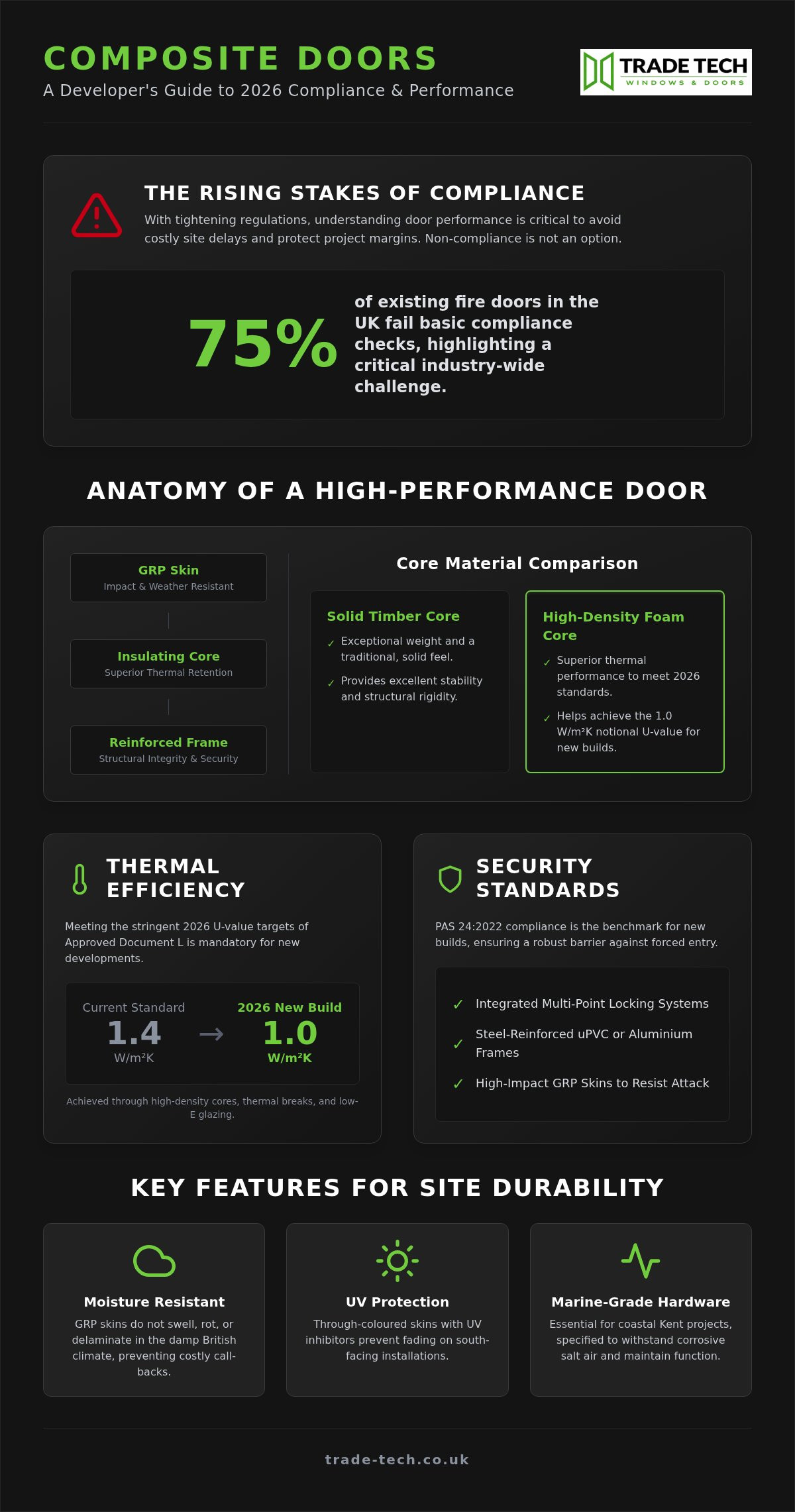
Approximately 75% of existing fire doors in the UK fail basic compliance checks, a statistic that highlights the rising technical stakes for modern developers. When sourcing composite doors Kent contractors must navigate a landscape of tightening regulations, from the BS 8214:2026 standards to stringent 2026 thermal requirements. It’s no longer just about the aesthetic finish. It’s about avoiding the site delays and compliance failures that erode project margins.
You understand that a late delivery or a failed inspection can stall a build for weeks; reliability is the foundation of any profitable project. This guide provides a technical deep-dive into sourcing and installing high-performance units that exceed current benchmarks. We’ll examine PAS24:2022 security protocols, the shift towards whole system performance, and logistical strategies to ensure your developments meet 2026 energy standards. Expect a methodical breakdown of how to secure a reliable supply chain while maintaining total regulatory compliance for every entrance on your site.
Key Takeaways
- Identify the performance differences between solid timber and high-density foam cores to meet 2026 thermal benchmarks.
- Ensure PAS 24:2022 compliance for new developments by specifying doorsets with integrated multi-point locking systems.
- Reduce site delays and protect project margins by sourcing high-specification composite doors Kent wide through localised logistical networks.
- Prevent cold bridging in modern builds by mastering the application of thermal breaks and Approved Document L requirements.
- Partner with Trade Tech Windows & Doors to streamline the procurement of compliant doors and complementary architectural glazing systems.
Understanding the Anatomy of High-Performance Composite Doors
A high-performance composite door is a multi-material entrance solution. It’s engineered for superior durability and thermal retention. Unlike standard timber or uPVC alternatives, it uses a layered approach to eliminate common failure points. Understanding the Anatomy of a Composite Door is vital for contractors who need to justify specification choices to clients or building control. For developers sourcing composite doors kent projects require units that resist the coastal winds and high-traffic usage typical of the region.
Material Composition and Durability
The cross-section of a trade-grade composite door reveals a complex assembly. Most professional units feature a 44mm or 48mm thick slab. You must choose between solid timber cores and high-density foam insulation. Solid timber cores provide exceptional weight and a traditional feel. High-density foam cores excel in thermal performance, helping meet the 1.0 W/m²K notional specification for new builds. Both options provide a stable foundation that resists the warping and twisting often seen in budget installations.
GRP (Glass Reinforced Plastic) skins are the industry standard for impact resistance. These skins are through-coloured, meaning scratches don’t reveal a white substrate. They offer a significant advantage over timber in the damp British climate. GRP is entirely moisture-resistant; it doesn’t swell, rot, or delaminate. This stability ensures the door remains functional and airtight for years, significantly reducing the likelihood of snagging lists and call-backs after handover.
Aesthetic Versatility for Professional Projects
Professional specifiers must balance performance with Kent’s diverse architectural heritage. From the historic streets of Canterbury to modern developments in Ebbsfleet, the right aesthetic is critical for planning approval. By specifying composite doors kent professionals can achieve precise visual matching without sacrificing performance. Trade-grade units offer woodgrain textures that are indistinguishable from real oak or rosewood, providing a premium finish for high-end residential builds.
Colour-fastness is a primary concern for South-facing installations. High-quality skins incorporate UV inhibitors to protect the finish from solar degradation. Hardware choice is equally vital. For projects near the Kent coast, standard finishes won’t suffice. You need to specify marine-grade hardware to withstand the corrosive effects of salt air. This ensures the door’s furniture remains pristine and functional throughout the warranty period.
Structural integrity relies heavily on frame integration. The leaf is only half the story. High-performance composite doors utilise steel-reinforced uPVC or aluminium outer frames. This provides the necessary anchor points for multi-point locking systems. It ensures the entire doorset acts as a single, secure barrier against forced entry, meeting the rigorous demands of modern site security.
Thermal Efficiency and U-Values: Meeting 2026 Standards
As of 2026, the regulatory floor for thermal performance has shifted significantly. For contractors installing composite doors kent wide, understanding the updated Building Regulations Part L is essential for site compliance. Current standards mandate a maximum U-value of 1.4 W/m²K for replacement doors in existing dwellings. However, for new build developments, the notional specification is now a more stringent 1.0 W/m²K. Meeting these targets requires more than just a thick slab; it demands a holistic approach to the entire doorset design.
Thermal breaks within the outer frame play a critical role in preventing cold bridging. This technical feature interrupts the path of heat transfer through the frame, ensuring the internal surface remains warm even in peak winter. For modern builds, this is non-negotiable to avoid condensation issues and maintain structural longevity. Glazing cassettes also impact the overall energy rating. Specifying high-performance sealed units featuring low-E glass and argon gas fill is vital. These units reflect heat back into the room whilst allowing solar gain, maximising the efficiency of the entrance.
Calculating the Real ROI of Energy Efficiency
High-performance doors are a primary lever for improving a project’s SAP rating. Since doors and windows can account for up to 40% of a home’s total heat loss, every decimal point gained in U-value performance contributes to a more favourable energy assessment. A premium composite door typically achieves a U-value between 1.0 and 1.4 W/m²K, whereas a traditional timber door often struggles to reach 1.6 W/m²K without significant and costly modifications. This gap represents a tangible improvement in thermal retention that developers can market to energy-conscious buyers in the Kent region.
Acoustic Insulation for Urban Developments
Urban projects near busy Kent transport links, such as the A2 or M20 corridors, require specific acoustic considerations. The same density that provides thermal retention also serves as a barrier against environmental noise. Specifying composite doors kent projects require often involves selecting units with dual-seal gaskets. These gaskets provide a continuous compression seal around the perimeter, significantly lowering decibel transfer from outside whilst providing superior draught proofing. This dual-purpose performance is a standard requirement for professional-grade installations in high-density areas.
To ensure your next project meets these rigorous acoustic and thermal standards without compromising on lead times, you can review our latest trade pricing and technical specifications.
Security Standards and PAS24 Compliance for Kent New Builds
For any professional specifying composite doors kent developments require rigorous adherence to PAS 24:2022. This updated standard moves away from testing individual components. It evaluates the entire doorset as a single, coordinated system. Under the Building Safety Act and Approved Document Q, any easily accessible door in a new-build dwelling must meet these security benchmarks. This isn’t just a recommendation; it’s a legal necessity for securing building control sign-off and ensuring the long-term safety of the residents.
The foundation of a secure installation is a high-specification multi-point locking system. Modern trade units typically feature a combination of hook bolts and deadbolts that engage at multiple points along the frame. This design distributes the force of any attempted entry across the full height of the door. To prevent the most common method of forced entry, cylinders must meet anti-snap, anti-drill, and anti-pick requirements. Specifying a 3-star Kitemarked cylinder as standard ensures that the locking mechanism remains the strongest link in the chain.
Locking Mechanisms and Hardware Specification
Choosing the right hardware depends on the specific project requirements. Hook bolts are preferred for their superior pull-out resistance compared to standard cam locks. For multi-occupancy buildings or high-traffic communal entrances, auto-locking systems provide a critical advantage. These systems engage the bolts automatically when the door closes, removing the risk of residents forgetting to throw the handle. Additionally, any glazed sections must incorporate laminated safety glass to meet Secured by Design standards, providing a resilient barrier against manual attack.
Testing and Certification for Peace of Mind
Certification provides the “golden thread” of data required for modern construction records. Composite doors undergo rigorous physical testing to simulate both opportunist and professional break-in attempts. This involves timed attacks using various tools to ensure the leaf, frame, and hardware can withstand significant force. Secured by Design (SBD) status is often a prerequisite for commercial tenders and social housing projects in Kent. It signals that the product has been vetted by the official police security initiative for its ability to deter crime.
Integrating these secure units alongside trade aluminium and uPVC doors allows developers to maintain a consistent security profile across an entire site. By sourcing fully compliant doorsets, you eliminate the risk of late-stage planning hurdles and provide your clients with a product that is built to protect. Consistency in hardware specification also simplifies long-term maintenance; it ensures that replacement parts meet the original security rating throughout the building’s lifecycle.
Sourcing and Installation: Minimising Site Delays in the Southeast
Unreliable lead times are a primary threat to project profitability. A missed handover date in a high-value development doesn’t just damage your reputation; it incurs tangible financial penalties. When sourcing composite doors kent contractors often face the choice between national volume suppliers and local specialists. National shipping networks are frequently prone to delays and transit damage. Localised supply across Kent and Sussex offers a significant logistical advantage, ensuring units arrive on time and in pristine condition.
Site storage is another critical factor in maintaining project momentum. Composite units should be stored upright on a level surface, away from direct sunlight and high-traffic construction zones. Protective packaging should remain intact until the point of installation to prevent surface abrasions. Poor handling during the first-fix stage is a common cause of avoidable snagging. By prioritising a streamlined supply chain, you ensure that the doors arrive exactly when they are needed, reducing the time they spend at risk on a busy site.
Logistical Planning for Developers
Efficient scheduling is the foundation of a successful build. You should coordinate deliveries to coincide precisely with the second-fix stage. This prevents the units from being exposed to the dust and impact risks of early-stage construction. Sourcing from a single specialist for both uPVC Windows and composite doors simplifies procurement. It ensures consistent lead times and a unified delivery schedule. For large-scale housing developments, managing bespoke orders through a single point of contact reduces administrative overhead and ensures technical specifications remain consistent across every plot.
Installation Precision and Aftercare
Precision during installation is non-negotiable for long-term performance. You must ensure the aperture is plumb and square before attempting to fit the frame. Even a minor misalignment can lead to binding or compromised weather seals. Threshold heights are a particular area of focus; for principal entrances, you must maintain a low threshold upstand not exceeding 15mm to comply with Approved Document M. Using the correct fixings and high-modulus sealants ensures the structural integrity of the installation. This attention to detail prevents future call-backs and ensures the composite doors kent developments feature remain functional for decades.
Request a technical trade quote for your next project
Why Trade Tech Windows & Doors is the Preferred Composite Door Supplier in Kent
Trade Tech Windows & Doors operates as a dedicated partner for the construction industry. We don’t deal with retail showrooms or domestic sales. This focus ensures our resources are entirely committed to trade success. Our inventory spans the full spectrum of architectural glazing. You can source high-specification composite doors alongside Roof Lanterns and aluminium systems from a single point of contact. This consolidated procurement model reduces administrative friction and ensures your site remains on schedule.
We offer direct trade pricing and provide transparent lead times from the moment you request a quote. This clarity is essential for managing project cash flow and site logistics. You receive proactive communication at every stage of the order process. We don’t just supply units; we provide the technical advice necessary to help you navigate complex regulatory requirements and installation challenges. For professionals sourcing composite doors kent wide, this level of support is the difference between a smooth handover and a costly delay.
A Partner for New Build Contractors
Specifying the right units for a large-scale development requires more than a standard brochure. We support New Build Contractors and Developers with comprehensive technical specifications and performance data. We provide the specific certification required for modern building control applications. Retail-focused suppliers often struggle with these technical trade demands. Our team understands the pressures of a commercial site. We offer modular customisation options that allow you to meet specific budget targets without compromising on the high-end finish your clients expect.
Expertise Across Kent and East Sussex
Local knowledge is a vital asset for any developer. We understand the regional building styles and environmental pressures unique to the Southeast. Whether you’re building in the exposed coastal areas of East Sussex or the historic urban centres of Kent, we provide the correct specification. Our logistical network is built for speed and reliability. We maintain a consistent delivery presence across Maidstone, Ashford, and Canterbury. This proximity allows for responsive deliveries and rapid support if site conditions or schedules change.
Reliability is the foundation of our business. We project a sense of stability that your projects can depend on. You need a partner that respects your time and understands the hidden cost of a site delay. Trade Tech Windows & Doors delivers on both counts. Contact us today to discuss the requirements for your next project and secure a professional-grade supply for your composite doors kent installations.
Secure Your Next Development with High-Performance Specification
Managing a profitable build in the Southeast requires technical precision and a supply chain that understands the shifting 2026 regulatory landscape. You now have the critical benchmarks for PAS24:2022 security and the specific U-value targets necessary for modern building control approval. By prioritising localised logistics and high-density core construction, you eliminate the common failure points that lead to site delays and costly snagging lists. Sourcing composite doors kent projects require doesn’t have to be a gamble on lead times or compliance.
Partnering with a specialist trade supplier provides the stability and technical support needed to deliver excellence on every plot. We provide the bespoke architectural solutions and high-performance, PAS24 compliant units your residential and commercial developments demand. Our direct focus on Kent and Sussex logistics ensures your units arrive exactly when your second-fix schedule requires them. Take the uncertainty out of your procurement process and focus on building high-quality homes.
Request a trade quote for composite doors today
We look forward to supporting your next project with the reliability and expertise your business deserves.
Frequently Asked Questions
What is the standard lead time for trade composite doors in Kent?
Lead times vary based on specification complexity and order volume. For composite doors kent contractors typically expect a turnaround of several weeks, though localised supply chains help mitigate the delays often seen with national shipping networks. We provide transparent, project-specific timelines at the point of quotation to ensure your site scheduling remains accurate and predictable.
Are all composite doors PAS24 compliant for new build projects?
PAS24:2022 compliance is a standard requirement for our new-build doorsets. These units are engineered to meet Approved Document Q, featuring reinforced frames and multi-point locking systems. It’s essential to specify this requirement during procurement to ensure the entire doorset, including the hardware and glazing, is certified for building control sign-off.
How do composite door U-values compare to standard uPVC doors?
High-performance composite doors often achieve superior thermal retention compared to standard uPVC alternatives. Whilst a typical uPVC door may hover around 1.4 W/m²K, our premium composite units can reach the 1.0 W/m²K notional specification for 2026 new builds. This efficiency is driven by high-density insulating cores and advanced thermal breaks within the frame.
Can I specify custom colours for large-scale Kent developments?
Bespoke colour matching is available for large-scale developments across the region. We can supply doors in a vast range of RAL colours to ensure architectural consistency across multiple plots. This flexibility allows developers to achieve a high-end, custom look whilst maintaining the durability and UV resistance of the standard GRP skin.
Do your composite doors come with a guarantee for trade installations?
All composite units supplied for trade installations come with comprehensive manufacturer guarantees. These typically cover the structural integrity of the slab, the finish of the GRP skin, and the functionality of the hardware. Specific terms are provided with each order, ensuring you can offer your clients long-term peace of mind regarding the durability of the installation.
What are the maintenance requirements for GRP skin composite doors?
GRP skin composite doors are engineered for low maintenance in the British climate. They don’t require the regular painting or staining associated with traditional timber entrance solutions. A simple wipe down with warm, soapy water is usually sufficient to maintain the finish. This resistance to warping and fading makes them a practical choice for high-traffic residential projects.
How do I ensure the threshold is DDA compliant for new builds?
DDA compliance is achieved by specifying a low-threshold system during the ordering process. To meet Approved Document M standards for new builds, the threshold upstand must not exceed 15mm. These systems are designed to provide level access for wheelchairs whilst maintaining high levels of weather performance and airtightness for the building envelope.
Are sidelights and top lights available for composite door units?
Integrated sidelights and top lights are available to match the main composite doorset. These can be supplied as part of a single, coordinated unit or as separate coupled frames depending on the aperture size. Specifying matching glazing and frame finishes ensures a cohesive aesthetic for larger entranceways in high-end composite doors kent installations.