
What if your next heritage project achieved a 1.2 W/m²K U-value without a single objection from the local planning officer? You know that balancing strict conservation requirements with the 2026 Future Homes Standard is a constant logistical challenge for developers in Kent and East Sussex. Site delays and survey inaccuracies often threaten project margins. This guide ensures you master the technical specification, precision measurement, and sourcing of high-performance trade uPVC sliding sash windows for your next professional contract.
We understand that precision is non-negotiable. You need authentic timber-effect aesthetics that satisfy Article 4 Directions whilst meeting the latest thermal and security standards. This professional specification guide provides a clear, methodical roadmap to achieving seamless installations. We will examine the transition to 2026 building standards, PAS 24 security requirements, and the critical role of trickle vents in modern ventilation. You will gain the technical insight needed to deliver excellence on every site. Expect a focus on fast, accurate, and compliant results that protect your reputation and your timeline.
Key Takeaways
- Understand how to meet 2026 Building Regulations (Part L) with multi-chambered profiles that exceed modern thermal requirements.
- Master the technical survey process for heritage properties, including precise ‘check reveal’ measurements to ensure a seamless fit.
- Learn how to specify authentic timber-effect finishes and heritage hardware to satisfy strict conservation area requirements.
- Optimise your supply chain by sourcing high-performance trade uPVC sliding sash windows from a specialist partner in Kent and East Sussex.
- Evaluate the economic case for uPVC, focusing on reduced capital expenditure and lower long-term maintenance costs for your clients.
Why uPVC Sliding Sash Windows are the Standard for Heritage Trade Projects
The construction industry has seen a decisive shift. For decades, timber was the only acceptable choice for period properties. Now, modern trade uPVC sliding sash windows offer a superior alternative that balances historical integrity with high-performance engineering. By studying the history and evolution of sash windows, we see that the design has always adapted to available materials. Today’s multi-chambered uPVC profiles provide the structural rigidity and thermal insulation that traditional wood simply cannot match without excessive cost.
Developers prioritising project margins and long-term reliability now favour uPVC. It eliminates the intensive maintenance cycles associated with timber, such as regular repainting and treatment against rot. This translates to lower capital expenditure during the build and reduced snagging issues post-completion. In the fast-paced Kent and East Sussex markets, where site efficiency is critical, the speed of installation and the durability of the finished product make uPVC the logical professional choice.
To see how these units transform a property during a professional installation, watch this helpful video:
Authenticity vs. Durability
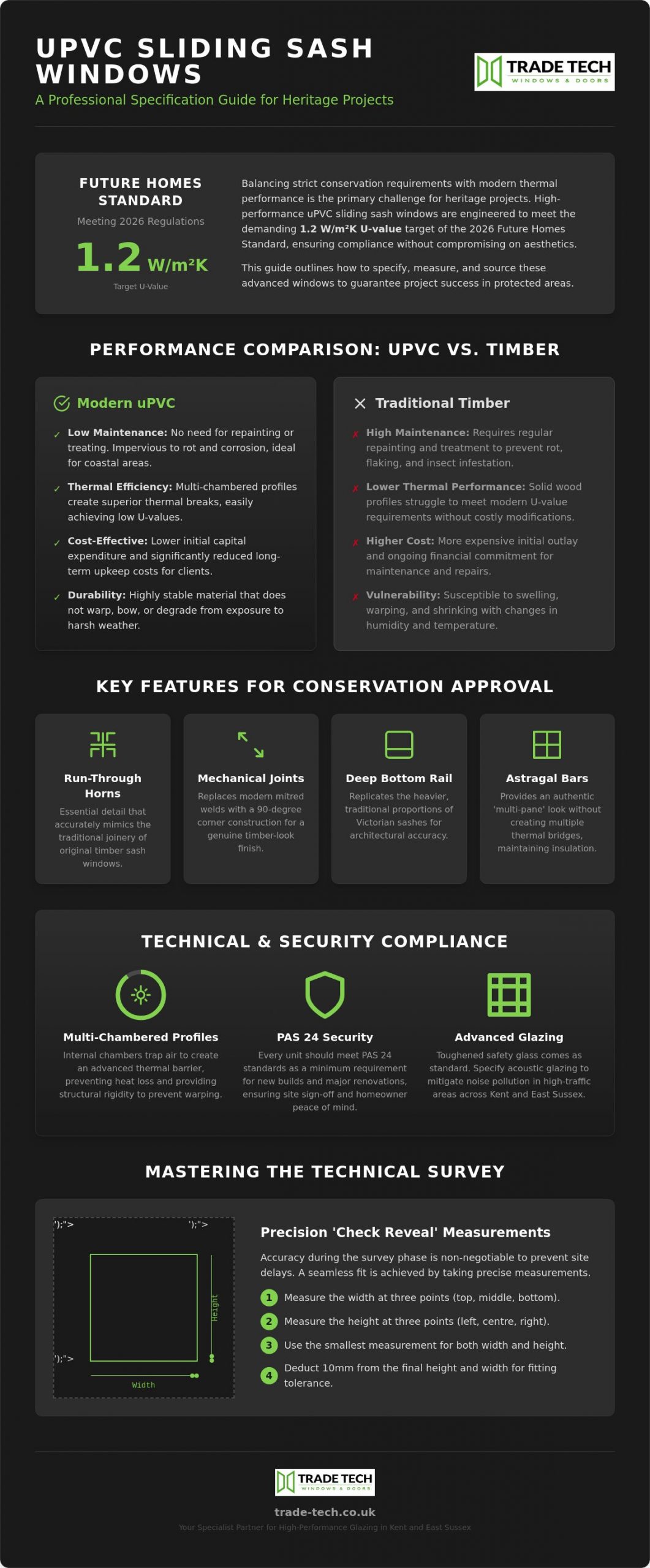
High-performance trade uPVC sliding sash windows have effectively neutralised the ‘plastic’ stigma. Advanced woodgrain foils now replicate the texture and colour of traditional oak or painted timber with remarkable accuracy. In coastal Sussex environments, where salt-laden air quickly degrades wooden frames, uPVC remains stable and impervious to corrosion. To satisfy planning officers, several features are non-negotiable for heritage projects:
- Run-through horns: Essential for mimicking traditional joinery.
- Mechanical joints: Replaces mitred corners for a timber-look finish.
- Deep bottom rails: Replicates the heavy proportions of Victorian sashes.
- Astragal bars: Provides the authentic ‘multi-pane’ look without compromising thermal integrity.
The Market Demand in the Southeast
Kent developers are seeing a surge in demand for ‘character’ homes that don’t demand the upkeep of a Victorian original. Homeowners expect the aesthetic of a heritage property but demand the comfort of modern glazing. By specifying heritage-style sash units, contractors can deliver on both counts. For projects where a mix of window styles is required, you might also consider uPVC Casement Windows for Kent Trade Projects to maintain a consistent aesthetic across different elevations. This approach ensures compliance with 2026 standards whilst protecting the regional architectural identity.
Technical Performance: Thermal Efficiency and Security Standards
Professional-grade trade uPVC sliding sash windows must now perform as high-precision thermal barriers. The 2026 regulatory landscape demands a rigorous approach to U-values. For new-build projects, developers are targeting a notional value of 1.2 W/m²K. Compliance with Approved Document L building regulations is no longer just about meeting a minimum; it’s about future-proofing the build against the upcoming Future Homes Standard. Multi-chambered profiles are the foundation of this performance. They trap air to create a thermal break whilst providing the structural rigidity needed for large-scale sash units. This design prevents the bowing or warping often seen in inferior products.
Security remains a top priority for residential developers. Every unit should meet PAS 24 standards to ensure site sign-off. Toughened glass comes as standard for most trade specifications. In high-traffic Kent corridors, specifying acoustic glazing is becoming standard practice to mitigate noise pollution. These technical enhancements ensure your projects meet both legal requirements and homeowner expectations for a quiet, secure living environment. For larger-scale developments where glazing specification extends beyond residential use, our guide to commercial windows sourcing and specification for 2026 provides an essential framework for achieving whole-window U-value compliance across mixed-use schemes.
Energy Ratings and Glazing Units
Choosing between double and triple glazing depends on the specific project target. Whilst double glazing often hits the 1.4 W/m²K mark for replacements, triple glazing is increasingly specified for new builds aiming for lower U-values. Warm edge spacer bars are essential. They reduce condensation and heat loss at the glass edge. Argon-filled units are now a critical component for achieving the thermal performance required by 2026 building standards. If you require bespoke glazing configurations, you can source high-performance sealed units directly from our specialist facility.
Hardware and Mechanism Reliability
A sash window is only as good as its mechanism. High-quality constant-force or spring balances ensure smooth, long-term operation. This reduces maintenance call-outs for developers. Locking systems must be robust. We provide cam catches and limit stops that offer security without compromising the heritage look. Child safety restrictors are also a vital specification for multi-storey residential developments. This ensures the sashes only open to a safe distance whilst still allowing for ventilation. For detailed pricing on these high-spec mechanisms, you can request a trade quote for your next project.
Customisation Options: Achieving a Traditional Timber Look
Specifying the right aesthetics is as critical as the U-value for high-end professional projects. The difference between a standard unit and a heritage-grade window lies in the granular details. For trade uPVC sliding sash windows, customisation starts with the furniture. Choose from heritage brass, polished chrome, or satin finishes to match the property’s existing hardware. These tactile elements provide the quality feel that homeowners expect in premium residential developments.
Architectural integrity depends heavily on the glazing bars. Georgian bars sit inside the sealed unit, offering a cost-effective solution for modern builds. However, for true authenticity, specify astragal bars. These sit on the surface of the glass, creating the physical depth and shadow lines of traditional multi-pane sashes. This distinction is often the deciding factor for planners in sensitive areas. Colour choice further defines the project. Whilst classic White and Cream remain popular, Chartwell Green is a frequent choice for rural Kent cottages. Modern developments often specify Anthracite Grey to provide a contemporary twist on a classic design.
Heritage Detailing for Trade Projects
Proportions must be historically accurate to avoid the ‘plastic’ look. Traditional 19th-century joinery featured a deep bottom rail, a detail we replicate to ensure the window looks balanced within the masonry. Run-through horns are equally essential. Rather than being glued on as an afterthought, these form part of the vertical profile for an authentic vertical sash appearance. You must also choose the right finish. Smooth sashes work well for modern replacements, but textured woodgrain foils are necessary to replicate the organic feel of painted timber.
Addressing Conservation Area Requirements
Navigating planning permission in historic towns like Tunbridge Wells, Rye, or Canterbury requires a methodical approach. Mechanical joints are the gold standard here. Unlike standard mitred welds that leave a diagonal plastic seam, mechanical joints create a 90-degree vertical butt joint. This mimics traditional joinery and often satisfies conservation officers who would otherwise insist on timber. When working on sensitive renovations, our sliding sash windows provide the necessary heritage features to bypass common planning objections. Always specify the ‘Heritage’ range for these projects to ensure the highest level of architectural compliance.
How to Survey and Order Trade uPVC Sliding Sash Windows
Precision at the survey stage prevents costly site delays. When dealing with trade uPVC sliding sash windows, the complexity of the opening often exceeds that of a standard casement. Period properties across Kent and East Sussex frequently suffer from structural settlement. You must ensure the aperture is plumb and square before finalising dimensions. If the masonry is out of alignment, your manufacturing sizes must account for the smallest width and height whilst allowing for a sufficient perimeter seal.
Older masonry often features a ‘check reveal’, where the window sits behind the external brick skin. You need to measure the internal opening versus the external opening to determine the correct frame width. This ensures the frame remains visible from the outside without being obscured by the brickwork. Next, determine the required cill size. This depends on the depth of the masonry and the required overhang for effective water shedding. You should also confirm drainage requirements; choose between face-drained or concealed drainage options early in the process.
Finalising the sash split is a critical aesthetic and functional step. A standard 50/50 split is common, but a 60/40 ‘Edwardian’ split might be required to match specific architectural styles on a project. Confirm all ironmongery finishes at this stage to avoid mismatched hardware during installation. Finally, verify current lead times. Align these with your project’s critical path to ensure the trade uPVC sliding sash windows arrive exactly when the site is ready for glazing.
Common Surveying Pitfalls to Avoid
Failure to account for internal plaster lines and external rendering is a common cause of fitment issues. If the plaster is exceptionally thick, it may overlap the frame more than anticipated. Always measure the width and height in at least three places: top, middle, and bottom, as well as left, centre, and right. Checking the structural integrity of the existing lintel during the survey is critical to ensure it provides adequate support for the new installation.
Streamlining the Trade Ordering Process
Efficiency is vital for maintaining project momentum. Use professional trade platforms to generate instant quotes and secure your place in the production queue. This allows you to provide accurate costs to your clients immediately. Dedicated technical support is invaluable for complex specifications, especially when customising sashes for sensitive conservation areas. Access our trade pricing portal to generate accurate project estimates and verify current lead times for your next development.
Reliable Trade Supply and Support in Kent and East Sussex
National logistics often create bottlenecks. Site delays frequently stem from transport issues or damaged goods during long-haul transit; a local Kent-based partner mitigates these risks by offering shorter lead times and more responsive site deliveries. For developers managing multiple plots in Kent and East Sussex, the reliability of the supply chain is as critical as the product specification. Trade Tech Windows & Doors prioritises efficiency to ensure your project stays on its critical path. Our regional presence allows for a level of responsiveness that national suppliers simply cannot match.
We support professionals from the initial specification through to final installation. We don’t just supply units; we provide the technical expertise required for complex heritage projects. This includes a comprehensive aftercare package and warranties that offer long-term security for your clients. By sourcing your trade uPVC sliding sash windows locally, you reduce the carbon footprint of your build whilst ensuring direct access to technical experts who understand regional requirements. We act as a dependable partner, protecting your time and your project margins.
Project Support for Developers and Contractors
Developers in Sussex require bespoke solutions that satisfy both modern performance targets and local aesthetic expectations. We provide the necessary technical drawings and CAD files to streamline the planning and design phases. This proactive support ensures that all glazing elements are fully integrated into the building’s thermal and structural plans from the outset. Our dedicated team works closely with New Build Contractors and Developers to ensure every unit arrives on site ready for immediate installation, reducing the risk of costly post-delivery adjustments.
Why Local Knowledge Matters
Local knowledge is a significant asset in the Southeast glazing market. Understanding the specific architectural trends in Maidstone, Brighton, and the surrounding towns allows us to provide more accurate advice on hardware and finishes. You gain direct contact with experts who know the Kent market inside out. This regional focus ensures that your project remains compliant with local planning whilst benefiting from a streamlined logistical process. For a broader look at high-performance specifications in the region, see our sibling article on UPVC Doors for Trade Kent. We remain a stable foundation for your professional success, providing the tools and technical advice necessary to deliver excellence on every site.
Deliver Excellence on Your Next Heritage Project
Mastering the technical specification of trade uPVC sliding sash windows is essential for any developer aiming to balance historical aesthetics with 2026 building standards. We’ve explored how multi-chambered profiles and precision surveying ensure your projects meet Part L thermal requirements and PAS 24 security benchmarks without compromising on character. By choosing authentic details like mechanical joints and run-through horns, you satisfy the most rigorous planning requirements whilst delivering modern efficiency.
Success on site depends on a reliable, regional supply chain that understands the unique architectural landscape of Kent and East Sussex. As a specialist supplier, we provide the dedicated trade pricing and technical support necessary to keep your developments on schedule. Don’t let logistical delays or specification errors impact your project margins. Take the next step in securing high-performance glazing for your contract.
Request a Professional Trade Quote for Your Next Sash Window Project and ensure your installations are future-proofed for the years ahead.
Frequently Asked Questions
What are the typical lead times for trade uPVC sliding sash windows in Kent?
Typical lead times for trade uPVC sliding sash windows in the Kent region generally range between two and four weeks. Standard white profiles often sit at the shorter end of this scale; however, bespoke woodgrain foils or heritage mechanical joints may require additional production time. We recommend verifying current manufacturing schedules at the point of survey to ensure your site timelines remain protected and predictable.
Do uPVC sliding sash windows meet current Building Regulations for thermal efficiency?
Yes, modern uPVC sash windows are engineered to meet and exceed current Part L Building Regulations. Most professional specifications achieve a U-value of 1.4 W/m²K for replacement projects and 1.2 W/m²K for new-build developments. These ratings are made possible through advanced multi-chambered frames and high-performance argon-filled glazing units that provide superior thermal insulation compared to traditional timber alternatives.
Can I get uPVC sash windows that are accepted in Conservation Areas?
High-specification uPVC sash windows are frequently accepted in Conservation Areas across the Southeast. Success depends on selecting heritage-grade details such as mechanical joints, run-through horns, and authentic astragal bars that mimic original joinery. You should always consult the local planning department regarding Article 4 Directions; however, our heritage ranges are specifically designed to satisfy these sensitive architectural requirements.
What is the difference between a mechanical joint and a welded joint in sash windows?
A mechanical joint replicates traditional timber construction with a 90-degree vertical butt joint. Welded joints use a standard 45-degree diagonal heat-weld which is common in modern glazing but often reveals its uPVC origins. Mechanical joints are the gold standard for heritage projects because they eliminate the diagonal plastic seam, providing an aesthetic that is almost indistinguishable from original wooden frames.
How do I ensure the sash windows are secure for a ground-floor installation?
Specify PAS 24 compliant hardware and toughened glass as standard for all ground-floor installations. Secure units feature robust cam catches and limit stops that prevent the sashes from being forced open from the exterior. These security enhancements provide peace of mind for residential occupiers without compromising the classic vertical sliding operation or the property’s historical character.
Are woodgrain foils durable enough for exposed coastal projects in Sussex?
Woodgrain foils are exceptionally resilient and specifically designed to withstand the harsh salt-spray environments of coastal Sussex. Unlike timber, which requires constant repainting to prevent rot in marine conditions, foiled uPVC is impervious to moisture and corrosion. The foil is thermally bonded to the profile; it won’t peel, fade, or blister even when subjected to high UV exposure and coastal winds.
What maintenance is required for modern uPVC sash mechanisms?
Modern uPVC sash mechanisms require very little maintenance to remain fully operational. We recommend cleaning the tracks annually to remove dust and applying a light silicone-based lubricant to the spring balances and pivot bars. This simple routine prevents friction and ensures the sashes continue to glide smoothly. It’s a significant improvement over the intensive maintenance cycles required by traditional cord-and-weight systems.
Do you offer trade accounts for recurring development projects?
We provide dedicated trade support and professional accounts for contractors and developers managing recurring projects. Trade partners gain access to tiered pricing structures and priority technical assistance to streamline the specification process. This collaborative approach ensures that high-volume developments in Kent and East Sussex benefit from consistent supply and reliable logistical support from a specialist regional partner.