
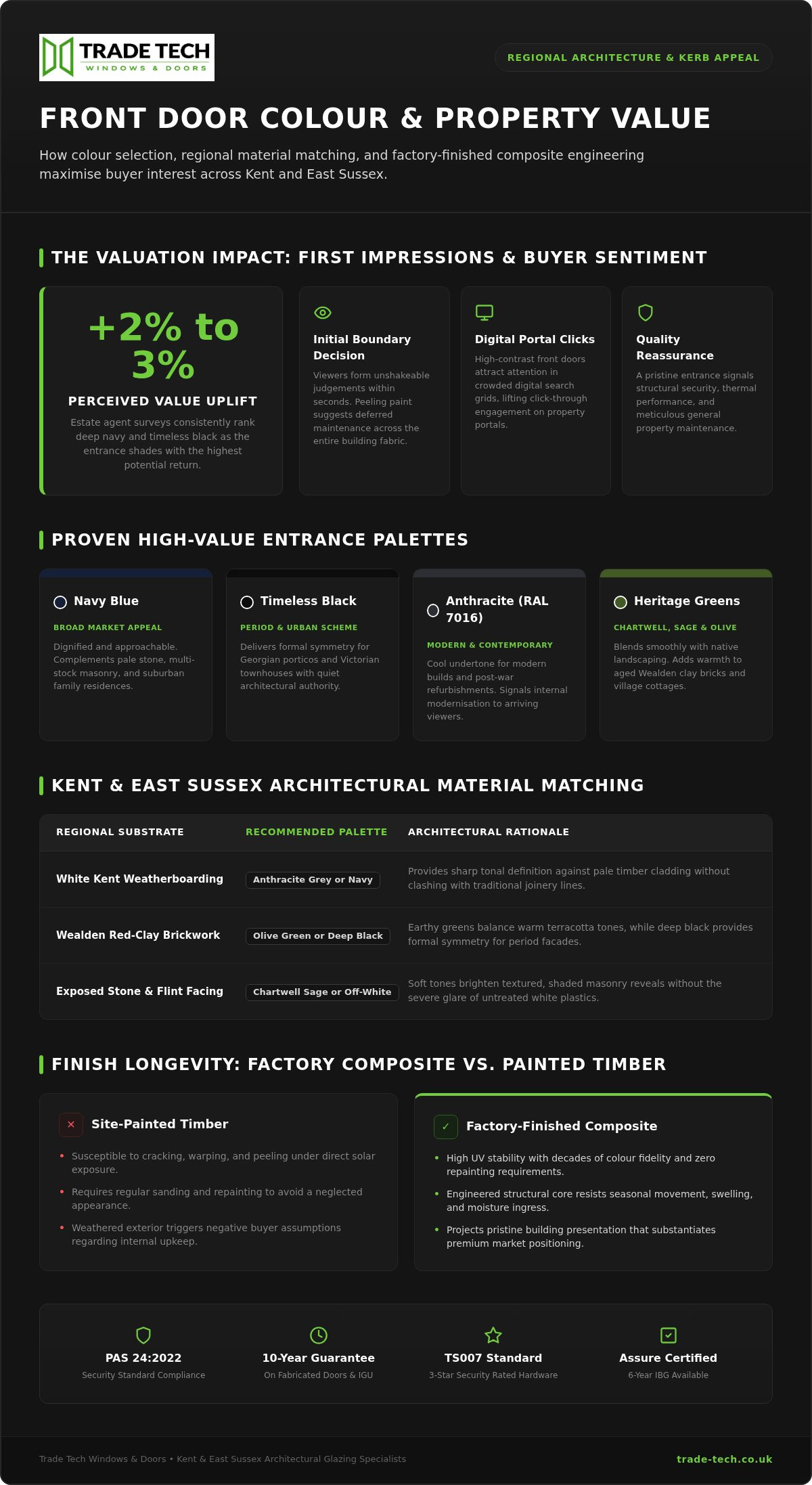
Estate agent surveys consistently rank deep navy and timeless black as the most profitable entryway shades, potentially adding two to three percent to a property’s perceived value. If you’re searching for the best front door colour to increase house value, the right choice isn’t just about following fleeting design fads; it’s about pairing proven market appeal with your home’s unique architectural character.
You likely worry that an overly bold hue might put off prospective buyers, or that a painted exterior will quickly weather, crack, and peel. Getting your property’s focal point right shouldn’t feel like a gamble. In this guide, you’ll discover how to select entrance colours that maximise buyer interest and protect long-term saleability. We examine the specific palettes that complement the regional brickwork, tile hanging, and stone found across Kent and East Sussex, whilst detailing how factory-finished composite doors and aluminium entrance doors deliver lasting colour fidelity without the upkeep.
Key Takeaways
- Learn how choosing the best front door colour to increase house value relies on pairing proven architectural tones with broad buyer appeal.
- Discover the most effective colour pairings for Kent weatherboarding, exposed stone, and traditional red-brick masonry across South East properties.
- Understand why factory-finished composite doors outperform repainted timber, providing decades of colour fidelity without cracking, warping, or peeling.
- Identify the hardware finishes and PAS 24:2022 security specifications that satisfy insurer demands while elevating front entrance kerb appeal.
The Valuation Impact: How Front Door Colour Influences Kerb Appeal
Front door aesthetics serve as an immediate proxy for general building upkeep. Surveyors and estate agents regularly identify entrance presentation as the primary catalyst for buyer sentiment. Before a purchaser examines a single interior room, their view of the property’s condition is largely established at the boundary. Understanding the best front door colour to increase house value gives developers and homeowners a direct advantage in setting that initial impression.
A property’s exterior presentation, historically referred to as Kerb Appeal, sets the baseline for perceived value. When an entrance door appears neglected or out of place, prospective buyers unconsciously anticipate costly repair bills elsewhere. Upgrading to a cohesive entrance creates clear visual distinction, framing the property as well-maintained, thermally sound, and structurally secure.
The Psychology of Property First Impressions
Purchasers make unconscious judgements within seconds of stepping onto a driveway. Weathered, peeling paint signals deferred maintenance, raising immediate questions about window seals, roofline timbers, and masonry pointing. A factory-engineered entrance, such as a modern composite door, creates a sense of stability. It reassures visitors that the fabric of the home receives consistent care. Cohesive styling establishes confidence, helping buyers picture themselves living in the space rather than tallying remedial work.
Digital Listing Performance and Street View Engagement
Most residential transactions begin online. Digital property portals display dozens of competing listings simultaneously, making high-contrast photography vital for driving engagement. If your property features a colour palette that blends into dull masonry, scrollers move on. Selecting the best front door colour to increase house value creates a strong focal point in street-level images:
- Higher click-through rates: Contrasting entrance doors naturally draw the eye in crowded digital search grids.
- Clearer architectural definition: Deliberate tones emphasise porch detailing, porticos, and fenestration lines.
- Stronger pricing justification: Sharp, pristine elevations help modernised properties substantiate premium market positioning across Kent and East Sussex.
The Best Front Door Colours to Increase House Value
Selecting the best front door colour to increase house value requires balancing broader buyer demographics against architectural context. Trendy pastel shades like pink or bright yellow might catch the eye on social media, but industry feedback confirms they polarise prospective buyers during property sales. Neutral, dignified, and architecturally grounded colours offer predictable investment returns, ensuring widespread market appeal without dating the property.
Anthracite Grey and Contemporary Architectural Tones
Anthracite grey (RAL 7016) remains a reliable performer across modern residential developments and post-war renovations. Its cool undertone complements modern window frames, neutral rendering, and sharp brickwork. Greys project an updated, well-specified look that signals internal modernisation to arriving viewers. You can explore modern styling options with factory-glazed composite doors engineered for long-term colour stability. For maximum kerb impact, specify slate and charcoal doors with brushed stainless steel hardware, creating sharp sightlines that elevate new-build elevations.
Timeless Neutrals: Navy Blue, Deep Black, and Off-White
Traditional tones remain the most commercially resilient choices on the market. They bridge the gap between suburban family properties and historic architectural schemes:
- Navy blue: Offers a dignified, approachable alternative to stark monochrome, working well against both pale stone and warm multi-stock masonry.
- Deep black: Delivers formal symmetry for Victorian terraces and Georgian townhouses, framing entrance porticos with quiet authority.
- Soft off-whites and pebbles: Brighten shaded entrance recesses without producing the harsh glare associated with untreated brilliant white plastics.
Heritage Greens: Sage, Olive, and Chartwell Green
Nature-inspired greens have become prime alternatives to traditional blues, especially across village settings and semi-rural properties. Earthy tones blend smoothly with landscaped front gardens, native hedges, and rural approaches. Chartwell green delivers classic country-cottage character to period homes, while darker olive and sage greens introduce warmth to aged Wealden clay brickwork without clashing with historic timber frames. If you want to specify resilient architectural finishes for upcoming renovation projects, reviewing high-performance door palettes through Trade Tech Windows & Doors exterior entrance collections helps guarantee consistent finish quality across every elevation.
Matching Door Colours to Architecture and Regional Materials
Determining the best front door colour to increase house value depends heavily on the exterior masonry. An entrance shade that elevates smooth monocouche render can clash aggressively with warm clay brickwork. Architectural coherence protects kerb appeal, ensuring your entrance feels integral to the building rather than an afterthought.
Red Brick and Warm Masonry Facades
Traditional clay brickwork across Kent and East Sussex features warm terracotta, orange, and rustic red undertones. Fitting a bright red or orange door creates an overwhelming, muddy palette that flattens exterior detail. Instead, cool contrasts bring clarity to the elevation:
- Navy blue: Delivers sharp complementary contrast against warm orange and red bricks.
- Sage and olive greens: Soften heavy brick facades, blending masonry with boundary planting.
- Daylight testing: Check brick undertones in both direct sunlight and overcast conditions before ordering your doorset.
Kent Weatherboard, Render, and Sussex Flint
Regional cladding materials require careful tonal balance. Traditional white horizontal weatherboarding provides crisp horizontal geometry, pairing exceptionally well with high-contrast anthracite grey, slate, or gloss black entrances. This contrast anchors the elevation and frames the doorway clearly from the kerbside.
Sussex flint walls present irregular textures, chalk bands, and warm lime mortar joints. Avoid harsh primary colours here; flint demands restrained grey-greens, pebbles, or muted navy to preserve the stonework’s natural visual texture. For newly rendered properties with crisp, off-white finishes, contemporary designs from the Italia Collection introduce clean geometric lines and deliberate architectural focus.
Period Homes Versus New-Build Developments
Architectural era dictates the visual rules of engagement. Victorian and Edwardian properties rely on formal symmetry, benefiting from rich heritage tones paired with decorative glass panels or etched fanlights. Contemporary developments, however, demand structural simplicity and uniform fenestration palettes.
For modern properties, coordinate your entrance finish directly with your window frames. Aligning your front door colour with adjacent aluminium windows establishes clean exterior symmetry across the whole facade. Establishing this alignment reassures buyers that the property has been fully renovated, confirming that the best front door colour to increase house value is always one that respects regional character and structural form.
Material and Finish: Why Factory-Finished Composite Outperforms Paint
A fresh coat of paint looks sharp on listing day, but DIY timber finishes quickly deteriorate under seasonal weather cycles. Applying the best front door colour to increase house value won’t yield returns if the surface blisters, chalks, or warps within months. Factory-engineered composite door systems resolve this vulnerability by bonding durable colour pigments directly into the door’s outer skin.
Durability, Weathering, and Colour Retention
Glass reinforced plastic (GRP) skins provide exceptional resistance against driving rain and coastal winds across Kent and East Sussex. Factory-applied, UV-stable coatings protect deep blacks, rich navies, and slate greys from sun bleaching. An authentic woodgrain finish replicates traditional timber grain without requiring sanding, varnishing, or seasonal repainting. These fabricated assemblies come backed by a 10-year guarantee against manufacturing defects, giving prospective purchasers lasting peace of mind.
Explore durable factory-finished composite doors from Trade Tech Windows & Doors
Thermal Performance and Building Regulation Compliance
Modern entrance systems combine visual presentation with energy efficiency. Surveyors and buyers scrutinise Energy Performance Certificates (EPC), making thermal performance an active valuation metric:
- Part L compliance: Engineered composite slabs easily satisfy Part L standards for conservation of fuel and power.
- High-density cores: Rigid polyurethane or timber composite cores prevent thermal bridging far better than hollow timber stiles.
- Integrated weather seals: Multi-point compression seals eliminate cold draughts that deter energy-conscious buyers at the threshold.
Glazing Panels and Acoustic Insulation
Incorporating glazed apertures balances external colour schemes while driving natural light into darker entrance hallways. Factory cassettes housing an energy-efficient double-glazed unit protect your property’s internal warmth. Beyond thermal efficiency, high-density door cores and specialised glass cassettes deliver vital acoustic insulation. This dampens exterior airborne sound from busy distributor roads, ensuring the best front door colour to increase house value is paired with a calm, quiet interior environment.
Specification Checklist: Hardware, Security, and Final Details
Pairing your entrance slab with certified security hardware turns visual kerb appeal into practical value. Even the best front door colour to increase house value falls short if loose handles, tarnished letterplates, or sticking locks create a sloppy impression during viewings. Every physical touchpoint must signal quality, security, and precision installation.
Hardware Finishes: Chrome, Brass, and Matte Black
Door furniture acts as the architectural trim that anchors your chosen colour. Contrasting metallic finishes highlight panel details and modernise exterior sightlines:
- Polished chrome and satin stainless steel: Deliver crisp, clean reflections against anthracite grey and deep black slabs.
- Architectural brassware: Adds warmth and historic authenticity to classic navy blue or deep forest green entrances.
- Matte black hardware: Blends smoothly with sage or olive green, offering a subtle architectural look that appeals to design-led buyers.
Security Features That Reassure Home Buyers
Prospective purchasers test handles and inspect locking mechanisms at the front threshold. Demonstrating full PAS 24:2022 compliance reassures buyers that their family and property are protected from day one. Integrating a Lock Lock security handle provides an active visual deterrent with a patented lock-block that prevents forced spindle turning.
High-specification installations combine multi-point locking mechanisms with an internal attack lock that engages if primary cylinders encounter tampering. Specifying cylinders that meet the TS007 standard (3 star) satisfies strict insurance requirements. It also confirms to conveyancers and surveyors that the doorset meets modern security standards without requiring immediate secondary upgrades.
Surveys, Frame Alignment, and Installation
Flawless operation depends on precision surveying. Taking exact brick to brick measurements ensures the outer frame sits square within the structural opening, maintaining uniform perimeter expansion gaps and tight weather seals. Moving hardware fitted to Trade Tech Windows & Doors systems includes a 1-year guarantee against operational failure, provided moving parts receive inspection and lubrication at least twice per year.
Subtle details dictate whether your investment translates into higher offers. Aligning house numerals, bell pushes, and knockers in balanced proportions reinforces structural symmetry. When you specify factory-aligned entrance assemblies, you ensure the best front door colour to increase house value delivers lasting performance, structural integrity, and verified kerb appeal. Discuss custom entrance specifications directly with the team via Trade Tech Windows & Doors Contact.
Maximise Kerb Appeal with Lasting Entrance Performance
Selecting the best front door colour to increase house value requires more than chasing seasonal trends. It demands careful alignment with regional brickwork, flint, or cladding, backed by engineered materials that never peel, crack, or fade. Factory-finished composite doors ensure your chosen shade retains its depth while improving thermal performance and buyer confidence from day one.
Backed by over 50 years of fenestration industry expertise, Trade Tech Windows & Doors combines durable architectural finishes with PAS 24:2022 accredited security hardware. As an Assure Certified Installer providing insurance-backed guarantees, we help developers and homeowners achieve measurable returns on every entryway upgrade across Kent and East Sussex.
Upgrade your property entrance with Trade Tech Windows & Doors composite doors
Give your home the entrance it deserves and create a pristine first impression that commands serious market value.
Frequently Asked Questions
Does changing my front door colour really increase property value?
Upgrading your entrance colour directly influences perceived property value and speeds up sales viewings. Industry surveys show high-appeal entrance shades add two to three percent to perceived valuation by elevating kerb appeal. A pristine door signals that the building fabric has been carefully maintained. For sellers in Kent and East Sussex, choosing the best front door colour to increase house value delivers immediate return by establishing a positive visual tone during viewings.
Which front door colour appeals to the widest range of UK buyers?
Classic navy blue, charcoal, and anthracite grey appeal to the widest demographic of property buyers. These timeless neutrals provide balanced architectural contrast without the personal polarisation associated with bold primary tones like bright red or yellow. Navy blue projects stability on period and suburban homes alike, while anthracite grey delivers crisp, clean sightlines on contemporary properties. Sticking with proven heritage neutrals prevents alienating prospective purchasers during the initial viewing.
Should my front door colour match the window frames?
Your front door does not need to match your window frames, but the colours must visually harmonise. Matching door and window colours works exceptionally well on modern builds and minimalist properties featuring anthracite or black aluminium windows. For traditional brick or Sussex flint elevations, contrasting a neutral white or cream window frame with a rich navy, black, or heritage green composite door creates visual depth. The goal is intentional contrast rather than an accidental mismatch.
Are dark front door colours prone to fading in direct sunlight?
Dark painted timber doors fade rapidly, but modern factory-finished composite doors resist UV degradation. Traditional paints absorb ultraviolet rays and thermal radiation, causing deep blacks and navies to chalk, bubble, and crack. High-performance composite doors utilise UV-stable GRP skins where the pigment is embedded directly into the outer layer. This through-colour technology protects your entryway against solar bleaching, even on south-facing elevations exposed to coastal weather across East Sussex and Kent.
What security standards should a new front door meet for resale?
A replacement doorset should comply with the PAS 24:2022 enhanced security standard. Surveyors, mortgage lenders, and insurers look for certified complete doorset systems that prevent forced entry. Look for doorsets fitted with TS007 3-star cylinders and multi-point locks featuring internal attack locks. Installing an Assure certified, PAS 24 compliant entrance ensures prospective buyers satisfy standard home insurance requirements without having to replace substandard locks upon completion.
Can a replacement composite door improve my home EPC rating?
Installing a modern composite doorset helps raise your Energy Performance Certificate (EPC) score. Outdated timber doors often warp, allowing cold draughts to enter through perimeter gaps. Modern composite doors feature high-density insulated cores and double-glazed units that easily meet Part L thermal efficiency regulations. Pairing structural thermal breaks with compression seals keeps heat inside your hallway. This technical efficiency contributes directly to better property energy bands, making the home more attractive to energy-conscious buyers.
How do I choose between a smooth modern finish and a woodgrain finish?
Base your surface texture choice on the age and architectural style of your property. A textured woodgrain finish complements traditional red-brick homes, Sussex flint, and rural cottages by preserving authentic timber aesthetics without seasonal maintenance. Smooth, untextured finishes suit modern developments, contemporary extensions, and urban townhouses. Aligning surface texture with your exterior masonry ensures you find the best front door colour to increase house value while preserving architectural integrity.