
Installing a non-compliant door isn’t just a technical oversight; under the Building Safety Act 2022, it’s a criminal offence that carries the risk of unlimited fines. You know the pressure of a looming Building Control inspection. The last thing any contractor in Kent or Sussex needs is a site sign-off being blocked because the glazing specifications don’t meet the latest security standards. Sourcing certified products with reliable lead times remains a constant challenge. You need direct, reliable, and efficient support to keep your projects on track.
This guide provides PAS24 & Part Q explained in plain English. We’ll help you master the technical requirements to ensure your projects remain fully compliant and your clients stay secure. You’ll gain a clear understanding of your legal obligations for both new builds and material changes of use. We’ll also explore the latest PAS 24:2022+A1:2024 amendments and show you how to specify uPVC or aluminium systems that pass inspection every time. From understanding forced entry risks to securing the right certification for your files, we provide the technical clarity you need to move forward with confidence.
Key Takeaways
- Identify the fundamental difference between Approved Document Q as the legal mandate and PAS 24 as the rigorous testing standard.
- Navigate the complexities of the 2024 amendments to ensure your glazing specifications meet the most current security benchmarks.
- Get PAS24 & Part Q explained regarding specific project types, from residential new-builds to commercial-to-residential conversions in Kent urban centres.
- Learn how to specify high-performance hardware and reinforced profiles that provide the necessary evidence for Building Control sign-off.
- Streamline your procurement process by sourcing certified uPVC and aluminium products from a specialist trade partner who understands local site pressures.
Understanding the Difference Between Approved Document Q and PAS 24
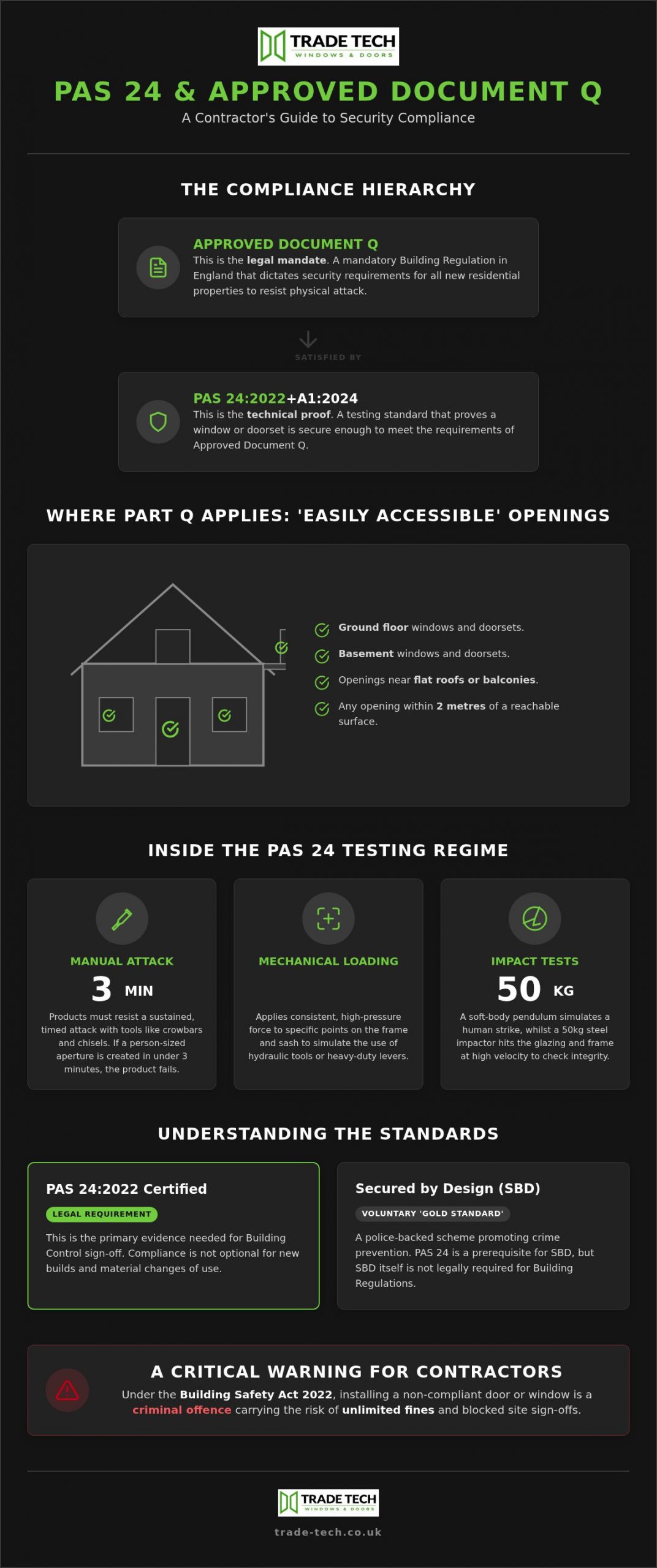
Confusion often surrounds these two terms; it’s best to view them as a hierarchy. One is the legal mandate, whilst the other is the technical proof required to satisfy it. Having PAS24 & Part Q explained clearly is vital for any project aiming for Building Control approval in Kent or Sussex. In simple terms, Approved Document Q sets the security requirements for dwellings. PAS 24 is the specific testing regime that proves a window or door is secure enough to meet those requirements. You can’t have one without the other in a professional new-build context.
What is Approved Document Q?
Published in 2015, Approved Document Q is a mandatory Building Regulation in England. It dictates that all new residential properties must be built to resist physical attack. This regulation applies to any “easily accessible” opening. For new-build contractors and developers, compliance isn’t optional. The regulation focuses on ensuring that products are sufficiently robust and fitted with appropriate hardware. Building Control typically defines accessible openings as:
- Ground floor windows and doorsets.
- Basement windows and doorsets.
- Openings near flat roofs or balconies.
- Any opening within 2 metres of a reachable surface.
Failure to provide products that meet these criteria can lead to costly delays or legal penalties. It’s a criminal offence to ignore these standards, and enforcement can now extend up to 10 years after completion.
What is PAS 24:2022?
PAS 24 is the Publicly Available Specification that provides a method for testing the enhanced security performance of windows and doorsets. The current standard is PAS 24:2022+A1:2024. Unlike tests for individual locks or hinges, this is a whole-product assessment. It subjects the entire unit to rigorous mechanical and manual stress. It covers both uPVC and aluminium systems, ensuring that every component works together as a secure barrier. Whether you’re installing uPVC casement windows or aluminium bi-folds, the PAS 24 certificate is your primary piece of evidence for compliance.
You must also distinguish between legal requirements and the Secured by Design initiative (SBD). SBD is a voluntary, police-backed scheme that promotes crime prevention through better environmental design. PAS 24 certification is a prerequisite for SBD accreditation, but SBD itself isn’t a legal requirement for Building Regulations. It acts as a “gold standard” often requested by housing associations or premium developers to provide extra peace of mind for homeowners. For most projects, however, PAS 24 certification is the specific benchmark you need to reach for legal sign-off.
The PAS 24 Testing Regime: How Windows and Doors Earn Certification
To have PAS24 & Part Q explained for your technical files, you must look beyond the paperwork and understand the physical stress these products endure. Certification isn’t granted lightly; it’s a holistic trial of the entire doorset or window assembly. The process involves multiple stages of simulated criminal activity designed to expose any structural or mechanical weakness before the product reaches your site. This ensures that the uPVC and aluminium systems you install in Kent and Sussex are more than just aesthetically pleasing; they’re genuinely secure.
The mechanical loading test applies consistent, high-pressure force to specific points on the product. This simulates the pressure of hydraulic tools or heavy-duty levers trying to force the sash from the frame. Simultaneously, manual intervention testing involves an operative using a standardised toolkit. This kit includes crowbars, chisels, and screwdrivers used to attempt entry through the most vulnerable points. A critical benchmark here is the “three-minute” rule. Products must resist a sustained, timed attack for this duration to pass. If an operative can create a “person-sized” aperture within three minutes, the product fails the assessment.
Testing the Frame and Glazing
Frame integrity is assessed using hard-body and soft-body impact tests. A soft-body test uses a heavy pendulum to simulate a human shoulder strike against the door leaf. The hard-body test involves a 50kg steel impactor hitting the glazing and frame at high velocity to check for cracking or displacement. For many composite doors and specific window configurations, the use of P1A laminated glass is essential to prevent the unit from being shattered. Testing also verifies that the glazing cannot be removed from the outside, which is a common tactic for opportunistic entry. uPVC and aluminium profiles are stressed to find weak points where the frame might flex away from the sash under pressure.
Hardware and Cylinder Vulnerability
Hardware is often the first point of failure in a security breach. Modern PAS 24 testing standards place heavy emphasis on lock cylinders. They must be resilient against “anti-snap” and “anti-bump” techniques that bypass standard euro-cylinders. Handles and hinges are also tested for their ability to resist being sheared or pried off with hand tools. During these tests, the “attack side” refers specifically to the external face of the doorset that would be exposed to a potential intruder. Providing PAS24 & Part Q explained data to Building Control is a standard part of our service. You can contact our technical team for full data sheets on our PAS 24 certified range to ensure your Kent or Sussex project remains fully compliant.
Legal Obligations: When Must Your Glazing Meet Part Q Standards?
Building Control inspectors are increasingly rigorous about documentation. For any new-build project in the Southeast, you must have your PAS24 & Part Q explained and evidenced before the final sign-off. The Official Approved Document Q states that security standards apply to all new dwellings. This includes any “easily accessible” opening. If you can’t produce a PAS 24 certificate for a ground-floor window or a basement door, you risk an enforcement notice. Under the Building Safety Act 2022, local authorities can now serve these notices up to 10 years after the work is completed.
New Build vs. Renovation
Developers in Sussex often prioritise PAS 24 even when a project technically falls outside the legal remit. Whilst Part Q generally doesn’t apply to simple domestic extensions, it’s considered best practice. Professional design-build firms, such as Spooner Brothers London, often incorporate these security benchmarks into their custom orangeries and home extensions to ensure long-term peace of mind for the homeowner. Choosing non-compliant glazing for an extension might save costs initially, but it leaves the property vulnerable. Research indicates that approximately 70-73% of burglars gain entry through a door. Installing a secure system from the start prevents future retrofitting costs and ensures the homeowner’s insurance remains valid. It also avoids the fear of Building Control rejecting an installation if they deem the work part of a more significant material change.
Commercial to Residential Conversions
Urban centres across Kent are seeing a surge in commercial-to-residential conversions. This “material change of use” triggers full Part Q compliance. You can’t simply repurpose existing commercial glazing without verifying its security credentials. If you’re installing new aluminium entrance doors, they must meet the same residential standards as a new-build house. Navigating the “reasonable provision” clause requires a supplier who provides the technical data sheets Building Control demands. We help you bridge this gap by supplying certified products that meet residential security benchmarks. This ensures your project moves from the construction phase to occupancy without technical delays or compliance failures.
Specifying Compliant Products: Hardware, Glazing, and Frame Requirements
Technical specification is where compliance is either won or lost. Having PAS24 & Part Q explained at the product level means looking beyond the frame material to the internal reinforcements and locking points. For uPVC casement windows, a multi-point locking system is the baseline requirement. However, the hardware must carry the Kitemark or an equivalent third-party accreditation to satisfy Building Control. You can’t rely on standard components; every hinge, handle, and striker plate must be part of the certified assembly that passed the physical testing regime.
Profile reinforcement plays a silent but critical role. Whilst uPVC is naturally durable, PAS 24 certification often requires additional steel or aluminium sections within the chambers to prevent the frame from flexing under mechanical load. Glazing specifications also shift when security is the priority. Standard toughened glass is often insufficient for accessible doorsets. In these cases, you must specify P1A laminated glass, which contains an interlayer designed to hold the unit together even after multiple impacts. This ensures the glass remains a barrier during the mandatory three-minute attack window.
Door Security: Composite and Aluminium
For most new-build projects, composite doors are the industry standard for Part Q compliance due to their inherent structural density. We supply these with five-point locking systems as standard to ensure pressure is distributed evenly across the frame. When you’re specifying for high-end developments, aluminium bi-folding doors must also meet these rigorous benchmarks. This involves heavy-duty shoot-bolts and hardened steel security tracks that prevent the panels from being lifted or forced out of their runners. Every component must work in unison to maintain the integrity of the thermal break whilst providing a formidable security barrier.
Window Security: Casement and Sliding Sash
Security features for uPVC windows include internal glazing beads to prevent the glass from being removed from the outside. Locking handles are mandatory, but the internal hardware is what does the heavy lifting. For sliding sash windows, achieving PAS 24 requires reinforced interlocks that prevent the sashes from being levered apart. Hinge guards are vital components that prevent the sash from being prised away from the frame on the hinge side during a physical attack. These small but essential details ensure your installation remains compliant and secure.
Request a trade price list for PAS 24 compliant glazing
Sourcing PAS 24 Glazing in Kent and Sussex: The TradeTech Advantage
Sourcing compliant glazing shouldn’t be a bottleneck in your construction schedule. In the fast-paced development environments of Kent and East Sussex, project momentum depends on the reliability of your supply chain. Having PAS24 & Part Q explained by a specialist partner ensures you don’t waste time on products that fail to meet the required benchmarks. We provide high-performance uPVC and aluminium glazing that balances technical excellence with direct trade pricing. This approach protects your project profitability whilst ensuring every installation is fully compliant from day one.
Building Control sign-off is often a paperwork-intensive process. Inspectors rarely accept verbal assurances; they require physical evidence of certification. We provide the comprehensive technical data sheets and PAS 24 certificates needed to satisfy these requirements. By choosing a local trade specialist, you gain a partner who understands the specific pressures of Southeast site management. We focus on providing the technical clarity and logistical speed necessary to keep your projects moving toward completion without compliance-related delays.
Technical Support for Contractors
Navigating the specification process for new build projects requires more than just a product catalogue. It requires expert advice on which systems meet specific security and thermal requirements. We help you select the right hardware and glass configurations for every opening, ensuring every unit supplied is accompanied by the correct PAS 24 certification. Our team provides transparent advice on trade pricing and volume orders. This helps you manage costs effectively across large-scale residential developments or complex commercial-to-residential conversions.
Reliable Delivery Across the Southeast
Logistics are just as vital as technical specs. We focus our operations on Kent and East Sussex to ensure highly responsive delivery times. Minimising site delays is our priority, which is why we provide accurate lead time projections you can actually rely on. Whether you need a single composite doorset or a full suite of aluminium bi-folds, we coordinate our deliveries to match your site’s schedule. You can contact the team today for a bespoke trade quote on compliant glazing. We provide the tools, the technical data, and the professional support you need to succeed in a competitive industry.
Secure Your Next Project with Compliant Glazing Solutions
Navigating the complexities of security regulations doesn’t have to stall your site momentum. By understanding the direct link between Approved Document Q and the physical trials of PAS 24, you protect your business from enforcement notices and costly retrofitting. Having PAS24 & Part Q explained provides the technical foundation needed to specify uPVC and aluminium systems that satisfy both Building Control and the end user. It’s about combining legal compliance with high-performance hardware and reinforced profiles to ensure every installation is robust.
TradeTech serves as your expert partner across Kent and East Sussex, providing the full technical certification required for seamless project sign-offs. Our comprehensive range of PAS 24 compliant windows and doors is designed for professional installers who value speed, accuracy, and direct trade pricing. We handle the technical headache so you can focus on delivery and site management. Whether you’re working on a residential new build or a commercial conversion, we have the systems to match your requirements.
Get a fast, professional trade quote for PAS 24 compliant glazing
We look forward to supporting your next development with reliable, certified glazing that keeps your projects on track and your clients secure.
Frequently Asked Questions
Is PAS 24 a legal requirement for all windows?
No, PAS 24 is only a legal requirement for windows in new dwellings or properties undergoing a material change of use that are deemed “easily accessible.” This typically includes all ground floor windows, basement windows, and those near flat roofs or balconies. Replacement windows in existing homes or standard extensions don’t legally require this certification, though many homeowners request it for improved security.
Does Approved Document Q apply to home extensions in Kent?
Approved Document Q generally does not apply to simple domestic extensions in Kent or East Sussex. The regulation is specifically targeted at new dwellings and material changes of use, such as converting an office block into residential flats. However, we often recommend specifying PAS 24 compliant products for extensions as best practice to ensure the new addition matches the security profile of the main building.
What is the difference between PAS 24 and Secured by Design?
PAS 24 is a specific product testing standard required to prove compliance with Building Regulations. Secured by Design is a voluntary police initiative that promotes broader crime prevention through environmental design. Whilst PAS 24 certification is a mandatory prerequisite for a product to achieve Secured by Design status, the latter is not a legal requirement for Building Control sign-off on most residential projects.
Do I need laminated glass to meet PAS 24 standards?
Laminated glass, specifically grade P1A, is usually required for doorsets and windows adjacent to doors to pass the manual intervention tests. It isn’t a blanket requirement for every window in a project. The specific glass specification depends on the individual product’s test results. We help you identify exactly which units require laminated glass to ensure your site remains fully compliant without unnecessary costs.
Can I upgrade my existing windows to meet PAS 24?
You cannot upgrade an existing window to achieve official PAS 24 certification. This standard applies to the whole assembly, including the frame, glass, and hardware, as tested in a laboratory environment. Even if you install high-security locks, the original unit won’t have the necessary paperwork required by Building Control. You must purchase a new, pre-certified window or doorset to meet these specific legal standards.
How do I prove to Building Control that my windows are Part Q compliant?
You must provide the technical data sheets and PAS 24 test certificates supplied by your manufacturer. This documentation is the primary evidence used for PAS24 & Part Q explained during a Building Control inspection. At TradeTech, we provide all necessary certification for our uPVC and aluminium systems to ensure your Kent or Sussex project moves through the sign-off process without technical delays.
Is PAS 24 certification the same as a FENSA certificate?
No, these certificates serve entirely different purposes. A FENSA certificate confirms that an installation meets general Building Regulations, such as thermal efficiency and ventilation. A PAS 24 certificate is a technical document proving that the specific product has passed rigorous physical security tests. You need the PAS 24 documentation specifically to demonstrate that the glazing meets the security requirements of Approved Document Q.
What happens if I install non-compliant windows in a new build?
If you install non-compliant glazing, Building Control can serve an enforcement notice requiring you to remove and replace the units at your own expense. Under the Building Safety Act 2022, local authorities can serve these notices up to 10 years after completion. Failure to comply is a criminal offence that can result in unlimited fines or, in extreme cases, up to two years of imprisonment.