
A cheap composite door is often the most expensive mistake a contractor can make in 2026. When site delays stem from inaccurate lead times or “faceless” national firms stop answering the phone, your margins suffer. You’ve likely dealt with the headache of poor quality hardware leading to costly call-backs or the complexity of meeting the latest Part L Building Regulations. Selecting the right composite door suppliers isn’t just about the unit price; it’s about minimising project risk through technical precision and local reliability.
We understand that your reputation depends on the durability of the products you install and the speed of your supply chain. This guide provides a masterclass in the technical and logistical criteria required to select a partner that adds value to your trade projects. You’ll learn how to navigate the 1.4 W/m²K U-value requirements for replacements and the PAS 24:2022 security standards for new builds. We’ll also examine why sourcing from a specialist Kent and East Sussex partner ensures your site stays operational whilst maintaining full compliance with the updated BS 8214 fire door standards.
Key Takeaways
- Understand the critical performance differences between foam-filled and solid timber cores to meet 2026 Part L thermal requirements.
- Identify why dedicated trade composite door suppliers offer more reliable lead times and technical support than retail-focused outlets.
- Discover the specific hardware and finish specifications essential for ensuring long-term durability in coastal Kent and East Sussex environments.
- Learn how to reduce project risk and administrative overhead by consolidating your glazing supply through a single specialist partner.
The Evolution of Composite Door Suppliers in the UK Market
A composite door is a sophisticated composite material unit engineered to resolve the inherent weaknesses of traditional timber or uPVC. By combining a dense core with a durable Glass Reinforced Plastic (GRP) skin, these units offer superior resistance to warping, bowing, and weathering. In 2026, professional composite door suppliers have moved beyond providing simple aesthetics; they now deliver high-performance engineering solutions that meet rigorous modern building standards. This evolution reflects a broader industry shift toward materials that offer longevity without the high maintenance costs of organic alternatives.
Developer demand has shifted significantly toward higher security and thermal efficiency. With the enforcement of stricter Part L regulations, a “standard” door is no longer sufficient. Reliability has become the primary currency for trade projects in 2026. Site managers can’t afford to wait for missing components or deal with poor communication from national, faceless entities. You need a partner that understands both residential and commercial glazing requirements to keep your project on track. Accuracy in lead times and technical support is now as vital as the product itself.
Why Composite Doors are Replacing uPVC as the Trade Standard
uPVC was once the default for cost-efficiency, but composite doors have claimed the trade standard. The enhanced structural integrity provided by solid timber or GRP cores makes them virtually impenetrable compared to standard uPVC frames. For new-build contractors and developers, the aesthetic appeal is a major driver. These doors add immediate kerb value, offering a premium feel that helps sell properties faster. They also require far less maintenance than traditional timber, meaning fewer call-backs for adjustments or refinishing over the building’s lifecycle.
Key Market Trends for 2026
The market is currently seeing a surge in “Smart” hardware integration. High-end developers are increasingly specifying doors with integrated sensors and keyless entry systems as standard. Bespoke colour palettes have also moved beyond standard Anthracite Grey; heritage shades like Chartwell Green and deep earthy tones are now common requests for regional projects. Stricter enforcement of thermal performance means that composite door suppliers must now prove the sustainability of their entire supply chain, ensuring every unit contributes to the overall energy rating of the development whilst meeting the PAS 24:2022 security standard.
Technical Specifications: Evaluating Core Materials and Performance
Technical precision is the hallmark of a professional installation. When evaluating composite door suppliers, you must look beyond the surface finish to the engineering beneath. The Association of Composite Door Manufacturers provides the framework for these standards, ensuring that units meet the rigorous demands of modern construction. A supplier’s ability to provide detailed data sheets on core density and skin thickness is a key indicator of their suitability for trade projects.
The structural integrity of a door depends heavily on its core composition. Most high-volume projects utilise Glass Reinforced Polyester (GRP) skins over a high-density foam core. This combination is highly effective for thermal insulation. Alternatively, solid timber cores offer a different set of benefits, prioritising weight and a traditional “thud” when closing. Both systems must be encased in a robust outer skin that provides scratch resistance and long-term colour longevity, even in high-traffic environments.
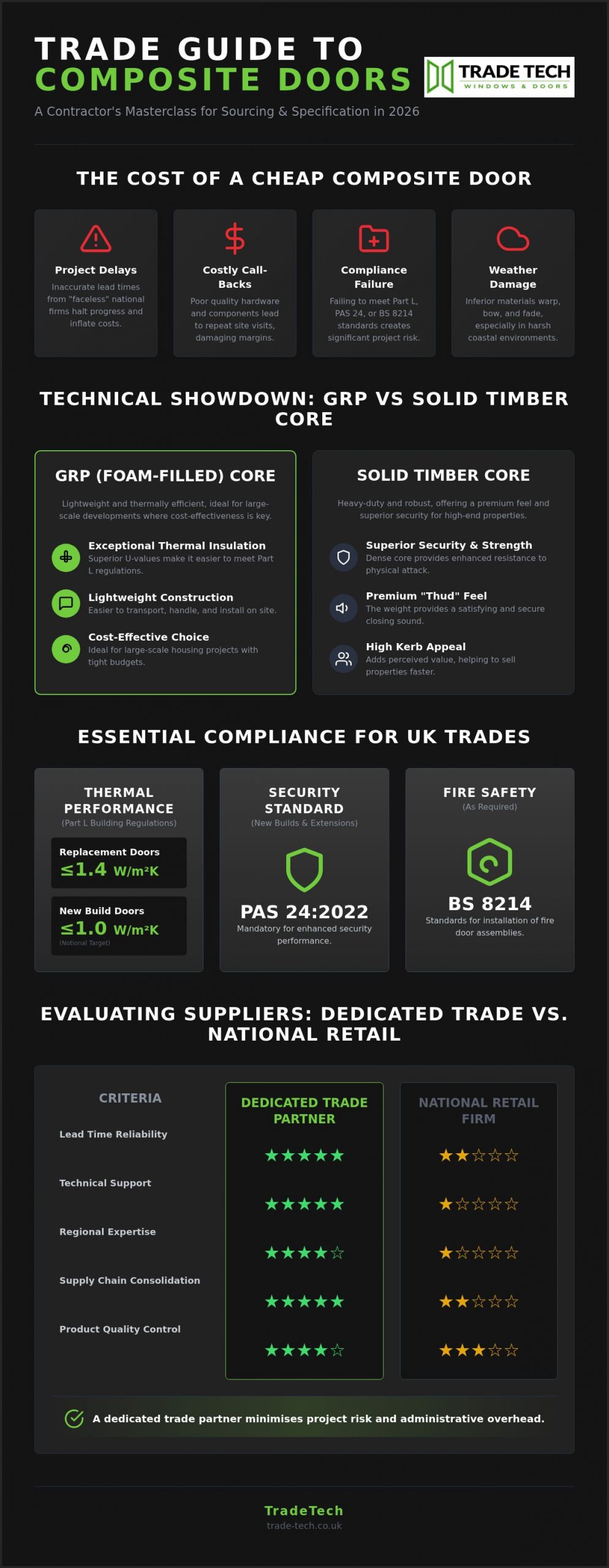
Thermal efficiency is no longer optional. For replacement projects, doors must achieve a U-value of ≤1.4 W/m²K to comply with Part L Building Regulations. New build developments face even tighter notional targets of 1.0 W/m²K. Acoustic performance is equally vital for urban developments or sites near major infrastructure. A well-specified composite door acts as an effective sound barrier, significantly reducing decibel transfer compared to older timber or hollow-core uPVC alternatives. Safety glass compliant with BS EN 12150 is a legal requirement under Part K for all glazed sections within 1,500mm of the floor level.
GRP vs Solid Core: Which Should You Specify?
Your choice of core material should align with the specific project goals. GRP doors are lightweight and offer exceptional thermal insulation, making them the cost-effective choice for large-scale housing developments. Solid timber cores provide a premium, heavy-duty performance that feels more substantial to the end-user. Specify GRP for high-volume social housing or budget-conscious developments, whilst reserving solid timber cores for premium residential projects where tactile quality is paramount. You can explore our range of bespoke composite doors to see how these specifications fit your next project.
Security Standards and PAS 24 Compliance
Security remains a non-negotiable priority for developers and homeowners alike. All accessible doors in new dwellings must meet the PAS 24:2022 enhanced security standard to satisfy Part Q requirements. This involves testing the door leaf and frame as a complete unit rather than as individual components. Multi-point locking systems are essential for achieving these standards. It’s critical to ensure that hardware, including handles and letterplates, matches the longevity of the door leaf to prevent premature failure and expensive call-backs.
Evaluating Composite Door Suppliers: Trade vs Retail Sourcing
Choosing between high-street retail outlets and professional composite door suppliers is a decision that impacts your project’s viability and your firm’s reputation. Retailers are structured for one-off consumer sales. They often lack the logistical infrastructure to handle phased deliveries or the technical depth required for multi-unit developments. For a contractor, relying on a retail-focused firm often leads to site delays and misaligned expectations. Professional trade suppliers provide the technical expertise needed to ensure every unit aligns with the UK Building Regulations (Approved Documents), particularly regarding Part L thermal performance and Part Q security.
Margins are protected through dedicated trade pricing structures. Unlike retail pricing, which fluctuates based on consumer marketing, trade accounts offer stability and volume-based discounts essential for accurate tendering. Credit facilities are also a vital component for managing cash flow across long-term builds. For professionals who value this level of analytical oversight, DTR Traders offers specialised market tools and a private community to help navigate broader financial trends. A “supply only” model from a national, faceless supplier often leaves you vulnerable. If a frame arrives damaged or a measurement is slightly out, you’re frequently stuck in a generic customer service queue. A dedicated trade partner acts as an extension of your team, providing proactive solutions rather than just a product in a box.
The Benefits of a Dedicated Trade Glazing Partner
A professional partner provides access to bespoke quoting tools and detailed technical drawings. This level of precision is essential during the specification phase to avoid costly errors on site. Priority lead times ensure that your installation schedule remains intact, respecting the specific phases of your construction programme. When you have direct access to expert advice for complex architectural glazing, you significantly reduce the risk of non-compliance. This support is invaluable when coordinating various elements like aluminium windows or roof lanterns alongside your door order.
Quality Control and After-Sales Support
Warranty terms are only as good as the supplier’s ability to honour them quickly. Rapid resolution of site issues requires a local presence and a supportive partnership approach. If a hardware fault occurs or a component is missing, you need a partner who can provide immediate assistance rather than waiting weeks for a replacement from a distant warehouse. Evaluating composite door suppliers based on their responsiveness is just as important as the initial unit cost. For those requiring trade pricing and professional support, a Kent-based specialist provides the reliability and regional knowledge that national firms often fail to deliver.
Sourcing for Regional Projects: Kent and Sussex Requirements
Architectural harmony is vital for planning approval and buyer appeal. The Southeast features a diverse mix of Victorian terraces, Oast house conversions, and sleek modern apartments. Matching the right door design to these varied styles requires a supplier with a deep understanding of the local landscape. Local knowledge of regional planning and building control expectations can prevent delays during the final sign-off phase, ensuring every unit meets the necessary aesthetic and safety criteria.
Coastal environments are notoriously aggressive on building materials. For projects within 5 miles of the Sussex coast, standard hardware is insufficient. Salt-laden air accelerates corrosion, making marine-grade stainless steel hardware a necessity rather than an upgrade. UV-stable GRP skins are equally critical; the high exposure levels on Southeast elevations can lead to colour fading if the material isn’t correctly specified. Sourcing composite doors for Kent developments ensures you receive products tested against these specific regional stressors.
Logistical Efficiency in the Southeast
Logistical precision is the foundation of site efficiency. Sourcing from a Kent-based hub drastically reduces your carbon footprint and transport costs compared to national shipping. Reliable composite door suppliers who understand the complexities of local road networks, such as the M20 or the tight access routes in historic Eastbourne, can guarantee more dependable delivery windows. This local familiarity ensures that site access constraints are managed proactively, preventing the bottlenecks that plague larger, “faceless” logistics operations. We provide comprehensive support for new-build contractors and developers across the region to streamline this process.
Request a trade quote for your Southeast project
Streamlining Your Glazing Supply with Trade Tech Windows & Doors
Trade Tech Windows & Doors operates as a strategic partner rather than just another name amongst composite door suppliers. We provide a single point of contact for your entire glazing package, including composite doors, aluminium entrance doors, and roof lanterns. This consolidated approach eliminates the logistical friction of managing multiple vendors. It ensures that technical specifications remain consistent across every opening on your site. By acting as an independent specialist based in Kent, we offer the responsiveness that national, faceless firms cannot match.
Our “specialist supplier and installer” model is designed specifically to reduce contractor risk. Most suppliers stop at the point of delivery, leaving you to manage the complexities of installation and compliance. We take a proactive role in site management, ensuring that every unit is fitted to meet the exact requirements of Part L and Part Q. This hands-on approach minimises the likelihood of call-backs and ensures your project passes building control inspections without delay. We understand the specific pressures of Southeast construction and provide a no-nonsense trade service that respects your margins and your time.
Consolidated Supply for Glazing Projects
There is significant efficiency in ordering aluminium windows and composite doors from one partner. This allows for perfect aesthetic matching, ensuring that frame profiles and colour finishes remain cohesive across the entire development. We organise our deliveries to align precisely with your project timeline, whether you require a single drop for a bespoke build or phased arrivals for a larger housing scheme. Consolidating your supply chain through Trade Tech Windows & Doors reduces administrative overhead and simplifies your site logistics whilst maintaining high standards of quality control.
Professional Installation and Partnership
Our expert installation service is the preferred choice for developers across Kent and East Sussex who value precision. We don’t just supply products; we provide technical problem-solving on the ground. If a site condition changes or a measurement requires adjustment, our team is equipped to handle it immediately. This supportive partnership builds trust and ensures a stable foundation for your project’s success. We invite you to contact our trade desk for a consultation to discuss your 2026 project requirements. Our team will guide you through the technical specification process to ensure your professional quote reflects the most efficient solution for your site.
Securing Your Next Development with Technical Precision
Mastering the technical landscape of 2026 requires a shift from simple procurement to strategic partnership. You’ve seen how critical the 1.4 W/m²K U-value target is for compliance and how marine-grade hardware protects your reputation in coastal builds. The right choice amongst composite door suppliers isn’t just about the door leaf; it’s about the technical support and logistical reliability that keeps your site moving. Accuracy in lead times and technical precision are the new industry standards.
Consolidating your glazing through a specialist Kent partner reduces administrative friction and ensures a cohesive finish across windows and doors. We provide high-performance glazing solutions and a no-nonsense professional trade service tailored for Kent and Sussex developers. Our team understands the specific pressures of the Southeast construction industry and delivers the stability your business deserves. Relying on local expertise means fewer call-backs and a more efficient path to final sign-off.
Request a Professional Trade Quote Today
We’re ready to provide the precision and reliability your next construction programme requires.
Frequently Asked Questions
What is the typical lead time for trade composite doors in Kent?
Lead times for trade composite doors in Kent typically range from 10 to 15 working days for standard specifications. Bespoke colour matches or non-standard glazing configurations can extend this to 4 weeks. We prioritise project efficiency by providing accurate delivery windows that align with your site phases. Reliable composite door suppliers understand that delays cost money, so we maintain a transparent schedule to ensure your installation team stays productive.
How do composite doors compare to uPVC for security in commercial projects?
Composite doors offer significantly higher structural integrity than standard uPVC units due to their dense core and GRP skin. While modern uPVC doors are secure, the multi-material construction of a composite door resists forced entry more effectively. All our units meet the PAS 24:2022 enhanced security standard. This makes them the preferred choice for commercial glazing projects and high-traffic residential developments where long-term durability and tenant safety are primary concerns.
Do your composite door units meet the latest Part L thermal regulations?
Yes, our composite door units fully comply with the latest Part L thermal regulations for 2026. For replacement projects, our doors achieve a U-value of 1.4 W/m²K or lower. For new-build developments, we provide high-performance specifications that meet the notional target of 1.0 W/m²K. Using advanced thermal breaks and high-density cores ensures your project meets building control requirements whilst reducing the overall energy footprint of the property.
Can you supply matching composite doors and aluminium bi-folds for the same project?
We specialise in providing consolidated glazing packages that include matching composite doors and aluminium bi-folding doors. Sourcing from a single partner ensures that colour finishes and hardware styles remain consistent across the entire project. This approach simplifies your site logistics and reduces administrative overhead. You won’t have to coordinate between multiple composite door suppliers and window firms, ensuring a cohesive aesthetic finish for your client.
What is the difference between GRP and Solid Core doors for trade specification?
GRP doors feature a high-density foam core encased in a glass-reinforced polyester skin, offering exceptional thermal insulation and lightweight handling. Solid core doors use a laminated timber interior, providing a heavier, premium feel and maximum structural rigidity. Specify GRP for high-volume projects where energy efficiency and cost are priorities. Choose solid core for luxury developments where the tactile “thud” of a heavy door is essential for the end-user’s perception of quality.
Do you offer supply and install services for new-build developments in Sussex?
We provide a comprehensive supply and install service for developers and contractors across East Sussex and Kent. Our specialist installation team is experienced in handling large-scale new-build projects, ensuring every unit is fitted to meet Part Q security and Part L thermal standards. By managing the process from technical survey to final sign-off, we reduce your project risk and ensure that the glazing installation doesn’t delay following trades.
How do I set up a trade account for competitive glazing pricing?
Setting up a trade account is a straightforward process that begins with a consultation with our trade desk. We’ll evaluate your project volumes and frequency to provide a competitive pricing structure tailored to your business needs. Account holders benefit from bespoke quoting tools, technical support, and priority lead times. This supportive partnership ensures you have the reliable backing necessary to tender accurately for residential or commercial glazing contracts in the Southeast.
What hardware options are recommended for coastal properties in the Southeast?
For properties within 5 miles of the Southeast coast, we recommend marine-grade stainless steel hardware as standard. Salt-laden air in areas like Eastbourne or Brighton quickly corrodes standard finishes, leading to premature failure. We also specify UV-stable GRP skins to prevent colour fading on exposed elevations. These technical choices ensure that your installations withstand the aggressive coastal environment, significantly reducing the likelihood of call-backs and maintaining the building’s kerb appeal.