
The 2026 Building Regulations update has fundamentally shifted the technical requirements for every installer across Kent and Sussex. Sourcing high-quality trade upvc doors shouldn’t feel like a gamble with your professional reputation or your project timelines. You’re likely tired of site delays caused by poor supplier communication whilst facing the stress of inconsistent product quality. You need a supply partner that understands the urgency of a live site and the precision required for modern building standards.
This professional guide delivers a comprehensive technical and commercial framework for sourcing high-performance units that actually perform. We’ll show you how to navigate the latest regulatory changes, ensuring every door meets the 1.4 W/m²K U-value limit for replacements or the stricter 1.0 W/m²K targets for new builds. You’ll learn how to prioritise a streamlined supply chain and verify PAS 24:2022 security compliance without the usual administrative headache. We’re providing the roadmap to secure local technical support that keeps your projects moving and your business growing.
Key Takeaways
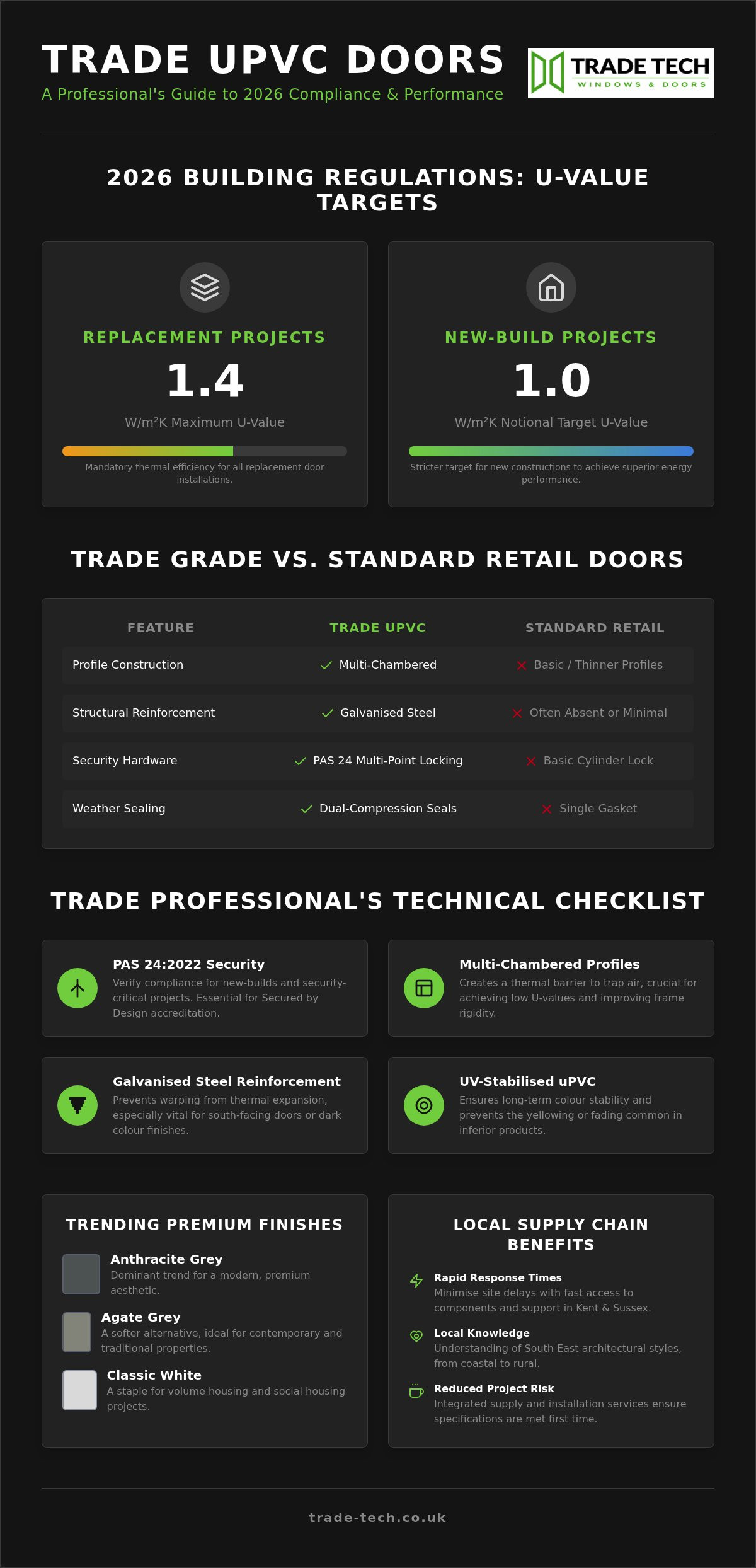
- Master the 2026 thermal efficiency targets, ensuring your installations meet the 1.4 W/m²K U-value for replacements and 1.0 W/m²K for new-build projects.
- Distinguish between standard retail units and high-performance trade upvc doors to guarantee profile consistency and long-term hardware reliability.
- Simplify building regulation compliance by identifying exactly which projects require PAS 24:2022 testing or Secured by Design accreditation.
- Compare the commercial viability of uPVC against composite alternatives to select the most cost-effective solution for social housing or luxury developments.
- Streamline your local supply chain in Kent and Sussex to reduce site delays and access bespoke technical support for complex glazing requirements.
Sourcing Trade uPVC Doors: More Than Just a Price Point
Retail doors are built for a showroom; trade upvc doors are built for a site. For the professional installer, the distinction isn’t merely aesthetic. It’s about structural integrity, compliance, and long-term reliability. The core of any high-performance door is Unplasticized Polyvinyl Chloride (uPVC), a rigid material chosen for its durability and resistance to the British weather. Whilst retail alternatives often prioritise thin profiles to reduce costs, trade-grade units focus on profile consistency. This ensures that every frame is square, every weld is clean, and every installation is efficient.
Professional contractors across Kent and Sussex now face a shift in market expectations. High-performance housing developments require more than just a “supply only” delivery. You need a partner that offers an integrated supply and installation service. This model reduces the risk of site damage and ensures that technical specifications are met from the first measurement to the final sign-off. In a competitive residential market, the ability to guarantee hardware reliability and thermal performance is a significant commercial advantage.
The Trade Professional’s Checklist
Precision matters. When assessing trade upvc doors, your checklist should start with the internal architecture of the profile. Multi-chambered designs are essential. These chambers trap air to create a thermal barrier, which is vital for meeting the 2026 Part L requirements. Without these, achieving the necessary U-values becomes impossible without resorting to prohibitively expensive glazing units.
Structural stability is the next priority. High-quality trade frames must include galvanised steel reinforcement. This prevents the uPVC from warping under thermal expansion, especially in south-facing installations or with darker colour finishes like Agate Grey. Finally, evaluate the hardware. Multi-point locking systems aren’t an optional upgrade; they’re a trade standard required for PAS 24:2022 compliance. Look for robust hinges and cylinders that can withstand high-frequency use in busy residential settings.
Why Local Supply Matters in the South East
Logistics can make or break a project’s profitability. Relying on national suppliers often leads to site delays when a single component is missing or damaged. Kent-based logistical support allows for rapid response times and a more personal service. A local supplier understands the specific architectural styles of the South East, from the traditional weatherboarded cottages in the Weald to contemporary coastal apartments in Sussex. For those managing broader glazing packages, our range of Trade uPVC and Aluminium Windows complements these door systems perfectly, ensuring a consistent finish across the entire building envelope.
Technical Specifications for High-Performance uPVC Doors
Technical precision defines the success of a trade installation. With the 2026 updates to Approved Document L, the thermal performance of trade upvc doors is no longer a secondary consideration. For replacement projects, you must achieve a maximum U-value of 1.4 W/m²K. New-build specifications are even more demanding, often requiring a notional target of 1.0 W/m²K. Meeting these targets requires a combination of high-performance profiles and advanced glazing technology.
In urban Kent locations like Maidstone or Ashford, acoustic insulation is a critical specifier. Heavy traffic noise requires doors that do more than just keep the heat in; they must act as a sound barrier. High-density uPVC frames, when paired with the right glazing configuration, significantly reduce decibel transfer. This performance is complemented by a range of contemporary finishes. Whilst classic white remains a staple for volume housing, Agate Grey and Anthracite Grey are the dominant trends for 2026, offering a premium aesthetic that mimics aluminium at a more accessible price point. For professionals looking to broaden their network, Trading With Traders provides a premium online community for traders to share expertise and grow.
Structural rigidity starts with the internal profile design. Multi-chambered systems are engineered to trap stagnant air, which acts as a natural insulator. These chambers also provide the necessary strength to support heavy double or triple-glazed units without sagging over time. To ensure long-term durability, specify UV-stabilised uPVC. This prevents the discolouration often seen in inferior retail products, maintaining the door’s appearance for decades. Weather-sealing technology has also advanced; dual-compression seals now provide a superior airtight fit, reducing call-backs for draughts or water ingress.
Advanced Glazing for Trade Projects
Glazing is the most significant factor in a door’s thermal and safety profile. Meeting Building Regulations requires toughened safety glass to BS EN 12150 for all door installations up to 1,500mm from the floor. By integrating high-performance sealed units, you can achieve the 1.0 W/m²K targets required for the Future Homes Standard. Low-E glass coatings and argon-filled cavities are now standard requirements rather than optional extras. For residential back doors, you can specify obscured or decorative glass patterns to provide privacy without sacrificing natural light.
If you’re managing a complex project, you can discuss your technical requirements with our specialist team for bespoke advice.
UPVC vs. Composite Doors: A Trade Comparison
Choosing between trade upvc doors and composite alternatives is a strategic decision based on project type and budget allocation. For large-scale social housing or multi-unit residential projects, uPVC remains the commercially dominant choice. It offers an unbeatable balance of thermal performance and low unit cost. In contrast, luxury developments in Sussex often demand the structural weight and aesthetic depth of a composite door for primary entrance points to justify a higher market valuation.
Maintenance requirements are a primary driver for rental portfolio managers and housing associations. uPVC is virtually maintenance-free, requiring only occasional cleaning and hardware lubrication to ensure longevity. This significantly reduces long-term operational costs compared to timber or high-maintenance finishes. Additionally, uPVC provides excellent aesthetic flexibility. You can match door profiles exactly to existing window suites, ensuring a unified look across the building envelope without the colour variance often found between different material manufacturers.
Security is another critical comparison point for the professional installer. Whilst both materials can achieve PAS 24:2022, they do so through different engineering methods. Composite doors use a GRP skin and solid core for physical mass, whereas uPVC relies on internal steel reinforcement and multi-chambered rigidity. Adhering to professional uPVC door security standards ensures that even the most cost-effective uPVC unit provides robust protection against forced entry, meeting the requirements of both insurers and local authorities.
When to Specify uPVC Doors
Specify uPVC for high-traffic garden access points where cost and functionality must align perfectly. uPVC French doors are ideal for these applications, offering wide apertures and reliable weather sealing at a competitive price point. In multi-unit developments, the cost-efficiencies of volume trade upvc doors allow for higher specifications elsewhere in the build. To maintain consistency, many contractors pair these doors with high-quality uPVC windows to streamline the procurement process. This approach ensures that technical support and delivery schedules remain centralised through a single local supplier.
When to Upgrade to Composite
Kerb appeal is the primary reason to upgrade to a composite specification. For the main entrance of a high-end Sussex build, composite doors provide a premium feel that standard uPVC cannot replicate. The enhanced thermal mass of a solid-core composite door also contributes to a more substantial acoustic and thermal experience for the homeowner. These units are best reserved for primary facades where the visual impact and perceived security justify the higher capital expenditure per opening.
Meeting Building Regulations and Security Standards
Regulatory compliance isn’t just a hurdle; it’s the foundation of every professional tender. The UK government laid the Building Regulations etc. (Amendment) (England) Regulations 2026 on 24 March 2026, marking a significant shift towards the Future Homes Standard. For installers in Kent and Sussex, this means trade upvc doors must now meet more stringent thermal and security benchmarks. Whilst the new rules for standard work apply from 24 March 2027, savvy professionals are already specifying to these higher standards to future-proof their projects. Precision is mandatory.
Approved Document L now mandates a maximum U-value of 1.4 W/m²K for replacement doors in existing dwellings. New build projects are even more demanding, with a notional specification of 1.0 W/m²K for opaque and semi-glazed doors. Beyond thermal performance, Approved Document M requires careful attention to threshold heights to ensure compliance with disabled access requirements. Thresholds shouldn’t exceed 15mm while maintaining weather-tightness, a technical challenge that requires precision-engineered profiles. Every installation should be backed by FENSA or CERTASS certification to provide homeowners and developers with the necessary legal assurance.
Thermal Efficiency and U-Values
Calculating the total unit U-value is critical for accurate project tenders. You shouldn’t rely on the glass value alone; the entire frame and sash assembly must be factored in. Achieving A-rated performance in standard uPVC door frames usually requires argon-filled sealed units and low-E glass. These components work together to trap heat, ensuring the building envelope remains efficient and compliant with the latest energy and greenhouse gas emission standards. High-performance units are no longer an optional upgrade; they’re the new industry baseline.
Security and Hardware Specification
Security is a non-negotiable requirement for modern residential developments. Compliance with PAS 24:2022 is a pass/fail standard that tests a product’s resistance to break-in attempts. For new build contractors, meeting Approved Document Q often necessitates Secured by Design (SBD) accreditation. This requires multi-point locking systems featuring hook bolts and deadbolts as standard. Hardware must also include anti-pick, anti-drill, and anti-snap cylinder locks to defend against common forced entry methods. It’s about protecting both the property and your professional reputation. Secured by Design isn’t just a badge; it’s a police-backed initiative that ensures trade upvc doors provide genuine peace of mind.
Access our latest trade pricing for compliant door systems
Streamlining Your Supply Chain with TradeTech
Efficiency in the supply chain is the primary differentiator between a profitable project and a logistical failure. National distributors often prioritise volume over local responsiveness, leaving contractors to manage site delays and technical errors alone. TradeTech operates differently. By focusing specifically on Kent and East Sussex, we provide the “boots on the ground” support that national “supply only” models cannot replicate. This proximity allows for proactive communication regarding lead times and reliable delivery schedules that respect your site’s operational rhythm.
Managing complex glazing requirements requires more than just a product catalogue. It requires a partner capable of providing bespoke architectural solutions for non-standard openings. Whether you’re specifying trade upvc doors for a residential block or coordinating a full glazing package for a commercial development, we support you from the initial specification through to the final installation. This end-to-end involvement ensures that technical details aren’t lost in translation between the supplier and the site team.
Professional Installation Services
Precision fitting is critical to maintaining the performance of high-specification units. Even the most advanced profile will fail to meet thermal or security benchmarks if installed incorrectly. For large-scale commercial glazing projects, expert installation is a necessity rather than an option. Our teams provide on-site technical advice to Kent developers, identifying potential issues before they become costly delays. By prioritising accuracy during the initial fit, we significantly minimise snagging lists and ensure that every unit performs exactly as specified in your project tender.
Partnering for Project Success
Success in the trade is built on reliable partnerships and consistent quality. By opening a trade account, you gain access to trade-only pricing and dedicated account management. This personalised service ensures that your specific project requirements are always prioritised. The breadth of the TradeTech range allows you to source your entire glazing package from a single, dependable supplier. From high-performance trade upvc doors and windows to contemporary roof lanterns and aluminium shopfronts, we provide a unified solution for every architectural challenge.
Contact TradeTech today for a professional quote
Securing Your Advantage in the 2026 Market
Success in the modern fenestration industry requires more than just high-quality hardware. It demands a thorough understanding of the 2026 Building Regulations and a commitment to technical precision. By specifying high-performance trade upvc doors, you ensure that every project meets the necessary 1.4 W/m²K thermal targets and PAS 24:2022 security benchmarks. This proactive approach protects your professional reputation and eliminates the risk of costly site delays.
TradeTech is your specialist supplier for Kent and East Sussex, providing the expert installation support and local logistical reliability that national distributors often lack. Our focus on developer needs ensures you receive the on-site technical advice required for complex glazing packages. Partnering with a local expert means your supply chain remains streamlined and your delivery schedules stay on track.
Request a Professional Trade Quote
We’re ready to help you deliver excellence on every site. Let’s build a more efficient future for your business together.
Frequently Asked Questions
What are the current lead times for trade uPVC doors in Kent?
Lead times for trade upvc doors vary based on the specific profile and finish chosen for your project. As a specialist supplier for Kent and East Sussex, we prioritise local logistics to ensure the most efficient delivery schedules possible. Standard white units typically move faster than bespoke foils or architectural colours. We recommend contacting our team with your specific schedule to receive an accurate timeline for your site requirements.
Do your uPVC doors meet the latest 2026 Part L building regulations?
Yes, our high-performance door systems are engineered to meet and exceed the 2026 Part L requirements. We provide units that achieve the mandatory 1.4 W/m²K U-value for replacements and the stricter 1.0 W/m²K notional targets required for new-build developments. By utilising multi-chambered profiles and advanced sealed units, we ensure your projects remain fully compliant with the latest energy and greenhouse gas emission standards implemented under the Future Homes Standard.
Can TradeTech provide both supply and installation for large-scale developments?
We offer a fully integrated supply and installation service specifically designed for developers and new-build contractors. Our teams provide on-site technical advice and precision fitting for large-scale residential and commercial projects across the South East. This end-to-end approach reduces the risk of site damage and ensures that complex architectural glazing solutions are executed to the highest technical standards. It allows you to consolidate your supply chain and maintain consistent quality.
What security certifications do your trade uPVC doors hold?
Every door in our trade range is tested to PAS 24:2022 standards to ensure robust resistance against forced entry. We also supply products that meet Secured by Design (SBD) requirements, which is a police-backed initiative mandatory for many new-build specifications under Approved Document Q. Our hardware includes multi-point locking systems with hook bolts and anti-snap cylinders as standard. These features provide the high level of security expected by insurers and local authorities.
Are there specific uPVC door styles recommended for Sussex conservation areas?
For projects in Sussex conservation areas, we recommend specifying flush sash profiles that sit flat within the frame to mimic traditional timber joinery. Pair these with authentic woodgrain foils or heritage colours like Agate Grey to satisfy local planning requirements whilst maintaining modern thermal performance. Whilst uPVC is highly versatile, we suggest consulting with local planning officers early in the specification process to ensure the chosen style aligns with specific regional heritage guidelines.
How do trade uPVC door prices compare to aluminium alternatives?
Trade upvc doors remain the most cost-effective solution for high-volume residential projects compared to aluminium. uPVC typically offers superior thermal insulation at a lower capital cost, making it the preferred choice for social housing and rental portfolios. Aluminium is generally specified for larger glazed openings or high-end contemporary builds where the strength of the material allows for slimmer sightlines. However, for standard residential openings, uPVC provides the best balance of performance and value.
Do you offer bespoke sizing for non-standard door apertures?
We specialise in providing bespoke architectural solutions for non-standard door apertures across all our product ranges. Every unit is manufactured to your exact site measurements, ensuring a precision fit that minimises installation time and snagging issues. Whether you require oversized frames for a commercial shopfront or unique configurations for a complex residential renovation, our technical team can assist with the specification to ensure structural integrity, weather-tightness, and full regulatory compliance.
What guarantees are provided on trade-supplied uPVC door hardware?
Hardware guarantees vary depending on the specific locking systems and handles specified for your project. We only supply trade-grade hardware designed for high-frequency use in busy residential and commercial environments. To ensure long-term reliability and compliance with security standards, we recommend following a regular maintenance schedule of hardware lubrication. Please contact our technical desk to discuss the specific warranty details and performance ratings for the hardware components included in your professional trade quote.