
A single delayed delivery or a scratched GRP skin can wipe out your profit margin on a South East residential project. You need high-performance composite front doors that arrive on schedule and remain in peak condition long after the final handover. Durable. Secure. Efficient. Finding a reliable local supplier in Kent or Sussex often feels like a constant trade-off between competitive pricing and technical precision. It is a challenge that can stall even the most efficient building programmes.
We recognise that inconsistent trade pricing and poor quality finishes lead to expensive call-backs and frustrated clients. It is a common industry pain point that complicates specifying for new builds and conversions, whilst also threatening project timelines. This comprehensive trade guide promises to simplify your procurement by providing a technical roadmap for sourcing PAS 24:2022+A1:2024 compliant units. We will examine essential thermal efficiency requirements, including the 1.4 W/m²K U-value limit for replacements, and preview the high-security hardware specifications required to meet the Future Homes Standard. By the end of this article, you will know exactly how to secure the best products for your Sussex or Kent project through the fast, accurate, and comprehensive support your business requires.
Key Takeaways
- Understand why GRP skins and multi-material cores make high-security composit front doors the most durable option for South East projects.
- Specify with confidence by mastering Part Q and PAS 24 security requirements for new-build and conversion developments.
- Evaluate the performance differences between composite, uPVC, and aluminium units to reduce long-term call-backs and maintenance.
- Achieve Part M compliance through precise threshold management and accurate surveying tolerances during the installation phase.
- Optimise your site schedule by sourcing directly from a local Kent partner to secure reliable lead times and consistent trade pricing.
Understanding Composite Front Door Construction and Performance
A composite door is a precision-engineered assembly. It’s designed to endure the high-traffic demands of Kent housing developments. By combining GRP, timber, and insulating foam, these units provide durability that single-material doors cannot match. Understanding Composite Door Construction is vital for contractors. It helps eliminate the risk of call-backs caused by environmental stress or mechanical failure. Trade professionals specify composit front doors because they offer a superior cost-to-performance ratio compared to traditional alternatives.
The Anatomy of a High-Security Composite Door
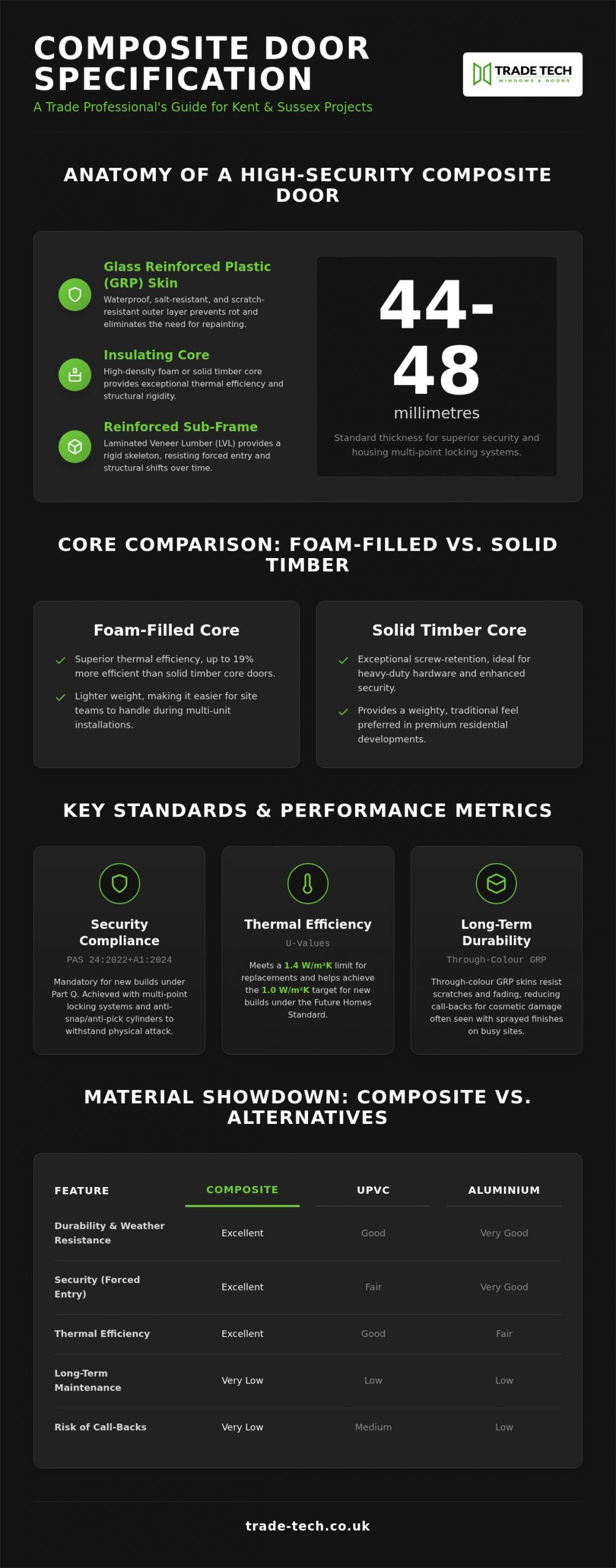
The integrity of a door depends on its internal structure. Most high-performance units feature a robust sub-frame integrated with a reinforced outer frame. This sub-frame is often manufactured from high-density materials like LVL (Laminated Veneer Lumber). It provides a rigid skeleton that resists forced entry and structural shifting. We typically supply composit front doors with a thickness of 44mm to 48mm. This extra mass provides the depth required for multi-point locking systems and improves the unit’s overall security rating. Heat-reflective skins are another critical component. They prevent the door from absorbing excessive solar energy. This reduces the likelihood of bowing or twisting during the warmer months in the South East.
GRP vs. Solid Timber Cores: A Trade Comparison
Choosing between a foam-filled core and a solid timber core involves balancing weight, security, and budget. Both options provide distinct advantages for different project types:
- Foam-filled cores: These offer superior thermal efficiency. They are lighter and easier for site teams to handle during multi-unit installations.
- Solid timber cores: These provide exceptional screw-retention for heavy-duty hardware. They offer a weighty, traditional feel that many premium buyers in Sussex prefer.
Impact resistance remains high across both types due to the GRP (Glass Reinforced Plastic) skin. This protective layer is the same material used in boat hulls. It’s waterproof, salt-resistant, and won’t rot. For coastal developments in Kent, this is a non-negotiable feature. GRP is scratch-resistant and doesn’t require the constant repainting associated with traditional timber. Some GRP foam-filled units are up to 19% more thermally efficient than a standard 48mm solid timber core door. This helps your project meet the 1.0 W/m²K target for new builds or the 1.4 W/m²K limit for replacement composite doors.
Selecting the Right Composite Door Specification for Your Project
Specifying composit front doors for professional developments requires a technical approach that goes beyond simple aesthetics. For new builds across Kent and Sussex, meeting Part Q building regulations is the primary hurdle. You need a product that balances visual appeal with strict legal security and thermal standards. Choosing the wrong specification leads to failed building control inspections and costly retrofitting. Professional contractors prioritising efficiency should focus on through-colour GRP skins. These are superior to sprayed finishes because the colour remains consistent even if the surface is scratched. This durability is vital on busy construction sites where minor transit damage is common.
Security Standards: PAS 24 and Document Q Compliance
Security is a non-negotiable requirement for modern developers. PAS 24:2022+A1:2024 is the current benchmark for accessible doorsets. This standard involves rigorous testing to ensure the frame and leaf can withstand coordinated physical attacks. Many housing association contracts and premium residential sites now mandate products that align with the official police security initiative. To meet these standards, hardware selection is critical. Multi-point locking systems are the industry standard. They secure the door leaf at multiple points along the frame to prevent it from being prised open. We recommend high-security cylinders featuring anti-snap and anti-pick technology. These features provide a robust defence against common burglary methods and ensure long-term peace of mind for the homeowner.
Glazing Options and Thermal Integrity
The glass you specify significantly impacts the overall U-value of the entrance. While the Future Homes Standard sets a target of 1.0 W/m²K for new builds, the glazing cassette is often the weakest point for heat loss. Triple glazing offers the best thermal performance, but double glazing remains a popular, cost-effective choice for many South East developments. It’s essential to ensure that decorative or privacy glass doesn’t compromise the unit’s thermal seal. You should also verify that the glazing cassettes are properly drained to prevent moisture ingress. Explore our range of sealed units to find high-performance glass options that maintain thermal integrity whilst providing the required privacy levels.
Hardware isn’t just about security; it’s about the daily user experience. High-quality handles, letterplates, and knockers should be manufactured from corrosion-resistant materials, particularly for coastal projects in Sussex. Choosing the right hardware finish can elevate a standard installation into a premium feature. If you are currently specifying for a multi-unit development, you can access our competitive trade pricing to ensure your project stays within budget without sacrificing quality.
Comparing Composite Doors vs. uPVC and Aluminium Alternatives
Trade professionals often weigh up composit front doors against uPVC or aluminium based on project specificities. Whilst uPVC remains the budget-friendly choice for high-volume entry-level builds, it often lacks the kerb appeal and structural rigidity required for premium developments. Conversely, aluminium offers a sleek, modern aesthetic but can carry a higher price point. Composite doors bridge this gap. They provide the aesthetic warmth of timber with the technical performance of modern polymers. They offer a versatile solution that suits both heritage refurbishments and contemporary new builds.
Durability in the Coastal South East
Salt air in coastal Sussex is notoriously aggressive. It accelerates the degradation of traditional timber and can cause pitting in low-grade metals. GRP (Glass Reinforced Plastic) skins are chemically inert. They don’t react to maritime environments. This makes composite the logical choice for projects in Hastings, Eastbourne, or Brighton. Unlike solid timber, which absorbs moisture and swells, composite units remain dimensionally stable. For commercial projects or modern apartment blocks requiring maximum structural durability, aluminium entrance doors for high-traffic areas are often the superior specification due to their inherent strength and slim profiles.
Aesthetic Versatility for Kent Renovations
Kent renovations often require a sympathetic touch to satisfy local planning or conservation guidelines. You can match the textured finish of composite doors with traditional uPVC casement windows to create a cohesive exterior. Woodgrain foils allow developers to achieve a heritage look without the maintenance burden of real oak or mahogany. Currently, we see a significant trade shift towards ‘Anthracite Grey’ and ‘Chartwell Green’ amongst installers. These shades offer a contemporary update to classic door styles and are proving highly popular with South East homebuyers.
Maintenance is where composite truly wins. It is a ‘fit and forget’ solution. A simple wipe down with soapy water is usually the only requirement to keep the unit in peak condition. When conducting a cost-benefit analysis over a 25-year lifecycle, composite proves its value. Timber requires repainting every 3 to 5 years. uPVC may lose its lustre or suffer from hardware misalignment over two decades. A high-quality composite door is expected to last at least 30 years. This longevity reduces the total cost of ownership and eliminates the likelihood of post-handover disputes regarding door performance. It is a stable foundation for any professional glazing project.
Installation Best Practices and Technical Requirements
Accuracy during the survey phase is the foundation of a successful install. You must allow for correct tolerances to ensure the unit operates smoothly over its 30-year lifespan. A standard 10mm expansion gap (5mm per side) is typically sufficient for most South East projects. However, the weight of composit front doors demands a perfectly plumb frame. If the frame is even slightly out of square, the multi-point locking system will bind. This leads to premature wear and expensive call-backs. Site teams should use high-quality laser levels to verify the aperture before the unit is even unboxed.
Threshold management is a technical priority for Part M compliance. Principal entrances must provide a clear opening width of at least 775mm for existing dwellings or 800mm for new builds. To meet accessibility standards, thresholds should have a low upstand of no more than 15mm. These must be chamfered or rounded to allow for easy wheelchair access. Fixing methods also matter. We recommend through-frame fixing rather than relying solely on installation lugs. The high density of a composite leaf requires a mechanical bond directly into the masonry. This prevents the unit from dropping or shifting under its own weight.
Frame Specification: uPVC vs. Aluminium Outer Frames
Composite doors are traditionally hung in uPVC frames, but aluminium outer frames are increasingly specified for modern Kent developments. Aluminium offers superior rigidity for wider openings and reduces the risk of the frame flexing. These frames are fully compatible with integral blinds and side screens. This allows you to create complex entrance configurations without sacrificing structural integrity. Choosing the right frame material also helps manage the thermal bridge and ensures the entire doorset meets the required U-value targets.
Building Regulations and Compliance Paperwork
Every installation must meet specific regulatory benchmarks to pass building control. For replacement projects, you must provide Fensa or Certass certification to the homeowner. For new builds, you need to prove the unit meets the 1.0 W/m²K U-value target. Safety glass is mandatory in all doors and side panels up to 1,500mm from the floor level. This glass must be toughened to BS EN 12150 or laminated to BS EN 14449. Finally, ensure your cill specification accounts for correct drainage. This prevents water pooling at the base of the GRP skin and protects the sub-floor from moisture ingress.
Contact our technical team for installation guidance
Post-installation adjustments are the final step in securing a perfect seal. Most modern hinges allow for lateral and vertical movement. Use these to ensure the weather gaskets are compressed evenly around the entire perimeter. A well-adjusted door shouldn’t just look good; it should provide a vacuum-like seal that eliminates drafts and maximises the thermal performance of the GRP core.
Sourcing Composite Doors in Kent: The Trade Tech Windows & Doors Advantage
Procuring composit front doors shouldn’t be the bottleneck in your project timeline. Whilst nationwide retail suppliers often struggle with the logistical nuances of South East construction sites, Trade Tech Windows & Doors operates as a dedicated local partner. We eliminate the middleman. This direct trade supply model ensures that technical specifications are translated accurately from the survey sheet to the factory floor. It allows for tighter control over the supply chain. We manage lead times proactively to prevent the site delays that can derail a multi-unit development in Kent or East Sussex. Our team understands the urgency of the trade.
Expert technical support is a core component of our service. Trade Tech Windows & Doors provides on-site installation advice and detailed guidance for complex specifications. Whether you’re dealing with a non-standard aperture or a specific Part M accessibility requirement, our team provides the stability and precision your business needs to succeed. We aren’t just a supplier. We are a seasoned professional peer who provides the tools necessary for your installers to deliver excellence. Our local delivery network ensures units arrive in peak condition, ready for immediate fitting.
Trade Pricing and Account Management
Professional installers value consistency over one-off retail discounts. By accessing trade pricing, you secure a stable foundation for your project’s financial planning. Trade Tech Windows & Doors doesn’t believe in inconsistent quotes. We assign a dedicated account manager to every trade client to facilitate clear communication. This single point of contact is vital for multi-unit developments and large-scale renovations. They manage bulk ordering schedules and ensure that every unit arrives on-site exactly when the fitting team is ready. This methodical approach mirrors the efficiency we promise in our physical operations.
Partnering for Success in the South East
Trade Tech Windows & Doors is positioned as the primary partner for new-build contractors and developers across Kent and Sussex. Our local delivery network ensures that your high-performance doors are transported with the care that only a specialist glazing firm can provide. We invite trade clients to visit our local showroom and technical centre to inspect the quality of our GRP skins and hardware first-hand. It’s the most effective way to verify the PAS 24 security features we’ve discussed throughout this guide. For a bespoke project quote or to discuss your specific site requirements, Contact Trade Tech Windows & Doors today.
Secure High-Performance Results for Your Trade Projects
Specifying the right entrance solution shouldn’t be a gamble. By prioritising technical compliance and understanding the structural benefits of GRP skins, you eliminate the risks of expensive post-handover failures. We have explored how PAS 24:2022+A1:2024 compliance and precise installation tolerances are essential for meeting current building regulations across Kent and Sussex. High-quality composit front doors provide the stability and thermal efficiency required for the Future Homes Standard whilst ensuring long-term durability in aggressive coastal environments.
Choosing a local specialist supplier like Trade Tech Windows & Doors gives your business a clear competitive edge. You gain access to dedicated trade support, reliable lead times, and a robust delivery network that understands the pressures of the South East construction industry. Our team acts as a supportive partner. We provide the technical expertise and high-performance units needed to handle complex site requirements with absolute precision. It is time to reduce call-backs and protect your margins with products built for professional standards.
Request a Professional Trade Quote for Composite Doors
We look forward to facilitating your next successful installation and helping your business grow through reliable, expert service.
Frequently Asked Questions
What is the standard lead time for trade composite doors in Kent?
Trade lead times typically range between 2 and 4 weeks for most standard specifications. We manage our local supply chain and delivery network across Kent to ensure your units arrive exactly when your fitting team is ready. By eliminating the middleman, we provide more reliable schedules than national retail firms. We confirm exact delivery dates at the point of order to help you plan your site programme effectively.
Are all composite doors PAS 24 compliant for new-build projects?
Our range includes units fully certified to PAS 24:2022+A1:2024, which is the current benchmark for security. This certification is a mandatory requirement for meeting Part Q building regulations on new-build developments. We provide all the necessary compliance paperwork for building control. This ensures your project meets the highest security standards and aligns with the requirements of the official police security initiative.
What is the difference between a GRP skin and a solid timber core door?
GRP skins provide a high-performance protective layer that outperforms traditional timber in maritime climates. Whilst solid timber cores offer a weighty, traditional feel, foam-filled composit front doors excel in thermal retention. Some GRP units are up to 19% more thermally efficient than 48mm timber alternatives. This makes them a superior choice for developers aiming to meet strict energy targets without sacrificing structural security.
Can composite doors be made to measure for non-standard apertures?
Every door we supply is manufactured to your precise survey dimensions. We don’t provide off-the-shelf sizes that require risky site modifications. We accommodate non-standard apertures within precise manufacturing tolerances to ensure a perfect fit into the masonry. This bespoke approach maintains the structural integrity of the frame and ensures the weather seals perform at maximum efficiency from the moment of installation.
Do you offer low-threshold options for disabled access (Part M)?
We supply various low-threshold options specifically designed for Part M compliance. These aluminium thresholds feature a maximum upstand of 15mm and are chamfered to allow for easy wheelchair access. This is a critical specification for principal entrances in new-build homes and commercial projects. We ensure these thresholds maintain their thermal integrity whilst providing the necessary accessibility for homeowners and visitors across the South East.
How do composite doors perform in coastal areas like East Sussex?
Composite doors excel in coastal areas like East Sussex due to their salt-resistant GRP skins. Traditional timber often swells, rots, or warps when exposed to aggressive maritime conditions. Our units are chemically inert and dimensionally stable, meaning they won’t degrade in high-humidity environments. This makes them a ‘fit and forget’ solution for seaside developments, significantly reducing the likelihood of expensive post-handover maintenance or call-backs.
What hardware brands are supplied as standard with your composite doors?
We specify high-performance hardware from leading trade brands known for their reliability and durability. Every unit features a multi-point locking system and anti-snap cylinders as standard to ensure maximum security. These components are selected for their high screw-retention qualities and resistance to corrosion. If your project requires specific architectural finishes, our technical team can provide a detailed breakdown of the available options to match your site standards.
Is it possible to match the door colour with existing uPVC windows?
Matching your composit front doors with existing uPVC casement or sliding sash windows is a straightforward process. We provide a comprehensive range of foiled and through-colour finishes, including popular trade shades like Anthracite Grey and Chartwell Green. This ensures a cohesive exterior aesthetic for both modern new-builds and heritage renovations. Our technical team can advise on the closest colour matches to ensure consistency across all your glazing units.