
How many hours did your site managers lose last year to timber door callbacks and warping complaints? For Kent developers, the transition to stricter 2026 energy standards means the margin for error has vanished. You need entrance solutions that are durable, secure, and efficient. Understanding the specific benefits of composite doors is now a commercial necessity to ensure every plot meets the 1.0 W/m²K U-value target for new builds without compromising on kerb appeal.
We know that meeting BS 8214:2026 fire safety codes and Approved Document Q security requirements shouldn’t slow down your build phase. This guide explores why composite technology is the superior choice for modern residential developments, combining high-security standards with unmatched thermal performance. We’ll preview the latest technical specifications and explain how a fast, reliable trade supply in the Southeast can eliminate your maintenance liability and protect your margins.
Key Takeaways
- Achieve 2026 Part L compliance with entrance solutions engineered for U-values as low as 1.0 W/m²K.
- Eliminate site callbacks and maintenance liability by replacing traditional timber with high-performance GRP-skinned composite technology.
- Maximise property value by leveraging the benefits of composite doors, including PAS 24 security and bespoke aesthetic finishes.
- Streamline project timelines with a reliable trade supply route designed to meet the demands of Kent and East Sussex developers.
Understanding the Shift: Why Composite Doors Outperform Timber and uPVC
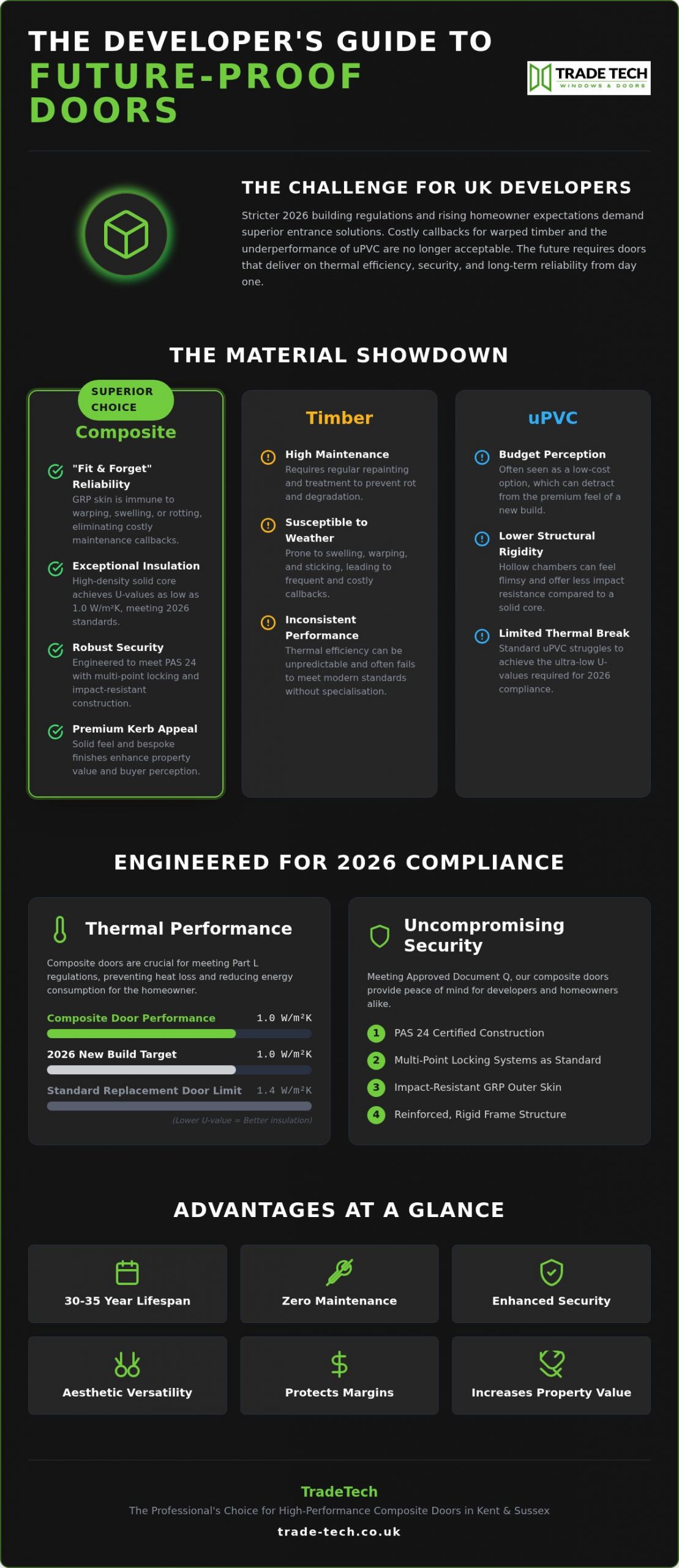
The construction landscape in the Southeast has undergone a fundamental change. Timber was once the standard for high-end residential projects, but high maintenance and poor weather resistance in exposed Kent locations have forced a shift. Modern composite doors are a sophisticated response to these failures. They represent an engineered solution, combining a high-density insulating core with a durable GRP skin and a rigid uPVC frame. This multi-material approach explains why composite doors outperform timber and uPVC in long-term residential applications.
For trade professionals, the decision to specify composite technology often comes down to the “fit and forget” factor. In high-volume developments, the cost of a single callback to plane a swollen timber door or adjust a dropped uPVC hinge can wipe out the profit margin on that unit. Composite units stay square, stay functional, and stay aesthetically perfect for decades.
The Material Advantage: GRP vs. Timber
Timber is beautiful but temperamental. It reacts to moisture and temperature, leading to seasonal movement that triggers expensive contractor callbacks. One of the primary benefits of composite doors is the GRP (Glass Reinforced Plastic) outer skin. This material is impact-resistant and impervious to water. It won’t swell, rot, or warp, even in the harshest coastal environments. Inside, the door features a high-density polyurethane foam centre or a solid timber core. This provides a level of structural stability and impact resistance that traditional wood simply cannot match. A well-installed composite unit has an expected lifespan of 30 to 35 years, significantly outlasting uPVC alternatives whilst requiring zero repainting.
Why uPVC Alone is Often Insufficient for Modern Front Doors
Standard uPVC entrance doors are frequently perceived as a budget-tier choice. While functional, they lack the tactile depth and aesthetic gravitas buyers expect in 2026. Structurally, a standard uPVC door relies on hollow chambers for insulation, which can feel flimsy under heavy daily use. In contrast, a composite slab is a solid, reinforced unit that offers a reassuring “thud” when closed. This perceived quality is vital for developers looking to enhance property value. The shift in buyer expectations means that a premium-feel entrance is no longer optional. It’s a requirement for successful plot sales in competitive markets.
- Stability: No bowing or twisting in direct sunlight.
- Durability: GRP skins resist scratches and dents from heavy site traffic.
- Efficiency: Solid cores provide a thermal break that hollow uPVC cannot achieve.
Security and Thermal Efficiency: Meeting 2026 Building Regulations
Compliance is the new baseline for Southeast developers. Under Meeting 2026 Building Regulations, every entrance must contribute to the building’s overall efficiency. The benefits of composite doors are central to this, offering a technical solution that timber simply cannot match. For trade professionals, specifying these units ensures that every plot meets the rigorous SAP requirements without the need for additional, costly insulation measures elsewhere in the build.
Thermal Performance and U-Values
Composite doors achieve U-values as low as 1.0 W/m²K, perfectly aligning with the notional specifications for new residential plots. The high-density insulating core acts as a thermal break, preventing heat from bridging between the internal and external faces of the door. This design is critical for maintaining consistent internal temperatures and reducing energy consumption. In an era of volatile energy costs, high-performance entrances are a significant selling point for prospective homeowners. By choosing units that exceed the 1.4 W/m²K requirement for replacement doors, you future-proof your projects against upcoming legislative shifts.
PAS 24 and Multi-Point Locking Systems
Security is equally non-negotiable. Approved Document Q requires all new dwellings to feature doors and windows that resist physical attack. Composite doors are engineered to meet PAS 24 standards, incorporating reinforced frames and impact-resistant GRP skins. This construction makes forced entry significantly more difficult compared to standard uPVC or traditional timber.
- Multi-Point Locks: Standard hardware includes hooks, deadbolts, and rollers that engage at multiple points along the frame.
- Secured by Design: Many units are compatible with SBD standards, providing additional peace of mind for the end-user.
- Anti-Snap Cylinders: High-security hardware prevents common entry methods like lock-snapping or drilling.
Acoustic insulation is a secondary but vital advantage. The high-density foam or solid timber cores don’t just stop heat loss; they significantly reduce external noise pollution. This is a crucial benefit for developments situated near busy Kent transit routes or urban centres. A quiet, secure home is a more valuable home. If you are planning a high-spec development, you can view our dedicated developer support to see how we streamline compliance for your next project.
Aesthetic Versatility: Tailoring Entrance Solutions to Diverse Property Styles
Kent and Sussex architecture is famously diverse. From the timber-framed cottages of East Sussex to the sleek, high-density residential developments in Maidstone, a one-size-fits-all approach to entrances fails to deliver. One of the most significant aesthetic benefits of composite doors is their capacity to replicate authentic timber grains whilst offering a palette of over 40 standard and premium colours. This allows developers to maintain the character of a heritage site without the inevitable decay associated with natural wood. The result is a professional finish that remains vibrant and stable, regardless of the weather conditions.
Traditional vs. Contemporary Designs
Period renovations in rural Kent require a sympathetic touch. For these projects, cottage-style slabs with deep-grooved detailing and traditional woodgrain textures are essential. These units preserve the historical aesthetic of the village centre whilst meeting modern accredited security standards. Conversely, modern urban developments demand a minimalist approach. Sleek, flush-fit slabs in Anthracite Grey or Black provide a sharp, professional finish that appeals to the contemporary buyer. You can also specify different colours for the internal and external faces, ensuring the door matches the building’s facade whilst complementing the interior decor.
Glazing and Hardware Customisation
The final specification of an entrance is defined by its hardware and glazing. For trade professionals, the ability to offer a complete, bespoke package is a major advantage. Our range of composite doors supports a vast array of decorative glass options, from classic leaded designs to contemporary frosted patterns. These glazed elements are often paired with integrated sidelights and toplights. These additions are designed to maximise natural light in hallways, creating a sense of space that is highly prized by residential buyers. Each glazed unit is toughened to meet safety regulations whilst maintaining the door’s overall thermal rating.
Hardware selection must be equally precise. Whether your project requires heritage knockers and finger pulls in antique brass or modern pull bars in brushed stainless steel, the finishes are engineered for longevity. High-quality hardware is a core component of the long-term benefits of composite doors, as it prevents the “tired” look that often plagues cheaper uPVC units after a few winters. These components resist pitting and corrosion, even in exposed coastal environments across Sussex. This attention to detail ensures the entrance remains a high-value asset, enhancing the property’s first impression and reducing the likelihood of remedial site visits for hardware failure.
Longevity and Minimal Maintenance: Reducing Callbacks and Enhancing Reputation
Handing over a residential project in Kent shouldn’t mark the start of a two-year snagging cycle. One of the most practical benefits of composite doors is the elimination of the remedial maintenance that plagues traditional timber installations. For trade professionals, this “fit and forget” reliability is a commercial asset. It ensures that once the keys are with the homeowner, your site managers can focus on the next phase of the build rather than coordinating door adjustments. Every minute spent returning to a completed plot to plane a swollen door or realign a dropped frame is a direct hit to your project’s profitability.
The resilience of the GRP (Glass Reinforced Plastic) skin is central to this longevity. Unlike timber, which requires a cycle of sanding, painting, and varnishing every few years, the composite surface is essentially maintenance-free. It doesn’t peel, flake, or rot, even when subjected to the high-traffic conditions of a busy family home. This durability ensures the entrance remains a high-value feature for decades, protecting the contractor’s reputation long after the initial sale. By specifying these units, you provide a solution that stays aesthetically perfect without the need for homeowner intervention.
Eliminating the Callback Culture
Sticky doors are a primary source of post-completion complaints. Timber naturally reacts to atmospheric moisture, expanding in winter and contracting in summer. This movement causes alignment issues that trigger emergency site visits. The structural stability of the composite core prevents this cycle entirely. High-quality weather seals are engineered to maintain a permanent, airtight barrier that doesn’t perish or lose its shape. Reducing these avoidable revisits is one of the key benefits of composite doors, allowing you to close out projects with total confidence in the long-term performance of the hardware.
Weather Resistance in Coastal and Rural Kent
Regional weather conditions across the Southeast can be brutal on external joinery. From the salt-laden winds of the East Sussex coast to the exposed rural locations in the Weald, entrances are constantly under pressure. Modern GRP skins are formulated for exceptional UV stability, preventing the colour fading and chalking that often affects inferior uPVC products. These units are built to withstand harsh coastal environments without pitting or corroding, maintaining their structural integrity for an expected lifespan of 30 to 35 years. This resilience ensures the property remains weather-tight and efficient regardless of the local climate.
Access Trade Tech Windows & Doors trade pricing for your next project
Sourcing High-Performance Composite Doors in Kent and Sussex
Sourcing the right entrance solutions requires more than just a product catalogue. It demands a partnership with a supplier that understands the specific pressures of the Southeast construction market. Trade Tech Windows & Doors serves as a specialist hub for contractors across Kent and East Sussex, providing the technical expertise needed to navigate 2026 regulations. By choosing a local specialist, you ensure that every unit is specified to withstand regional conditions whilst meeting the aesthetic expectations of local planning authorities. Understanding local building trends is vital for project success. Whether you are matching heritage aesthetics in the Weald or installing minimalist designs in coastal developments, our regional expertise ensures a seamless fit.
The logistical benefits of composite doors are amplified when you source them alongside complementary glazing products. We provide a streamlined procurement route for entire projects, offering everything from uPVC casement windows to architectural aluminium. This integrated approach reduces the complexity of managing multiple lead times and ensures a consistent high-spec finish across the entire development. Reliable, fast-turnaround supply is our core promise. We act as a stable foundation for your project, allowing you to focus on site management whilst we handle the technical details of your glazing package.
The Trade Tech Windows & Doors Advantage for Developers
We provide comprehensive technical support for every trade account. This includes detailed guidance on specifying the correct door slabs and frame units to meet unique site requirements. Our role is to act as your technical partner, ensuring that every entrance contributes to the building’s compliance and kerb appeal. To provide a complete glazing package, many developers pair our composite range with aluminium bi-folding doors for rear elevations. For deeper procurement insight, you can refer to our professional guide to composite door suppliers. This resource details how to optimise your supply chain for 2026 standards.
Next Steps: Quote and Specification
Specifying high-performance entrances for your next residential or commercial project is a straightforward process. We provide fast, accurate quotes based on your specific schedules and technical drawings. Our delivery network is optimised for the Southeast, ensuring reliable site deliveries that respect your build timeline. Whether you are managing a single plot renovation or a multi-unit development, our team is ready to assist with technical specifications and pricing. You can contact Trade Tech Windows & Doors today to discuss your project requirements or request a trade price list. We understand that time is your most valuable asset, so we prioritise responsiveness and precision in every interaction.
Explore the full range of composite doors for your next project
Future-Proofing Your Next Development with Composite Technology
The transition to 2026 Building Regulations demands a move away from high-maintenance timber and basic uPVC. Specifying composite units allows you to meet strict thermal targets whilst providing the high-security standards buyers now expect. These entrances are no longer just a luxury upgrade. They are a strategic necessity for modern compliance and plot value.
The long-term benefits of composite doors include reduced site revisits and a “fit and forget” reliability that protects your project margins. As a specialist supplier for Kent and East Sussex, Trade Tech Windows & Doors provides PAS 24 and SBD compliant options through a reliable trade-only service. We understand the Southeast market and provide the technical support required to keep your projects moving at pace. Our focus remains on accuracy, speed, and professional support for every trade partner.
Request a Trade Quote for Composite Doors
We look forward to helping you deliver secure, efficient, and high-value homes across the region.
Frequently Asked Questions
What are the main benefits of composite doors for trade professionals?
One of the primary benefits of composite doors for trade professionals is the total elimination of post-installation callbacks. Unlike timber, which frequently warps and requires planing, composite units remain structurally stable in all weather conditions. This reliability protects your profit margins and enhances your reputation for quality on every residential plot. They are designed for rapid, precise installation, ensuring your team stays on schedule.
How do composite doors compare to uPVC doors in terms of security?
Composite doors offer significantly higher security than standard uPVC alternatives due to their solid core and GRP skin. While many uPVC doors rely on hollow chambers, composite slabs are reinforced and impact-resistant, making them much harder to breach. Most trade-grade composite units are PAS 24 certified and Secured by Design compliant as standard, providing the physical resistance required for modern building compliance.
Do composite front doors require a lot of maintenance?
No, composite front doors require virtually no maintenance beyond an occasional wipe with a damp cloth to remove surface grit. The GRP outer skin is through-coloured and UV-stable, which prevents the need for the sanding, painting, or varnishing cycle associated with timber. This “fit and forget” quality is a major advantage for both developers and homeowners, ensuring the entrance looks new for decades.
Are composite doors energy efficient enough for new building regulations?
Yes, modern composite doors are engineered to exceed 2026 energy standards, achieving U-values as low as 1.0 W/m²K. This ensures full compliance with Part L of the Building Regulations for new dwellings. Their high-density insulating cores prevent thermal bridging, making them far more efficient than traditional timber or older uPVC models. They are a critical component for achieving high SAP ratings on new builds.
Can I customise the colour and style of a composite door for a specific project?
You can fully customise every aspect of the door to suit the architectural requirements of your project. Options include over 40 standard and premium colours, with the ability to specify different internal and external finishes. We provide a vast range of traditional cottage-style slabs and contemporary flush designs, complemented by bespoke hardware and decorative glazing options to match Kent’s varied property types.
What is the typical lifespan of a high-quality composite door?
A high-quality composite door has a typical lifespan of 30 to 35 years. This longevity significantly outperforms standard uPVC doors, which usually last around 20 to 25 years. The durable GRP skin and moisture-resistant core ensure the unit remains functional and aesthetically perfect for decades. This extended service life makes them a more sustainable and cost-effective choice for long-term property management.
How much do composite doors cost compared to timber or uPVC?
Composite doors represent a middle ground in terms of initial investment. While they cost more than standard uPVC units, they are significantly more affordable than premium timber doors. When assessing the benefits of composite doors, it’s clear they offer the best long-term value for developers. The lack of maintenance and extended lifespan results in a much lower total lifecycle cost compared to other materials.
Are composite doors suitable for coastal properties in Kent and Sussex?
Yes, composite doors are ideal for coastal properties across Kent and Sussex. The GRP skin is impervious to salt spray and corrosive sea air, which often causes timber to rot or uPVC to discolour. Their UV-stable finish ensures that even in exposed, south-facing locations, the door maintains its colour and structural integrity. They provide a weather-tight solution that withstands the harshest regional environments.