
The frame material you specify for a high-traffic urban project can be the difference between a satisfied client and a noise-related callback. While aluminium is often the first choice for its slim sightlines, its inherent conductivity presents unique challenges for sound insulation compared to the multi-chambered design of uPVC. Understanding the technical nuances of uPVC vs aluminium windows noise reduction is essential for any contractor facing strict planning permissions or demanding acoustic requirements.
You’ve likely felt the frustration of balancing heavy-duty soundproofing with the modern aesthetics your clients demand. We’ll show you how to navigate these trade-offs to deliver a technically sound specification for noise-sensitive sites. This guide examines the Weighted Sound Reduction Index (Rw) ratings of different frame types and explains why the synergy between the profile and the specialised sealed unit is the ultimate factor in acoustic performance. By the end, you’ll have the data needed to specify the quietest solution for your next project.
Key Takeaways
- Master the Weighted Sound Reduction Index (Rw) to specify units that meet strict planning permissions for noise-sensitive urban developments.
- Understand the technical trade-offs of uPVC vs aluminium windows noise reduction, comparing natural dampening profiles against modern thermally broken systems.
- Identify why the glass unit accounts for up to 80% of acoustic performance and how to specify high-performance sealed units for maximum attenuation.
- Learn how modern polyamide thermal breaks in aluminium frames disrupt sound wave transmission to overcome traditional material conductivity challenges.
- Select the optimal frame style to balance local aesthetics in Kent and Sussex with the heavy-duty sound insulation required for high-traffic environments.
Understanding Acoustic Performance in Window Specification
Acoustic performance is no longer a luxury for residential projects; it’s a core technical requirement. For new-build contractors and developers across Kent and East Sussex, meeting strict planning permissions often hinges on specific decibel (dB) reduction targets. Local authorities frequently mandate a minimum Weighted Sound Reduction Index (Rw) of 40 dB for sites near major transport links or urban centres. Achieving these figures requires a precise understanding of how frame material and glass configuration work together.
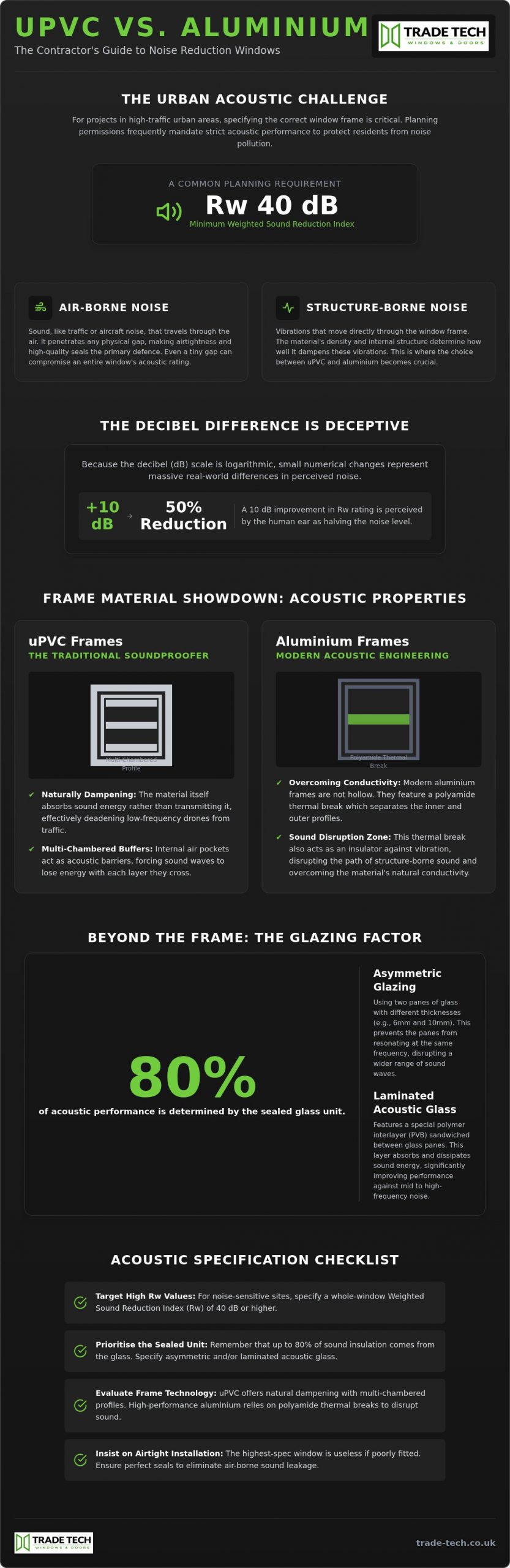
The Weighted Sound Reduction Index (Rw) provides a single figure to represent the sound insulation performance of a window. It accounts for the human ear’s sensitivity to different frequencies. Because the dB scale is logarithmic, small numerical increases represent significant real-world improvements. A window rated at 40 dB is significantly quieter than one at 30 dB. In fact, a 10 dB reduction is perceived by the human ear as a 50% drop in noise levels. This makes the choice in uPVC vs aluminium windows noise reduction a critical decision during the early specification phase.
The Science of Sound Leakage
Sound penetrates buildings via air-borne and structure-borne paths. Air-borne noise, such as traffic or aircraft, enters through any physical gap. This makes airtightness your primary defence. Even a tiny gap in a window seal can compromise the entire acoustic rating. Structure-borne noise involves vibrations moving through the frame itself. The rigidity and density of the material determine how well it dampens these vibrations. Whilst uPVC is naturally dampening, aluminium requires technical intervention to achieve similar results.
Measuring Noise Reduction (dB)
Specifying the right product requires distinguishing between glass-only ratings and whole-window performance. When assessing uPVC vs aluminium windows noise reduction, the frame’s ability to hold thick, heavy glass is paramount. Standard double glazing typically achieves around 31 dB. To reach the 40 dB threshold required for noise-sensitive sites, you must specify insulated glazing technology with varying glass thicknesses.
This approach, known as asymmetric glazing, prevents sound waves from resonating at specific frequencies. High-performance sealed units often use laminated acoustic glass to further dissipate energy. The frame must support these units whilst maintaining a perfect seal against the building aperture. Poor installation or low-quality hardware can negate the benefits of even the highest-rated acoustic glass. Precision in specification and fitting is non-negotiable for professional trade projects.
Why uPVC Windows Are the Traditional Choice for Soundproofing
uPVC (Unplasticised Polyvinyl Chloride) is a naturally dampening material. It doesn’t resonate in the same way as metal. This inherent property makes it a stable foundation for any acoustic specification. In the ongoing discussion of uPVC vs aluminium windows noise reduction, uPVC is often cited as the traditional leader because of its ability to absorb sound energy rather than transmit it. Its high mass and non-conductive nature provide a significant advantage when tackling low-frequency noise; it effectively deadens the persistent drone of heavy traffic or industrial machinery.
To further improve the interior environment, combining high-performance frames with specialised window treatments from Fabrico can help to further deaden noise and enhance the thermal efficiency of the room.
The synergy between thermal and acoustic performance in uPVC is undeniable. The same features that prevent heat loss also stop sound waves. Recent laboratory tests on airborne sound insulation demonstrate that the internal geometry of the window frame is just as critical as the glazing itself. For contractors working in high-density urban areas, choosing a frame that tackles both challenges simultaneously ensures a more efficient build and a quieter interior for the end user.
Multi-Chambered Profile Technology
The internal structure of a modern uPVC frame consists of a series of independent air pockets. These multi-chambered profiles act as acoustic buffers. As sound waves attempt to penetrate the frame, they must pass through multiple layers of uPVC and air, losing energy at every transition. High-performance trade uPVC and aluminium windows use these chambers to disrupt sound transmission paths effectively. The inclusion of internal steel reinforcements adds necessary mass. This extra weight is vital for dampening the vibrations that lead to structure-borne noise in residential developments.
Sealing and Gasket Performance
Airtightness is the first line of defence against external noise. If air can get in, sound can too. uPVC systems excel here because of their fusion-welded corners. Unlike mechanically joined frames, welded corners create a continuous, seamless perimeter that eliminates potential air-borne noise paths. When you specify uPVC casement windows, you’re also utilising high-compression weather seals. These gaskets are designed to stay flexible and maintain a tight seal against the frame for years. This prevents the “whistling” effect often associated with wind-driven noise on exposed sites. If you’re specifying for a noise-critical site in the South East, you can review our trade pricing to find the right balance of performance and budget for your project.
Aluminium Windows and Noise: Overcoming the Conductivity Challenge
The idea that aluminium is a poor acoustic choice is a persistent industry myth. While untreated metal is highly conductive, modern architectural systems are far from simple metal extrusions. When evaluating uPVC vs aluminium windows noise reduction, you must look at the thermal break technology. Modern aluminium windows use advanced polyamide bridges to separate the internal and external profiles. These bridges do more than stop heat transfer. They effectively dampen sound vibrations, preventing the frame from acting as a resonator for external noise.
Research into the acoustic performance of windows confirms that the quality of the thermal break and the air-tightness of the assembly are the decisive factors. High-performance aluminium frames now rival uPVC in their ability to meet Part L requirements and stringent acoustic standards. This makes them a viable choice for high-end residential projects where sleek aesthetics must meet heavy-duty performance. You no longer have to sacrifice thin sightlines to achieve a quiet interior.
The Role of Polyamide Thermal Breaks
Modern aluminium frames are composite structures. The polyamide thermal break acts as a non-conductive barrier that disrupts the path of both heat and sound waves. Older aluminium systems often lacked this feature, leading to the reputation for poor insulation. Current trade frames are engineered with multi-chambered thermal breaks that mimic the dampening effect of uPVC. This technology is essential for projects in Kent and Sussex that must comply with modern building regulations whilst mitigating the noise from busy A-roads or rail corridors.
Structural Integrity and Heavy Glazing
Aluminium’s primary advantage lies in its strength-to-weight ratio. Acoustic glass is heavy. Achieving an Rw of 40 dB often requires asymmetric glass panes and laminated layers, which significantly increase the weight of the sealed unit. Aluminium frames support this additional mass without the need for bulky profiles. This allows you to specify high-performance units for commercial glazing or large-scale residential developments in high-traffic urban areas. The frame remains stable under the load, ensuring seals stay tight and performance doesn’t degrade over time.
For projects featuring large apertures, such as aluminium bi-folding doors, structural integrity is non-negotiable. Large glass areas are prone to vibration if the frame lacks rigidity. Aluminium’s stiffness ensures that the seals remain compressed and the glass remains stable, even in noisy garden environments. This structural stability is a key differentiator in the uPVC vs aluminium windows noise reduction debate for wide-span openings. It allows for expansive views without the penalty of increased noise penetration.
Beyond the Frame: Glazing and Installation Factors
While frame material provides the structural foundation, it only accounts for approximately 20 to 30% of a window’s total acoustic performance. The heavy lifting is done by the glass and the integrity of the installation. When comparing uPVC vs aluminium windows noise reduction, specifying high-performance sealed units is the most effective way to hit high decibel targets. A standard 4mm-16mm-4mm double glazed unit typically achieves a Weighted Sound Reduction Index (Rw) of around 31 dB. To reach the 40 dB thresholds often found in urban planning permissions, you must look beyond standard glass configurations.
Asymmetric and Laminated Glazing
Sound waves have a ‘critical frequency’ where they pass through glass more easily. If both panes are the same thickness, they resonate at the same frequency. This creates a weak point in your insulation. Asymmetric glazing solves this by using different thicknesses, such as a 6mm pane paired with a 4mm pane. This configuration forces sound waves to encounter different densities, disrupting their energy. For maximum attenuation, acoustic laminated glass uses a Polyvinyl Butyral (PVB) interlayer. This soft layer acts as a dampener, absorbing vibrations that standard glass would simply transmit. Whilst Argon gas is essential for thermal efficiency, its impact on noise is negligible compared to glass mass and lamination.
Installation Precision and Perimeter Sealing
Poor installation is the most common reason high-specification windows fail to perform on-site. We call this the ‘weak link’ theory. Even a 1% gap in the perimeter seal can lead to a 10 dB drop in acoustic performance. For new-build contractors and developers, achieving an airtight fit is non-negotiable. This involves more than just expanding foam. Professional installers use high-density acoustic sealants and ensure that structural fixings don’t create ‘acoustic bridges’. These bridges allow vibrations to bypass the window’s dampening features. Every junction between the frame and the building aperture must be treated as a potential sound path.
Explore our range of high-performance acoustic sealed units
Choosing the Right Solution for Your Project in Kent and Sussex
Selecting the right frame involves more than comparing material properties; it requires a deep understanding of the local environment. Developers in Kent and East Sussex face unique challenges, from the high-decibel traffic of the M20 corridor to the harsh wind loads of the Sussex coastline. The choice between uPVC vs aluminium windows noise reduction often depends on whether you’re prioritising heritage aesthetics or modern, slim-profile structural strength. We provide the technical data needed to make this distinction clear for every project.
Project-Specific Recommendations
High-traffic urban sites in towns like Maidstone or Crawley demand the highest acoustic specifications. In these environments, multi-chambered uPVC systems offer exceptional natural dampening. However, for modern apartment blocks requiring expansive glazing, thermally broken aluminium is often the superior choice for its structural rigidity. Both materials can reach high Rw ratings when paired with the correct asymmetric glass units. The goal is to match the frame’s structural capability with the site’s specific noise profile.
Coastal properties in East Sussex present a different set of requirements. Here, you must balance wind-load resistance with acoustic performance. Salt-heavy air can be punishing, making high-quality finishes essential. For heritage renovations in protected Sussex villages, flush-sash uPVC windows provide the traditional look of timber without the acoustic leaks common in older frames. Similarly, for period properties near busy A-roads, uPVC sliding sash windows offer a heritage-compliant solution that significantly outperforms original single-glazed units.
Sourcing for the Trade
Sourcing direct from a specialist trade supplier ensures you receive units that comply with current UK building regulations and local planning requirements. TradeTech supports professionals across the South East with accurate technical specifications and reliable lead times. We understand that on-site delays cost money. By providing high-performance units that meet the specific dB targets of your project, we help you avoid the risk of noise-related client complaints or planning failures.
Accessing our trade pricing allows you to maintain healthy margins whilst delivering premium acoustic solutions. Whether you’re working on a single residential replacement or a large commercial development, precision in the supply chain is vital. Our team provides the expert guidance necessary to navigate the technical trade-offs between different window systems.
Contact TradeTech for a technical consultation on your next project
Specifying Superior Acoustic Performance for Your Next Project
The technical debate surrounding uPVC vs aluminium windows noise reduction often centres on the frame material, yet true acoustic success requires a holistic approach. Whilst uPVC provides natural dampening and aluminium offers the structural integrity for heavy glazing, the synergy between the profile and the sealed unit remains the decisive factor. Specifying asymmetric glass and ensuring airtight installation are non-negotiable steps for meeting strict urban planning requirements in noise-sensitive areas across Kent and Sussex.
TradeTech provides the expert technical support developers and contractors need to navigate these complex specifications with confidence. As a specialist trade supplier, we provide high-performance sealed units and robust frame systems engineered for the most demanding environments. We understand the pressures of the construction industry and prioritise the precision your project demands to avoid noise-related callbacks.
Request a trade quote for high-performance acoustic windows
Our team is standing by to help you specify the quietest, most efficient solution for your next build.
Frequently Asked Questions
Is uPVC or aluminium better for reducing traffic noise?
uPVC has a slight inherent advantage due to its multi-chambered profile and natural dampening properties, but modern thermally broken aluminium frames can match this performance when paired with high-spec glazing. The technical choice in uPVC vs aluminium windows noise reduction often depends on the frame’s ability to support heavy acoustic glass. Whilst uPVC is the traditional leader, aluminium’s structural strength allows for thicker glass units that effectively block low-frequency traffic rumble.
Can double glazing provide enough noise reduction for properties near a main road?
Standard double glazing with identical glass thicknesses typically achieves an Rw of 31 dB, which is often insufficient for properties directly adjacent to busy main roads. To meet the common planning requirement of 40 dB for high-traffic sites, you must specify asymmetric glazing or acoustic laminate. These specialised configurations disrupt sound wave resonance much more effectively than standard 4mm glass units, providing a significantly quieter internal environment.
What is acoustic laminated glass and is it worth the extra cost?
Acoustic laminated glass consists of two panes bonded with a specialised Polyvinyl Butyral (PVB) interlayer that absorbs sound vibrations. It is a vital investment for noise-sensitive projects because it targets the critical frequency where standard glass fails to insulate. This configuration provides superior attenuation compared to standard glass of the same total thickness, making it the professional choice for bedrooms in urban developments or near rail links.
Does the frame colour affect the acoustic performance of uPVC windows?
No, the colour or foil finish of a uPVC profile has no impact on its acoustic performance or sound dampening capabilities. Whether you specify anthracite grey, white, or a woodgrain foil, the internal multi-chambered structure and gasket performance remain identical. Sound insulation is determined by the profile geometry and the quality of the sealed unit rather than the aesthetic surface finish applied to the exterior.
How much noise reduction can I expect from replacing old single-glazed windows?
Replacing old single-glazed windows with modern high-performance units can result in a perceived noise reduction of approximately 50%. Single glazing typically offers poor insulation, often providing only 20 to 25 dB of protection. Moving to a well-installed double-glazed system with an Rw of 31 to 35 dB represents a 10 dB improvement. Because the decibel scale is logarithmic, this numerical shift is heard as a halving of the external noise level.
Do trickle vents reduce the effectiveness of soundproof windows?
Standard trickle vents can create a direct path for air-borne sound, potentially compromising the acoustic integrity of a high-specification window. For noise-sensitive sites, you must specify acoustic trickle vents. These specialised units include internal baffles and sound-absorbing foam to maintain necessary building ventilation whilst minimising the penetration of external noise. They ensure that the window meets both Part F ventilation and Part L acoustic requirements simultaneously.
Are bi-folding doors less soundproof than standard patio doors?
Bi-folding doors can be slightly less soundproof than sliding patio doors because they require more vertical seals and mechanical joints. Each folding leaf creates a potential path for air-borne sound if the gaskets are not perfectly compressed. Sliding doors often feature larger glass panes and fewer frame junctions, which can be advantageous; specialists such as Alex’s Sliding Glass Door – Window Repair & Replacement demonstrate how targeted repair and maintenance can keep these systems performing at their peak. However, using high-performance aluminium profiles with multi-point locking ensures that seals stay tight enough to maintain high acoustic standards.
What is the best window configuration for a quiet bedroom in a noisy area?
The optimal configuration for a quiet bedroom is a fixed or casement window featuring asymmetric acoustic laminated glazing and high-compression seals. Fixed units provide the best airtightness, but where ventilation is required, casement windows offer superior compression against the gaskets compared to sliding sash designs. Specify a 6.8mm acoustic laminate pane paired with a 6mm standard pane to disrupt a wide range of sound frequencies effectively.