
Achieving the 0.8 W/m²K U-value required by the 2026 Part L update means triple glazing is no longer an optional luxury; it’s the new benchmark for Kent developments. For trade professionals, the challenge isn’t just meeting these tighter regulations. It’s sourcing high-performance Sealed Units that won’t fail prematurely or arrive weeks behind schedule. You understand that every site call-back and every delayed delivery eats directly into your project’s profitability. It’s a constant battle to navigate shifting standards whilst managing client expectations and tight construction timelines.
This guide provides the technical clarity you need to specify glass with absolute confidence. We’ll help you master the nuances of double and triple glazed specifications to ensure your installations are durable, efficient, and compliant. We will examine the impact of the new actual-size U-value calculation methodology and how to secure a reliable local supply to keep your projects moving. You’ll gain a clear roadmap for sourcing superior units that protect both your reputation and your bottom line.
Key Takeaways
- Master the technical differences between Low-E glass types and gas fills to optimise thermal performance for every installation.
- Learn how specific Sealed Units configurations influence SAP ratings and ensure your projects remain fully compliant with building regulations.
- Recognise the early signs of seal failure and the installation errors that cause them to protect your professional reputation.
- Streamline your supply chain by sourcing high-specification glass locally in Kent, including premium options like integral blinds.
- Gain practical insights into measuring and specifying replacement units to reduce lead times and improve site efficiency.
What is a Sealed Unit? Understanding Insulated Glass Units (IGUs)
A sealed unit, technically referred to as Insulated glazing, is the functional engine of any modern window. It comprises two or more panes of glass separated by a spacer bar and bonded into a single, hermetically sealed assembly. This construction creates an insulating layer of air or gas between the panes, which significantly reduces heat transfer. We’ve moved decisively away from the era of single glazing. Modern Sealed Units are now high-performance components that define a building’s thermal efficiency and acoustic comfort.
The hermetic seal is the most critical feature. It prevents moisture ingress and the subsequent condensation that once plagued older window designs. By trapping a dry atmosphere or an inert gas within the cavity, the unit acts as a thermal barrier. This setup does more than just keep heat in; it also provides essential acoustic damping, reducing external noise pollution for homeowners in busy Kent residential areas.
The Anatomy of a Modern Sealed Unit
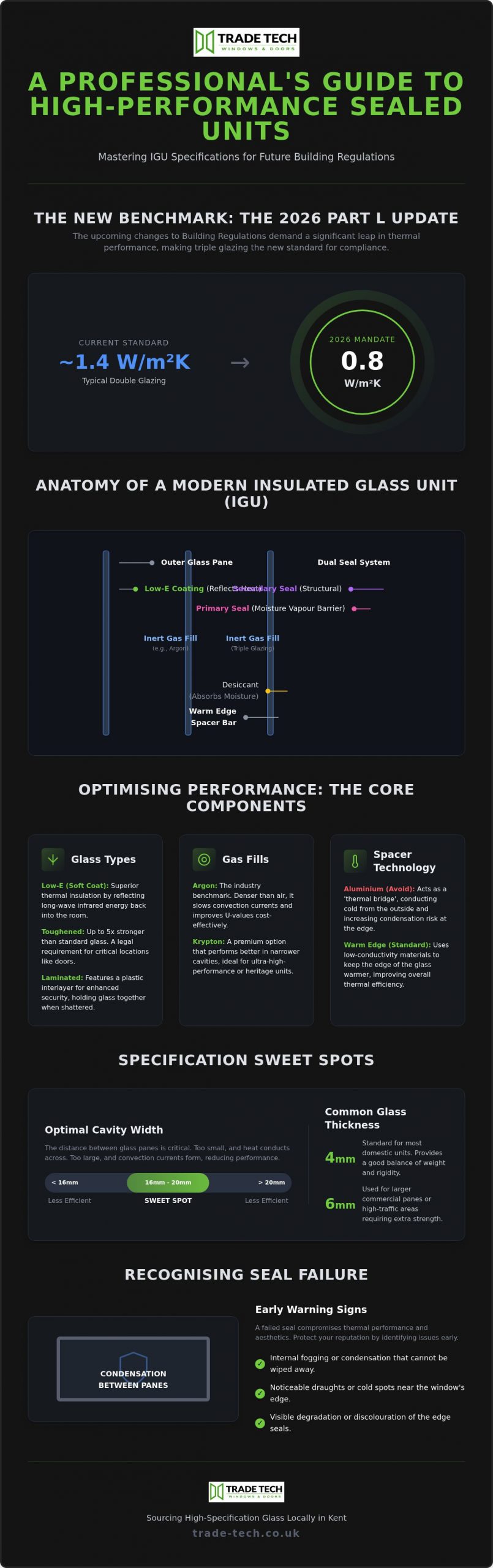
Understanding the layers within a unit is vital for ensuring long-term durability on site. A professional unit relies on a dual-seal system to maintain its integrity:
- The Primary Seal: Usually made from polyisobutylene (PIB), this is applied to the sides of the spacer bar. Its sole job is to provide a high-performance barrier against moisture vapour.
- The Secondary Seal: Typically composed of polysulphide or silicone, this outer edge seal provides the structural strength. It holds the glass panes and spacer bar together against wind loads and thermal expansion.
- The Desiccant: These moisture-absorbing beads are housed inside the hollow spacer bar. They extract any trace amounts of water vapour trapped during assembly, ensuring the cavity remains perfectly clear.
Standard vs Bespoke Specifications
Specifying the right Sealed Units requires a balance of glass thickness and cavity width. Standard domestic units often use 4mm glass, whilst larger commercial panes or high-traffic areas might require 6mm for added rigidity. The width of the cavity between the panes is equally important. Most trade professionals aim for the 16mm to 20mm “sweet spot”. Cavities smaller than this allow heat to jump across the gap too easily; cavities larger than 20mm can trigger internal convection currents that actually pull heat away from the room. Getting these dimensions right is essential when ordering Trade uPVC and Aluminium Windows to ensure they meet the specific energy ratings required for your project.
Technical Components: Glass Types, Gas Fills, and Spacers
Specifying the right Sealed Units requires more than choosing between double or triple glazing. The internal components determine whether a window merely fills a hole or actively manages a building’s climate. Low Emissivity (Low-E) glass is the foundation of this performance. These panes feature microscopic, transparent metallic coatings designed to reflect long-wave infrared energy. In winter, this coating bounces internal heat back into the room. During summer, it helps reduce solar gain. For trade projects in Kent, using “soft-coat” Low-E glass is often the preferred choice as it offers superior thermal insulation compared to older “hard-coat” alternatives.
The gas fill between the panes is the next critical layer. Argon gas is now the industry benchmark. It is denser than dry air, which significantly slows down the convection currents within the cavity. Whilst argon is the standard for most A-rated windows, Krypton gas is an alternative for specialist projects. Krypton performs better in narrower cavities, though its higher cost usually restricts its use to ultra-high-performance triple glazing or heritage thin-unit applications. For most standard developments, argon-filled units provide the best balance of cost-effectiveness and thermal efficiency.
Safety and security specifications also dictate glass choice. Toughened glass is heat-treated to be up to five times stronger than standard float glass. It is a legal requirement for “critical locations” such as doors or low-level glazing. For enhanced security or high-end residential projects, laminated glass is the superior option. It uses a plastic interlayer that holds the glass together if shattered, providing a formidable barrier against forced entry. When the project calls for both safety and high-end decorative appeal, FGD Glass Solutions provides architectural glass products that meet these rigorous standards while enhancing the building’s design.
Warm Edge Spacer Technology
The spacer bar is no longer just a structural frame. Traditional aluminium spacers act as thermal bridges, conducting cold directly from the outside to the internal pane. This often results in perimeter condensation and “cold spots” around the window edge. Warm-edge spacers, made from plastic-composite materials, have made aluminium bars largely obsolete in modern trade projects. By reducing heat loss at the unit’s edge, these spacers can improve the overall window U-value by up to 10%. They are essential for meeting the strict Part L requirements of the Future Homes Standard.
Specialist Glass Coatings and Tints
Bespoke projects often require specific glass behaviours. Solar control glass is a popular choice for large roof lanterns and expansive bi-folding doors. It uses a tint or coating to limit the amount of solar radiation entering a room, preventing the “greenhouse effect” in South East homes. For hard-to-reach units, self-cleaning glass uses UV light to break down organic dirt, which is then washed away by rainwater. If your project is located near the M20 or other busy Kent motorways, acoustic laminates are a vital specification. These units use a special acoustic interlayer to dampen sound frequencies that standard glass cannot block. If you need assistance with complex specifications, you can explore our range of high-performance glass options to find the perfect match for your site requirements.
Thermal Performance and Building Regulations: Meeting Part L
Thermal efficiency is no longer a secondary consideration for Kent developers. It is the primary driver of product specification. The U-value is the critical metric here. It measures the rate of heat transfer through the unit. Lower values indicate superior insulation. For Sealed Units, achieving a low U-value is essential for meeting the stringent requirements of the 2026 Part L update. This regulation, published in March 2026, mandates that replacement windows in existing homes must achieve a maximum U-value of 1.4 W/m²K. For new-build dwellings, the notional target is 1.2 W/m²K, though a value of 0.8 W/m²K is often required to meet overall carbon reduction goals.
The configuration of your Sealed Units directly impacts a building’s Standard Assessment Procedure (SAP) rating. Compliance has become more complex due to a shift in calculation methodology. From March 2027, U-values must be calculated based on the actual size and configuration of each window as installed, rather than using a standard reference window. This change makes achieving target values more challenging. Beyond U-values, you must also consider G-values and Lt-values. The G-value measures solar heat gain. The Lt-value measures visible light transmission. A high-performance unit must balance these to provide natural light whilst preventing overheating in South East projects.
Double vs Triple Glazing: Which to Specify?
High-specification double glazing can often reach the 1.4 W/m²K requirement for replacements. However, triple glazing is rapidly becoming the practical standard for new-build projects aiming for the 0.8 W/m²K benchmark. Triple units offer a significant leap in thermal performance, but they introduce logistical considerations. They are heavier and thicker than double glazed alternatives. You must ensure that your uPVC casement window frames and hardware are specified to support this additional weight. For developers in Kent and Sussex, the higher initial cost of triple glazing is increasingly viewed as a necessary investment to future-proof properties against rising energy costs and upcoming carbon-zero standards.
Condensation Management and Ventilation
Efficient glazing changes how a building manages moisture. External condensation is frequently reported on high-performance units. This isn’t a fault; it’s proof that the unit is working. The internal heat isn’t reaching the outer pane to warm it up. Conversely, internal condensation on the room-side glass suggests poor room ventilation. This makes the inclusion of trickle vents vital when installing high-performance units to maintain air quality. Inter-pane condensation is the only type that indicates a total unit failure. The dew point is the temperature at which air becomes saturated with water vapour and condensation begins to form.
Identifying Failed Sealed Units and Measuring for Replacement
Misting or fogging between the panes is the definitive sign that the hermetic seal has breached. This failure allows moisture-laden air to enter the cavity. Once the desiccant inside the spacer bar is saturated, visible water droplets form. Common causes include blocked frame drainage channels. When water cannot escape the rebate, the Sealed Units sit in standing water. This constant exposure triggers a chemical breakdown of the secondary seal, leading to premature failure. Poor installation or the natural degradation of the sealant over 15 to 20 years are also frequent factors.
Maintaining the structural integrity of a property is essential to prevent such issues; to see how professional teams manage high-quality upkeep, visit HJ Smartfix Technical & Maintenance for expert renovation and maintenance services.
Use the “candle test” to identify if an existing unit features a Low-E coating. Hold a flame or torch near the glass and observe the four reflections. If one reflection is a different colour, usually a subtle pink or purple, it confirms the presence of a metallic coating. Matching this specification is essential for visual consistency when replacing single units amongst older glazing. It ensures the thermal performance remains balanced across the entire elevation.
Accurate measurements are the only way to avoid project delays. Measure the width and height of the glass in millimetres. Always measure the “tight” size of the opening and subtract a standard clearance, typically 3mm, to allow for expansion and setting blocks. For the overall thickness, use a glass gauge. A standard modern unit is often 28mm, consisting of two 4mm panes and a 20mm cavity. If you’re unsure, removing the glazing bead and measuring the unit directly is the safest approach.
Step-by-Step Guide to Measuring Units
- Identify the “sight line” to ensure the spacer bar remains hidden behind the glazing bead. If the spacer is too high, it will be visible, ruining the professional finish.
- Measure the glass thickness and cavity width separately if the unit is already removed to confirm the 4-20-4 or 6-16-6 configuration.
- Use glass suction lifters for any unit over 25kg to ensure site safety and prevent edge damage during removal.
- Check the depth of the glazing bead. This confirms the maximum possible unit thickness the frame can accommodate.
Upgrading Units in Existing Frames
You don’t always need to replace the entire trade window frame. If the uPVC or aluminium profile is in good condition, a glass-only upgrade is a fast, cost-effective way to improve a building’s SAP rating. Be mindful of compatibility; older uPVC profiles often have shallower glazing pockets that won’t accept modern 28mm Sealed Units. You might be limited to 20mm or 24mm widths. For a deeper look at how frame performance complements the glass, read our guide on Energy Efficiency in uPVC Window Frames.
Order high-performance replacement sealed units
Sourcing Sealed Units in Kent: The TradeTech Advantage
Success in the South East glazing market depends on the strength of your supply chain. For site-based contractors and developers, TradeTech serves as a dedicated partner across Kent and East Sussex. We provide more than just glass. We offer the technical proficiency and logistical support required to navigate the complexities of modern building regulations. Sourcing your Sealed Units locally ensures you aren’t at the mercy of national haulage delays or impersonal customer service centres. Our focus is on precision, speed, and comprehensive trade support.
Premium projects often demand more than standard specifications. We supply high-spec units featuring integral blinds, providing a sleek, maintenance-free solution for homeowners. These units house the blinds between the glass panes, protecting them from dust and damage whilst maintaining the unit’s thermal integrity. It’s a high-margin upgrade that adds significant value to your installations. Whether you’re working on a single residential replacement or a large-scale commercial contract, we provide the architectural solutions that set your work apart.
Bespoke Solutions for Developers and Contractors
Modern developments frequently feature complex glazing requirements. We specialise in custom shapes and high-performance glass for architectural roof lanterns, ensuring every component meets the exact structural and thermal needs of the site. High-volume supply for new-build housing is a core part of our operation. We understand that project timelines are non-negotiable. That’s why we offer direct-to-site delivery options throughout Maidstone, Brighton, and the surrounding areas. Our logistics team organises deliveries to match your installation schedule, reducing on-site storage risks and keeping your team productive.
Quality Assurance and Warranties
Quality isn’t an afterthought. Every unit we supply is manufactured to EN 1279 standards, the European benchmark for insulated glass units. This certification guarantees that the dual-seal system and gas retention levels meet rigorous durability tests. Sourcing Sealed Units that carry this assurance protects you from the site call-backs and reputational damage caused by premature seal failure. We stand behind the stability and excellence of our products, providing a reliable foundation for your glazing business.
Contact the TradeTech team today for professional glazing quotes.
Future-Proof Your Glazing Specifications
Mastering the technical nuances of modern glass is the only way to stay competitive as regulations tighten. You now have the technical clarity to specify high-performance Low-E coatings, warm-edge spacers, and argon fills that meet the challenging 0.8 W/m²K benchmark. By understanding the shift toward actual-size U-value calculations, you can ensure every installation is fully compliant and built to last. Specifying high-quality Sealed Units doesn’t just satisfy building control; it protects your professional reputation by eliminating the risk of premature failures and costly site call-backs.
A reliable local supply chain in Kent and Sussex is your greatest asset for maintaining site momentum. We provide the technical support and rapid turnaround you need to deliver excellence on every project, from bespoke architectural solutions with integral blinds to high-volume housing developments. Our commitment to EN 1279 standards ensures that your sourcing is as dependable as your craftsmanship. You can move forward with confidence, knowing your projects are backed by industry-leading thermal performance and local trade expertise.
Get a trade quote for high-performance sealed units from TradeTech
We’re ready to help you deliver your most efficient and durable project yet.
Frequently Asked Questions
What causes a sealed unit to mist up between the panes?
Misting occurs when the hermetic seal between the glass panes breaches, allowing moisture-laden air to enter the cavity. This is frequently caused by poor frame drainage where standing water degrades the secondary sealant over time. Once the desiccant inside the spacer bar becomes fully saturated, it can no longer absorb moisture, leading to visible condensation or fogging between the panes.
How long do double glazed sealed units typically last?
High-quality double glazed units typically last between 15 and 25 years, depending on the environment and installation quality. Units in south-facing elevations often fail sooner due to increased thermal expansion and contraction, which puts more stress on the seals. Using dual-seal systems manufactured to EN 1279 standards ensures the maximum possible lifespan for your trade projects in the South East.
Can you replace the glass in a window without replacing the frame?
You can replace the glass units without removing the entire window frame, provided the existing profile is structurally sound. This is a common and cost-effective method for upgrading thermal performance or fixing failed Sealed Units. It involves removing the internal glazing beads, swapping the glass, and ensuring the new unit is correctly packed and shimmed to maintain frame alignment.
What is the standard thickness for a double glazed sealed unit?
The industry standard thickness for a modern double glazed unit is 28mm. This usually consists of two 4mm glass panes separated by a 20mm cavity. Older uPVC systems often used 20mm or 24mm units, so it’s vital to measure the glazing pocket and bead depth before ordering replacements. Achieving the 28mm “sweet spot” allows for optimum argon gas insulation and thermal efficiency.
Is triple glazing significantly better than modern double glazing?
Triple glazing provides significantly better thermal performance, often achieving U-values as low as 0.8 W/m²K. This is a substantial improvement over the 1.2 W/m²K notional target for new-builds under the 2026 Part L update. Whilst more expensive and heavier, it’s becoming the practical standard for developers aiming to meet carbon-zero targets before the new rules are fully implemented in 2027.
What is a warm edge spacer and is it worth the extra cost?
A warm edge spacer is made from an insulating plastic-composite material that replaces traditional, highly conductive aluminium bars. It’s absolutely worth the investment as it can improve the overall window U-value by up to 10%. By reducing the “cold bridge” at the glass edge, these spacers significantly decrease the likelihood of perimeter condensation and mould growth in residential properties.
How do I know if my sealed unit has a Low-E coating?
You can identify a Low-E coating by holding a small flame or torch up to the glass and looking at the four reflections. If the coating is present, one of the reflections will appear a different colour, typically a pink or purple tint, compared to the others. Professional installers often use a dedicated electronic coating detector for 100% accuracy on site before installing new Sealed Units.
Are there specific building regulations for glass in doors or low-level windows?
Building regulations require safety glass in critical locations where there’s a high risk of impact. This includes all glass in doors and windows where the glazing starts within 800mm of the floor level. Toughened or laminated glass is mandatory for these areas to meet current safety standards. It’s essential to specify the correct glass type to ensure your Kent projects remain fully compliant.